- Home
- Government Offices & Civic Halls
Civic buildings · LGUs, barangays & public clinics
Solar for Government & Civic Offices in Cebu. Lower daytime power bills for public buildings.
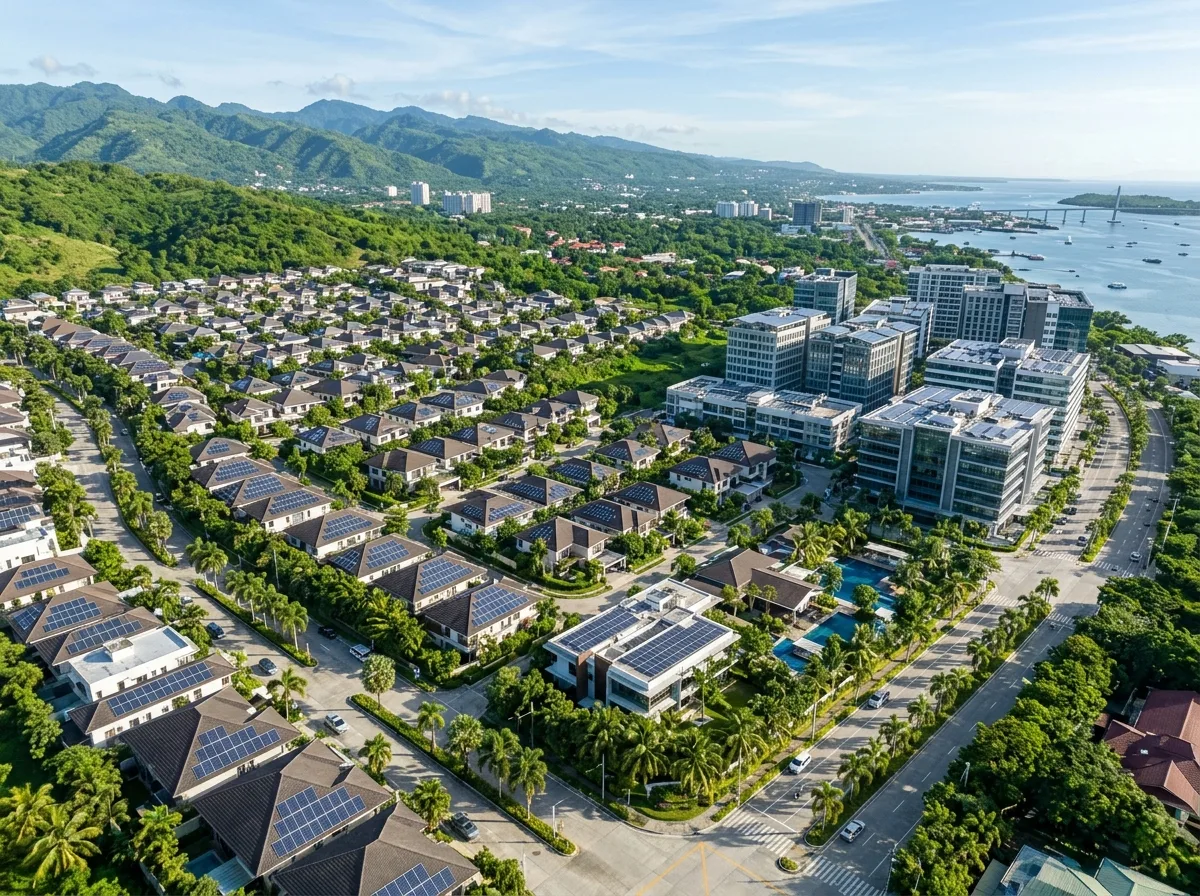
Municipal halls, barangay multi-purpose centers, rural health units, DRRMO command posts, and national agency offices across Cebu operate mostly between 8:00 AM and 5:00 PM Monday through Friday—making civic roofs natural clean fits for 3–5 yr ROI via commercial and hybrid solar.
- 8 AM–5 PM offices run in daylight
- 3–5 yrs typical payback period
- Battery option for DRRMO posts
The problem
Why are daytime office aircon & backup power expenses straining Cebu public budgets?
Public municipal buildings, packed civic permit windows, air-conditioned treasurer vaults, biometric ID stations, public health rural clinics, and civil registry servers pull intense daytime cooling load straight across peak Visayan sun hours—burning tight annual MOOE electricity allocations continuously against ~₱15–₱16/kWh VECO, MECO, and CEBECO utility bills.
Most LGU offices close at 5 PM, so most of their power is used in daylight hours, when solar produces. Many town halls also have emergency duties: when typhoons bring the lines down, DRRMO radios, vaccine refrigerators and relief charging desks need power.
Generators help, but they need fuel, and fuel can be hard to get after a typhoon.
- Packed public transaction halls, assessor wings & city hall cooling cassettes
- Rural health unit (RHU) 2°C–8°C vaccine cold boxes & birthing room AC
- Barangay/DRRMO emergency disaster command radios, repeaters & relief lighting
- National ID registration workstations, server vaults & courtrooms
- Public market cold sheds, civic water cistern boosters & covered gymnasium LEDs
How solar helps
Which clean architecture serves administrative offices vs. 24-hr DRRMO emergency posts?
Civic offices maximize taxpayer budgets through crisp transparent designs: main multi-storey municipal halls deploy lean zero-export 3-phase grid-tied solar arrays slicing heavy 8-to-5 cooling costs with leaner capital spend—while DRRMO command posts and RHU clinics install LiFePO4 battery storage staying lit.
Daytime 8-to-5 office grid-tie savings
City halls, legislative session wings, and national regional field buildings operating purely Monday–Friday business hours achieve swift returns using zero-export 3-phase grid-tied solar paired to existing office power without giant room batteries.
Typhoon-ready DRRMO & health clinic backup
Disaster operations rooms, radio repeaters and RHU vaccine refrigerators can run on a LiFePO4 battery that switches over automatically in an outage and recharges from the panels each day. We size the battery to those loads; the generator can stay as backup.
Barangay halls & rural water-pump independence
Upland barangay halls can use our 6–18 kW packages (₱305,000–₱970,000), and barangays can add solar water pumping to fill hilltop tanks without diesel.
System sizing
What solar capacity suits a barangay hall vs. a Cebu municipal or city hall complex?
CebuSolar inspects twelve months of municipal electric bills alongside critical DRRMO/RHU backup loads, wide covered gym/session steel spans, transformer capacities, and procurement documentation requirements—delivering published fixed 6–18 kW barangay packages through custom 50–500 kW+ civic campuses province-wide.
| Civic Facility Scale | Representative Public Load | Suggested Solar Tier | Deployment & Pricing Model |
|---|---|---|---|
| Barangay multi-purpose hall, day-care center & rural health station | Split office aircons, RHU vaccine cooler, printer desks, disaster charging | 6 kW to 12 kW Hybrid (10–22 panels, 6.2–13.64 kW) | Fixed packages: ₱305,000–₱640,000 (with 5–16 kWh battery) |
| DRRMO emergency response HQ or busy district civic annex | Command dispatch PCs, radio towers, satellite links, medical chillers | 16 kW to 18 kW Hybrid (28–32 panels) | Fixed 16–18 kW (₱795,000–₱970,000) or expandable 64 kWh stack |
| Municipal hall complex, public library & central gymnasium | Central legislative session AC, civil registry offices, covered gym lights | 50–150 kW three-phase | Zero-export 3-phase hall rooftop + DRRMO battery backup; custom quote |
| Major metropolitan city hall, regional agency campus or civic plaza | Multi-storey executive blocks, chilled water AC, public registry servers | 150–500 kW+ three-phase | Full multi-roof civic C&I plant integrated at main MDP; custom quote |
Estimates only. Complete structural assessments, procurement spec sheets, and itemized locked pricing follow an on-site survey. Actual savings depend on occupancy, size, location, and rates. Prices are subject to change without prior notice.
Cost and payback
What do civic building solar projects cost, and when do utility savings pay back?
Our hybrid packages range from ₱305,000 to ₱970,000, and larger municipal and city buildings get an itemized quote with full specifications for your BAC and engineering office. Public buyers follow their own procurement rules, including public bidding where required. Savings on VECO (₱15.30/kWh, October 2026) and CEBECO daytime power typically repay the cost in 3 to 5 years.
Benchmarked against Visayan Electric’s October 2026 schedule of ₱15.30/kWh, Mactan (~₱15.98/kWh), and provincial co-ops like CEBECO I, II, and III (~₱15.08–₱15.91/kWh in September 2026), replacing daytime municipal MOOE utility cash outflows frees part of the electricity budget for other public needs.
Every project supplies Tier-1 620–630 W N-type bifacial modules (JinkoSolar, JA Solar, Trina Solar, LONGi, AIKO), Solis inverters, Dyness/Pylontech LiFePO4 batteries, Schneider protection, and stainless hardware (C&I pricing).
- Transparent itemized hardware BOM & engineering documentation prepared clearly
- 1-year workmanship, 12-year inverter, and 30-year panel (at least 87% at yr 30) warranties
- Structured project milestones: 40% order, 40% delivery & mounting, 20% switch-on
- Metro Cebu service: we aim to reach you within 48 hours
- Itemized quotes, datasheets and electrical plans for procurement files
How it works
How does CebuSolar survey, document, and build civic halls?
Working from our Cebu City office at Mclin Building, Corner T. Padilla St. and M.J. Cuenco Ave., our installers survey the building for free, provide electrical plans and Tier-1 specifications for your engineering office, and can install over weekends.
Free engineering & load walk
We analyze twelve monthly power statements, inspect gymnasium or civic hall trusses thoroughly for wind anchoring, and verify DRRMO emergency critical subpanel routing.
Transparent BOM & dossier
We provide electrical plans, Tier-1 datasheets and warranty terms to support your review and procurement process.
Non-disruptive weekend switch
Technical crew bolts exterior panels leaving daytime taxpayer permitting counters undisturbed (install process), performing brief weekend breaker coupling.
Long-term local Cebu support
The Solis monitoring app shows generation for public reporting, backed by spare parts in stock under our 1-year workmanship warranty.
Common Cebu municipal engineer & barangay captain solar questions
Municipal engineering chiefs, treasurers, and barangay officials across Metro Cebu, Argao, Toledo, Danao, and Bogo frequently ask what happens to unconsumed Saturday/Sunday office generation, whether solar saves emergency post-typhoon power without fuel trucks, whether covered courts make ideal spans, and what warranties cover the hardware.
What happens every weekend when municipal offices lock up on Saturday and Sunday?
On weekends the zero-export inverter reduces its output to match the small load (guardhouse, CCTV, refrigerators). The extra solar is not exported or stored, which is why we size the system mainly to the weekday office load.
Can a barangay covered sports court hold enough panels to power the entire barangay hall and clinic next door?
Often, yes. Covered courts have large roofs next to the barangay hall or clinic. We check the roof structure during the survey before recommending it.
Does hybrid battery solar really keep DRRMO radios and emergency vaccine fridges active after major typhoons?
It can keep the circuits you choose running. A hybrid system with a LiFePO4 battery recharges from the panels each day, even while the grid is down, as long as the panels and wiring come through the storm undamaged. We size the battery to the radios and refrigerators you want on backup (grid resilience guide).
Can isolated mountain barangays deploy standalone solar water pumping for community hilltop tanks?
Yes. Barangay solar water systems pump spring or well water during the day into elevated tanks, cutting diesel costs (pumping overview).
What formal technical specifications and warranties does CebuSolar furnish for public procurement files?
Every project arrives itemized with Tier-1 datasheets, schematics, 1-year workmanship, 12-year inverter, and 30-year panel (at least 87% at yr 30) written warranty certificates; see Warranty and Solar FAQ.
Get your personalized solar quote
Tell us about your place, pin it on the map and add a photo of your bill. Our team replies on Viber within one business day.
- 1. We size your system from your bill and map your roof by satellite.
- 2. You get your quote: panels, battery, monthly savings, payback and price.
- 3. Happy with it? We check your roof and wiring on site, then lock in one fixed price.