- Home
- Hospitals & Clinics
Solar for healthcare · Hospital & clinic EPC
Solar for Hospitals & Clinics in Cebu. Lower daytime HVAC bills and shield critical care.
Private hospitals, outpatient diagnostic centers, dialysis clinics, dental-surgical centers, and provincial birthing hubs run relentless 24-hour air-conditioning, sterile ventilation, cold-chain vaccine refrigerators, and imaging suites across Cebu City, Mandaue, Lapu-Lapu, Talisay, Bogo, and Carcar. CebuSolar designs commercial solar with clean LiFePO4 clinic backup.
- 6–500 kW+ clinic & hospital scale
- 3–5 yrs typical payback period
- Tier-1 620–630 W N-type bifacial
The problem
Why do electricity and diesel backup expenses weigh heavily on Cebu clinics and hospitals?
Healthcare facilities operate continuous comfort and negative-pressure HVAC chillers, blood-bank refrigerators, RO water treatment for kidney dialysis, imaging labs, and sterilization autoclaves through Cebu’s warmest daytime hours. Paying utility tariffs around ₱15–₱16 per kWh alongside generator diesel strains clinical operating budgets steadily.
Across hospital districts in Cebu City, Mandaue, Mactan, Talisay, and provincial medical hubs in Bogo, Carcar, Danao, and Toledo, outpatient clinics and hemodialysis chairs fill steadily between 7:00 AM and 6:00 PM—overlapping squarely with Cebu’s strongest rooftop sunlight. Meanwhile, elevated afternoon outdoor heat forces central chillers and multi-split VRF condensers across patient wards, waiting lobbies, and operating suites to pull maximum electrical current right at midday.
In provincial clinics served by suburban or rural feeders, grid brownouts and voltage transients disrupt blood chemistry analyzers, vaccine cold-storage freezers, EHR electronic chart servers, and dental/dialysis treatment chairs every time utility power drops prior to standby diesel stabilization.
- Central chilled-water HVAC plants, VRF condensers, and clean-air HEPA isolation fans
- Multi-station hemodialysis RO water purification skids and clinic treatment bays
- Blood bank freezers, vaccine refrigerators, and pathology lab diagnostic analyzers
- Daytime outpatient radiology suites (digital X-ray, ultrasound, CT cooling), elevators, and lighting
- Hospital EHR networks, nurse-call consoles, ICU monitors, and pharmacy dispensing aircon
How solar helps
Which solar architectures suit private hospitals, dialysis clinics, and labs in Cebu?
Healthcare facilities split between large urban multi-story chillers built for zero-export grid-tied savings and standalone clinics requiring silent LiFePO4 battery protection during outages. CebuSolar pairs Tier-1 620–630 W N-type bifacial panels with Solis inverters, Dyness or Pylontech LiFePO4 batteries, and clean Schneider switchgear.
Hybrid LiFePO4 power for dialysis & outpatient clinics
Freestanding dialysis centers, diagnostic labs, dental practices, and provincial infirmaries gain quiet outage resilience from hybrid solar with LiFePO4 batteries. Batteries absorb sudden grid brownouts silently before diesel noise or exhaust disturbs recovering patients while daytime solar cuts AC bills.
Zero-export grid-tied solar for multi-wing hospitals
Regional medical centers tied to large VECO or MECO three-phase substations recover capital fast with three-phase grid-tied solar. Canopy and roof-deck arrays feed directly into daytime HVAC chillers, elevator banks, and diagnostic buses downstream of main automatic transfer switches.
Modular packages & water-pumping integration
Smaller standalone birthing homes, optical clinics, veterinary hospitals, and barangay clinics fit neatly onto fixed 6–18 kW hybrid packages starting from ₱305,000—while rural campus boreholes cut utility water-booster costs with solar water pumping.
System sizing
How much solar power does a Cebu clinic, dialysis hub, or hospital need?
Healthcare sizing prioritizes essential cold-chain and outpatient circuits, available concrete deck, pitched annex, or parking-canopy area above shaded rooftops, automatic generator transfer interlocking, and twelve months of power bills. CebuSolar offers 6–18 kW clinic kits and custom 50–500 kW+ hospital installations.
| Medical facility scale | Primary daytime equipment | Suggested solar capacity | Configuration & pricing |
|---|---|---|---|
| Dental practice, optical shop, pharmacy, or veterinary clinic | Autoclave, suction pump, split aircon, lab fridge, imaging PC, lighting | 6 kW to 12 kW Hybrid (10–22 panels, 6.2–13.64 kW solar) | Fixed packages: ₱305,000–₱640,000 (5–16 kWh battery, expandable 5–64 kWh) |
| Standing dialysis clinic, diagnostic lab, or birthing infirmary | RO water plant, 8–12 chairs, lab analyzers, waiting-room HVAC, cold fridge | 16 kW to 18 kW Hybrid or 50–100 kW three-phase | Fixed 16–18 kW packages (₱795,000–₱970,000) or custom clinic array |
| District multi-specialty hospital or urgent medical center | Operating theater aircon, imaging bays, elevators, wards, admin wing | 100–250 kW three-phase | Roof deck + parking canopy grid-tied array + lab LiFePO4 backup; custom quote |
| Major tertiary hospital complex & medical tower | Central HVAC chiller header, multiple hospital wings, central cold chain | 250–500 kW+ three-phase | Multi-building commercial EPC integrated with ATS genset control; custom quote |
Estimates only. Structural deck review, ATS genset-transfer analysis, and one fixed itemized price follow a site audit. Actual savings depend on system size, electricity consumption, location, and utility rates. Prices are subject to change without prior notice.
Cost and payback
What do healthcare solar systems cost in Cebu, and how quickly do they pay back?
Standalone clinic packages from 6 kW to 18 kW cost ₱305,000 to ₱970,000 fixed installed, whereas larger 50–500 kW+ hospital arrays are custom-quoted at one fixed price after site survey. At Cebu rates near ₱15–₱16/kWh, typical medical payback lands in 3 to 5 years.
Hospitals run high continuous daytime cooling and medical ventilation loads every single day of the year including weekends and holidays, maximizing self-consumption across all clear mornings and afternoons. Benchmarked against VECO’s October 2026 tariff of ₱15.30/kWh, MECO (~₱15.98/kWh in September 2026), and provincial CEBECO rates, offsetting grid kilowatts releases vital capital back toward clinical services.
Safety and durability matter deeply inside medical facilities, so CebuSolar deploys Tier-1 620–630 W N-type bifacial modules from JinkoSolar, JA Solar, Trina Solar, LONGi, and AIKO, Solis inverters, Dyness or Pylontech LiFePO4 batteries, Schneider Electric and Suntree protection breakers, and stainless steel hardware. Test clinic payback on our ROI calculator or inspect fixed packages on our cost page.
- One fixed turnkey contract price after on-site survey, every component itemized
- Milestone payments: 40% on order, 40% on delivery and mounting, 20% on switch-on
- Backed by 5-year workmanship, 12-year inverter, and 30-year panel warranties (at least 87% output at year 30)
- Clinic scalability: extra 620 W panels at ₱12,000 and 5 kWh (₱75,000), 10 kWh (₱140,000), or 16 kWh (₱160,000) batteries
- We help with your local LGU electrical permits and VECO, MECO, or CEBECO zero-export compliance
How it works
How does CebuSolar install quietly above active wards, clinics, and operating rooms?
Our Cebu City team coordinates tightly with hospital facility and infection-control officers—routing staging externally via service stairs or perimeter cranes, scheduling concrete drilling strictly outside clinic consultation hours, and integrating ATS emergency switchboards on planned Sunday shutdown windows.
Hospital & ATS audit
We inspect twelve months of VECO, MECO, or CEBECO bills, concrete slab waterproofing, emergency generator automatic transfer switches, and condenser locations.
Code-safe design & fixed quote
We preserve flat roof chiller clearances and ambulance canopy spans, specify non-penetrating ballasted or stainless deck mounts, help with permits, and issue one fixed quote.
Quiet exterior installation
Teams erect arrays with minimal daytime noise inside patient wings, timing electrical tie-in onto sub-distribution panels or planned off-hours.
Warranty & Cebu support
Every medical plant includes our Cebu warranty backed by locally stocked spare parts with a Metro Cebu 48-hour response target.
What do Cebu hospital administrators and chief engineers ask before going solar?
Medical directors, clinic owners, and chief facility engineers across Cebu City, Mandaue, Lapu-Lapu, and provincial towns often ask about standby life-safety generator transfers, electromagnetic noise around imaging equipment, ambulance parking canopies, cold-chain vaccine battery backup, and local LGU permit assistance.
Will rooftop solar interfere with hospital life-safety standby diesel generators and UPS systems?
No, when wired properly. Grid-tied three-phase Solis inverters connect upstream of hospital automatic transfer switches or operate alongside dynamic PV-genset controllers so solar disconnects or throttles instantaneously the moment emergency life-safety diesel sets carry critical-branch hospital panels.
Can solar inverters interfere with MRI, CT, or ECG equipment?
Solis inverters are built to international electromagnetic-compatibility standards, and we install them in electrical service rooms away from imaging bays. During the site visit we review inverter and cable placement with your biomedical or facility engineer before the design is fixed.
Our hospital roof deck is crowded with chillers and cooling towers—where do panels mount?
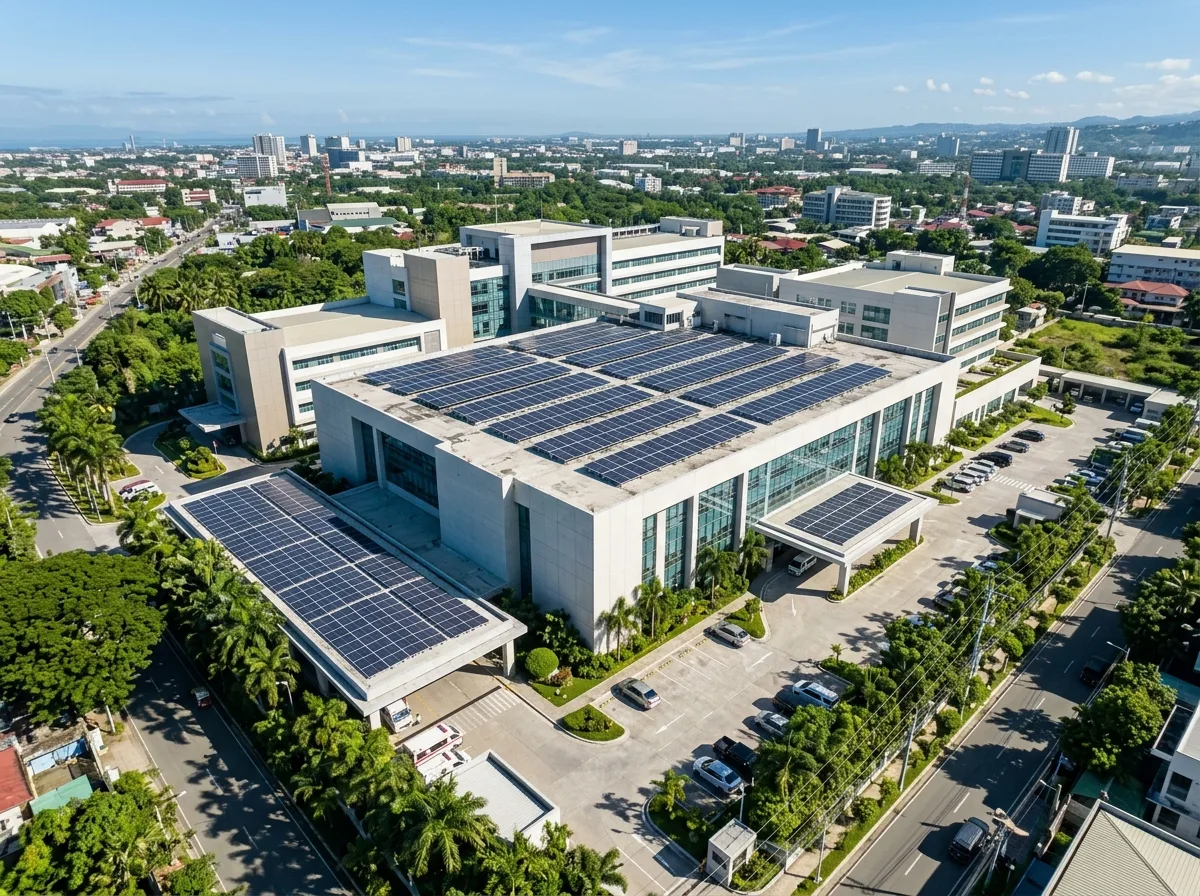
Many urban hospitals build elevated steel solar carports over surface patient parking lots, ambulance bays, and annex roofs alongside clear mechanical deck spaces. Elevated parking canopies generate power while keeping staff and ambulance entries cool and shaded.
Can solar batteries keep vaccine and lab fridges cold during outages?
Yes, for circuits we size the battery for. Putting vaccine refrigerators, lab analyzers and reception power on a hybrid inverter with Dyness or Pylontech LiFePO4 storage keeps them running through typical provincial brownouts; we size the battery to the backup hours you need. Medical-grade cold chains should keep their own alarms and UPS as well.
Does CebuSolar assist with city building and electrical permits for medical clinics?
Yes—we help with your permits by preparing single-line electrical diagrams, structural roof-load or carport layout drawings, and Tier-1 datasheets required for LGU electrical offices and VECO, MECO, or CEBECO zero-export setups.
How does a Solis hybrid battery pack coordinate with our mandatory DOH standby hospital generator?
A hybrid Solis system with LiFePO4 batteries supports selected clinic circuits during outages and works alongside your existing standby generator, wired upstream or through the inverter’s generator port. Your DOH-required generator and UPS stay in charge of life-safety and critical-care loads (solar vs diesel generator).
Are sealed LiFePO4 batteries safe inside a crowded municipal hospital or birthing building?
Yes—Dyness and Pylontech LiFePO4 lithium iron phosphate cells possess high thermal stability without corrosive hydrogen gas fumes of flooded lead batteries (LiFePO4 safety profile).
Get your personalized solar quote
Tell us about your place, pin it on the map and add a photo of your bill. Our team replies on Viber within one business day.
- 1. We size your system from your bill and map your roof by satellite.
- 2. You get your quote: panels, battery, monthly savings, payback and price.
- 3. Happy with it? We check your roof and wiring on site, then lock in one fixed price.