- Home
- Packaging & Consumer Goods
Solar for packaging & FMCG · Industrial plant EPC
Solar for Packaging & Consumer Goods in Cebu. Cut extrusion and bottling energy bills.
Carton corrugators, PET bottle blowers, injection molders, flexo printing presses, and FMCG bottling lines pull heavy three-phase motor and heater loads across continuous daytime shifts. CebuSolar builds three-phase commercial solar plants from 50 kW to 500 kW+ across VECO, MECO, and CEBECO corridors.
- 50–500 kW+ 3-phase industrial scale
- 3–5 yrs typical payback period
- Tier-1 620–630 W N-type bifacial
The problem
Why are monthly power bills so steep for Cebu packaging and FMCG plants?
Packaging and consumer-goods manufacturers pair high-pressure air compressors, heated extrusion barrels, hydraulic clamping motors, process water chillers, and automated conveyor lines under large metal roofs. At Cebu tariffs around ₱15–₱16 per kWh, continuous thermal and pneumatic loads make electricity a decisive factor in unit production cost.
Throughout Mandaue, Consolacion, Minglanilla, Naga, Talisay, and Lapu-Lapu industrial compounds, packaging converters and consumer-goods bottlers operate high-speed lines feeding Visayas and Mindanao supermarkets. Blow-molding PET bottles demands steep high-pressure compressor wattage, while corrugated box plants, shrink-film extruders, and label flexo presses combine electric barrel heaters with large chilled-water cooling loops fighting midday heat.
Furthermore, sudden feeder blinks along overloaded industrial lines trigger frozen polymer inside extruder screws, rejected print registration runs, and lengthy line restarts—unless backup power stabilizes sensitive controls. Converting sprawling factory and finished-goods warehouse roofs into solar arrays slashes daytime kWh draw directly where unit costs hurt most.
- Injection molders, thermoforming heaters, and film extrusion barrel zones
- High-pressure PET blow-molding compressors and plant pneumatic manifolds
- Closed-loop mold chillers, evaporative cooling towers, and air-conditioning
- Corrugators, die-cutters, multi-color flexo presses, and stretch-wrap conveyors
- Boiler controls, carton palletizers, and finished-goods warehouse lighting
How solar helps
Which solar configuration fits packaging lines and FMCG factories in Cebu?
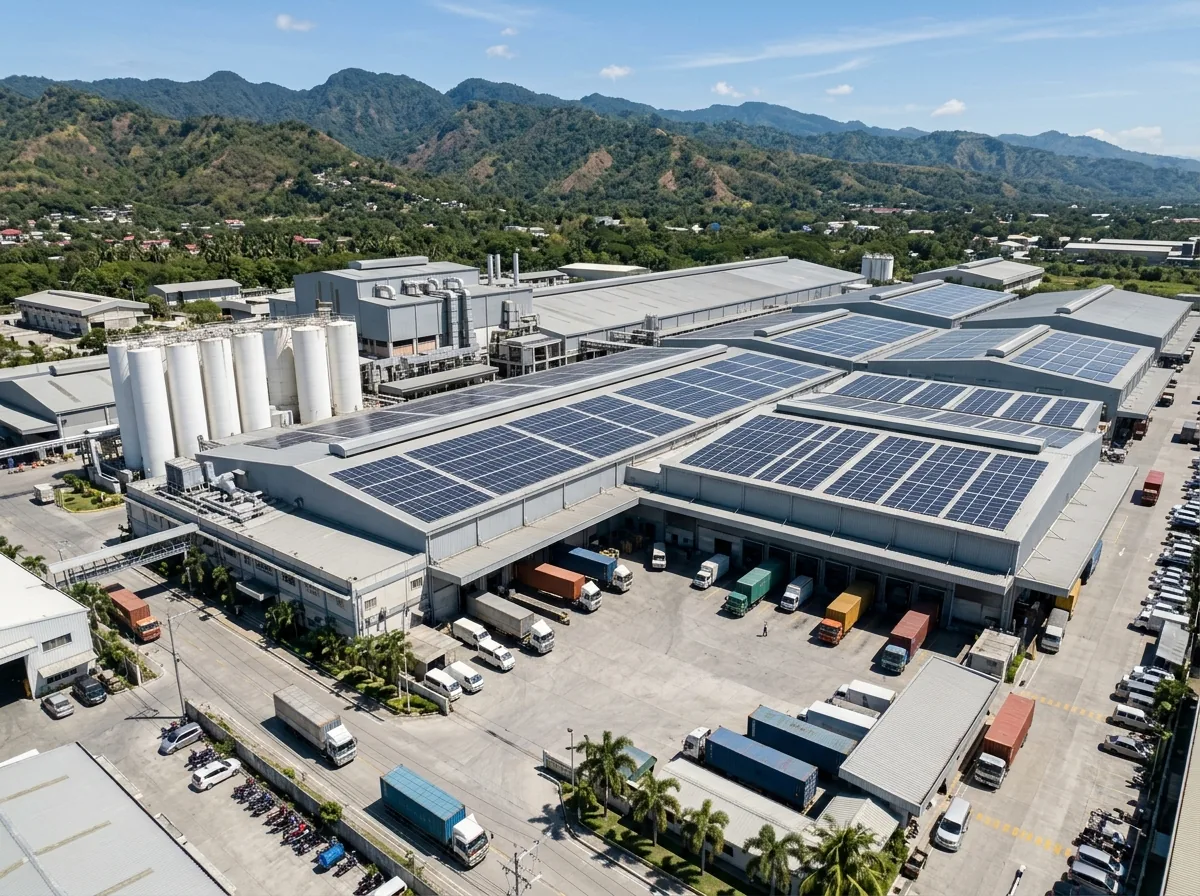
Expansive packaging plants sit directly beneath broad, flat steel roofs capable of hosting substantial three-phase capacity right above main switchboards. CebuSolar pairs Tier-1 620–630 W N-type bifacial panels with Solis three-phase inverters, zero-export sensing, LiFePO4 protection for press PLCs, and solar water pumping.
Three-phase grid-tied solar for extrusion & chillers
Plants running heavy daylight or 24-hour extrusion, molding, and bottling shifts achieve fastest return via grid-tied solar. Multi-string Solis three-phase inverters feed continuous compressor and mold-chiller amperage right at your low-voltage distribution board with zero battery cost.
Hybrid LiFePO4 backup for press PLCs & QA labs
Momentary grid sags halt color registration servers, gravimetric resin blenders, lab testing equipment, and shipping dispatch networks. Adding hybrid solar with Dyness or Pylontech LiFePO4 batteries protects delicate control electronics, office HVAC, and warehouse scanners across brief outages.
Cooling-pond pumping & converter workshops
Plants operating deep-well makeup pumps for mold cooling towers or washdown stations cut utility draw via solar water pumping—while smaller box converters, label print shops, and repackaging depots start with fixed 6–18 kW hybrid packages.
System sizing
What size solar plant does a Cebu packaging or FMCG facility need?
Plant sizing evaluates 12-month utility bills, continuous compressor and extruder kilowatt demand, transformer tap limits, and usable production plus warehouse roof space. CebuSolar provides fixed 6–18 kW packages for light print and packing shops and custom 50–500 kW+ three-phase installations for major plants after an audit.
| Facility scale | Primary daytime machinery | Suggested solar capacity | Configuration & pricing |
|---|---|---|---|
| Small label print shop, repacking hub, or depot | Digital press, shrink wrappers, air compressor, office AC, lighting | 6 kW to 18 kW Hybrid (10–32 panels, 6.2–19.84 kW solar) | Fixed packages: ₱305,000–₱970,000 (5–16 kWh battery, expandable 5–64 kWh) |
| Mid-sized box converter or plastic molding shop | Injection molders, mold chillers, die cutters, material blowers | 50–150 kW three-phase | Rooftop grid-tied array with zero-export; custom quote after site visit |
| Commercial FMCG bottling or extrusion plant | High-pressure air compressors, blow molders, shrink tunnels, cooling towers | 150–300 kW three-phase | Three-phase Solis plant + genset sync; custom quote |
| Large regional corrugator & consumer-goods complex | Continuous corrugating lines, multi-bay warehouses, chilled storage | 300–500 kW+ three-phase | Multi-inverter commercial plant + optional LiFePO4 backup; custom quote |
Estimates only. Electrical load logging, roof structural inspection, and one fixed itemized price follow a site survey. Actual savings depend on system size, electricity consumption, location, and utility rates. Prices are subject to change without prior notice.
Cost and payback
How much does packaging-plant solar cost in Cebu, and how quick is payback?
Industrial installations from 50 kW to 500 kW+ receive a custom turnkey quote at one fixed price after site inspection, while smaller 6–18 kW shop kits cost ₱305,000 to ₱970,000 fixed. At October 2026 Cebu rates near ₱15–₱16/kWh, manufacturing investments typically recover cost in 3 to 5 years.
High daytime utilization drives consistent returns because cooling towers, pneumatic compressors, and curing heaters run heaviest under midday sun—meaning every kilowatt produced goes directly into active production instead of sitting idle. Measured against VECO’s October 2026 rate of ₱15.30/kWh alongside MECO and CEBECO commercial tariffs, cutting daytime grid reliance strengthens per-case unit economics immediately.
Every CebuSolar build uses bankable Tier-1 components chosen for industrial longevity: 620–630 W N-type bifacial panels from JinkoSolar, JA Solar, Trina Solar, LONGi, and AIKO, Solis inverters, Dyness or Pylontech LiFePO4 batteries, Schneider Electric and Suntree protection breakers, and stainless steel fixings. Smaller workshops can estimate payback via our ROI calculator or view package tables on our cost page.
- One fixed turnkey price issued after structural and electrical audit, every part listed
- Three-stage milestone payments: 40% on order, 40% on delivery and mounting, 20% on switch-on
- Protected by 5-year workmanship, 12-year inverter, and 30-year panel performance warranties (at least 87% output at year 30)
- Expandable smaller hybrid setups: add 620 W panels at ₱12,000 each or stack 5 kWh (₱75,000), 10 kWh (₱140,000), or 16 kWh (₱160,000) batteries
- We help with your LGU electrical permits and VECO, MECO, or CEBECO zero-export paperwork
How it works
How does CebuSolar install solar on active FMCG plants without stopping lines?
Our Cebu City crew works outside truck bays and strictly overhead on production and warehouse roofs while extrusion, printing, and packing run uninterrupted inside. Main switchboard tie-in happens strictly during a planned weekend or scheduled maintenance pause so resin barrels and chillers stay stable.
Plant & roof survey
We inspect twelve months of VECO, MECO, or CEBECO bills, map roof exhaust stacks and boiler flues, and verify main transformer switchgear and standby genset panels.
Engineering & fixed quote
We locate array rows clear of heat vents and skylights, prepare zero-export single-line diagrams, assist with permit submissions, and deliver one fixed itemized price.
Zero-downtime installation
Roof mounting and external cable trays finish without entering sensitive food-packaging bays, timing electrical tie-in during an agreed maintenance gap.
Cebu warranty & fast service
Post-commissioning care includes our Cebu warranty, locally stocked spare parts, and a Metro Cebu response target within 48 hours.
What do Cebu packaging and FMCG plant engineers ask before going solar?
Plant directors, maintenance engineers, and operations leads in Mandaue, Consolacion, Minglanilla, and MEPZ often raise questions about boiler exhaust vents, warehouse roof phasing, inductive compressor and molder surges, standby diesel generators, zero-export settings, and industrial permit assistance before signing off.
Can rooftop solar avoid hot exhaust stacks, boiler vents, and ridge ventilators?
Yes. During our physical roof survey, we map every boiler stack, extrusion exhaust fan, and translucent skylight panel on-site, creating clean setback corridors and maintenance walkways so modules stay clear of hot exhaust plumes while capturing maximum unobstructed sunlight.
Do injection molders and heavy air compressors work with three-phase solar?
Yes. Under grid-tied solar, your utility transformer continues providing instantaneous motor clamping and starting currents while Solis three-phase inverters feed smooth, continuous kilowatts across base extruder heaters, mold chillers, and plant compressors all day.
How does industrial solar coordinate with standby diesel generators during grid drops?
We wire three-phase arrays upstream of automatic transfer switches or fit a dynamic PV-genset controller so solar disconnects or throttles safely alongside standby diesel engines, preventing reverse-power trips on plant generators.
Can a plant install solar on its finished-goods warehouse first and expand onto factory halls later?
Yes. Phased installations let manufacturers tie a 50–150 kW array onto an adjacent warehouse roof connected to the plant’s main switchboard and add additional rooftop or carport phases later without reworking core switchgear.
Does CebuSolar assist with permits and zero-export setup for industrial plants?
Yes—we help with your permits by preparing single-line electrical diagrams, structural clamp specs, and Tier-1 datasheets required for municipal electrical offices and VECO, MECO, or CEBECO zero-export compliance.
Get your personalized solar quote
Tell us about your place, pin it on the map and add a photo of your bill. Our team replies on Viber within one business day.
- 1. We size your system from your bill and map your roof by satellite.
- 2. You get your quote: panels, battery, monthly savings, payback and price.
- 3. Happy with it? We check your roof and wiring on site, then lock in one fixed price.