- Home
- Vegetable Farming
Solar for commercial horticulture · Irrigation & cold room EPC
Solar for Vegetable Farming in Cebu. Power mountain irrigation and packing cold rooms.
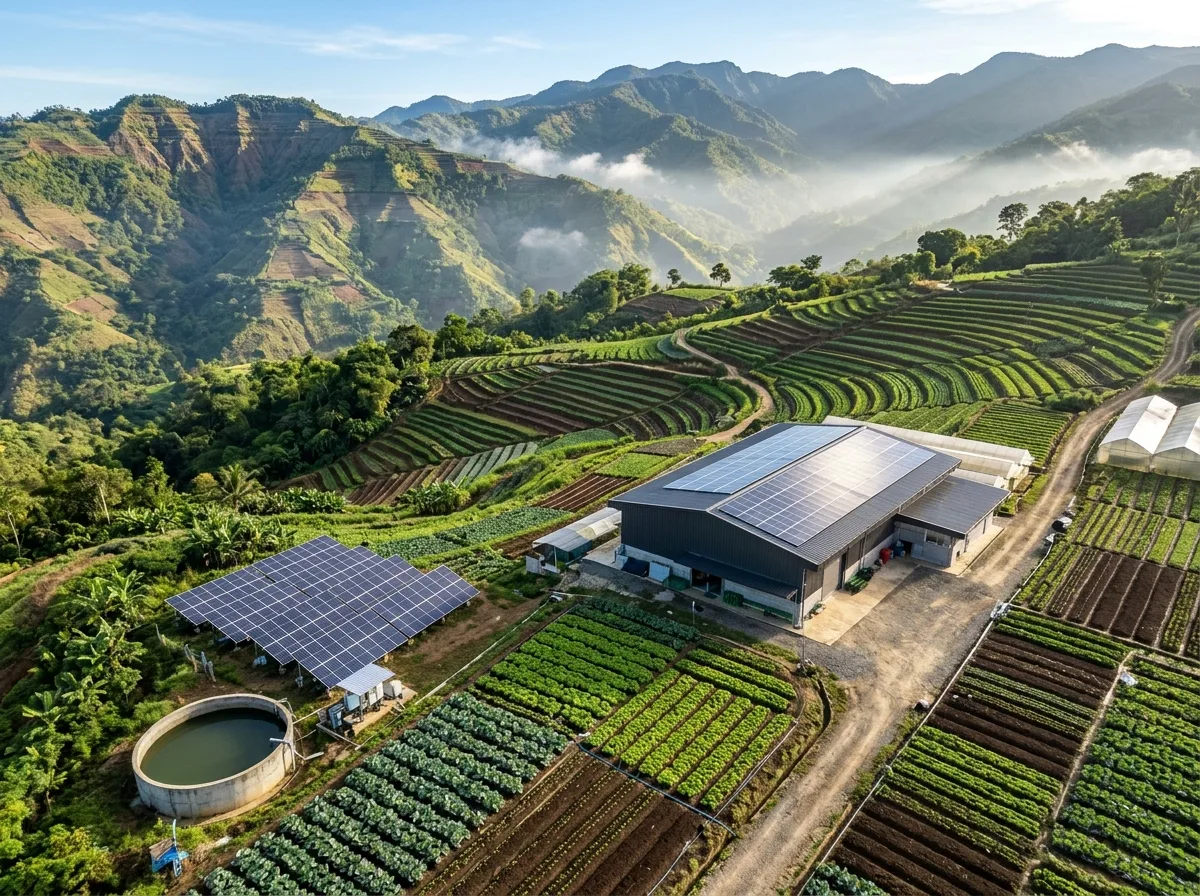
Highland cabbage, lettuce, pepper, and tomato growers plus controlled greenhouses in Dalaguete (Mantalongon), Busay, Balamban, Asturias, and Argao haul irrigation water uphill and chill harvests for Metro Cebu supermarkets. CebuSolar delivers solar water pumping and hybrid farm solar built for tough terrain.
- Irrigation + Cold pumping & packinghouses
- 3–5 yrs typical payback period
- 620–630 W Tier-1 N-type bifacial
The problem
Why are pumping and cold-storage power costs squeezing Cebu vegetable growers?
Commercial highland vegetable production fights steep pumping elevation heads from valley springs up to terraced plots alongside costly refrigerated packinghouses. Whether paying remote diesel fuel bills or provincial CEBECO tariffs around ₱15–₱16 per kWh, watering and pre-cooling eat into farmgate margins.
In Cebu’s premier vegetable corridors—Mantalongon in Dalaguete, Gaas and Cansomoroy in Balamban, Busay and Sudlon in upland Cebu City, and neighboring Argao and Barili ridges—growers depend on reliable dry-season drip lines, overhead micro-sprinklers, fertigation mixers, and rain-shelter greenhouse circulation fans to hit supermarket quality specs year-round. Lifting water 40 to 150 meters vertically with diesel transfer pumps requires daily drum deliveries up narrow mountain tracks.
Where feeder power reaches commercial packinghouses, extended afternoon voltage drops and brownouts on rural mountain lines jeopardize field-heat removal in walk-in vegetable coolers, wilting high-value leafy greens and salad herbs before dawn delivery trucks reach Carbon Market or Metro Cebu groceries.
- Deep-borehole and spring booster pumps feeding hilltop irrigation reservoirs
- Pressurized drip-fertigation manifolds, overhead sprinklers, and greenhouse misters
- Post-harvest hydro-coolers, vegetable wash conveyors, and walk-in chill rooms
- Greenhouse exhaust fans, shade-net ventilation motors, and seedling nurseries
- Sorting-shed lighting, weighing scales, CCTV security, and farmhouse power
How solar helps
Which solar setups fit highland irrigation plots and farm packinghouses in Cebu?
Vegetable operations pair direct sunlight pumping into high reservoirs with battery-backed chillers on connected packing sheds. CebuSolar builds with Tier-1 620–630 W N-type bifacial panels, Solis inverters, Dyness or Pylontech LiFePO4 batteries, stainless hardware, and wind-braced ground or shed mounts.
Direct solar water pumping to elevated tanks
Terraced mountain farms cut daily diesel hauls using dedicated DC or VFD-driven solar water pumping. Arrays mounted near spring boxes or deep boreholes pump full flow across sunny dry months straight into concrete hillside storage cisterns for gravity-fed drip irrigation.
Hybrid LiFePO4 solar for packinghouses & coolers
Farms connected to CEBECO or VECO lines protect freshly harvested lettuce, broccoli, and bell peppers against rural brownouts with hybrid solar and LiFePO4 storage, keeping packing-shed cold rooms, sorting tables, and office monitors cool while utility bills fall.
Modular 6–18 kW farm kits & off-grid estates
Smaller family agribusinesses, hydroponic greenhouses, and remote upland farms beyond utility poles deploy 6–18 kW hybrid packages starting at ₱305,000 or off-grid solar—while consolidated commercial packers scale up with grid-tied arrays.
System sizing
What size solar installation does a Cebu vegetable farm or packhouse need?
Farm sizing calculates dynamic total pumping head (elevation plus friction loss), daily liters needed per hectare, packing-shed chiller horsepower, and roof or open-slope space. CebuSolar supplies fixed 6–18 kW packages for smallholder farms and custom 50–500 kW+ installations for major agri-estates.
| Vegetable farm operation | Typical daytime equipment | Suggested solar capacity | Configuration & pricing |
|---|---|---|---|
| Highland drip-irrigation parcel or off-grid green-house | Submersible/surface transfer pump to hillside tank, drip manifold, LED shed lights | Dedicated solar pump array or 6–10 kW Hybrid | Fixed 6–10 kW kits: ₱305,000–₱520,000; custom sizing for standalone pump VFDs |
| Commercial hydroponic farm & small chill room | Chiller compressor, nutrient dosing pumps, greenhouse fans, sorting lights | 12 kW to 18 kW Hybrid (22–32 panels, 13.64–19.84 kW solar) | Fixed packages: ₱615,000–₱970,000 (5–16 kWh battery, expandable 5–64 kWh) |
| Regional highland aggregation & washing packhouse | Multi-room walk-in chillers, hydro-cooling bath, borehole pump, packing bay | 50–150 kW three-phase | Rooftop/ground array + LiFePO4 backup; custom quote after site audit |
| Large multi-hectare agri-business & supermarket cold hub | Multiple irrigation pump houses, central cold storage, ice flaker, crate washer | 150–500 kW+ commercial | Distributed pump arrays + packhouse plant; custom quote after survey |
Estimates only. Elevation head verification, pump curve check, and one fixed itemized price follow a site audit. Actual savings depend on system size, electricity consumption, location, and utility rates. Prices are subject to change without prior notice.
Cost and payback
How much does vegetable farm solar cost in Cebu, and when does it pay back?
Farmhouse and hydroponic 6–18 kW hybrid packages run ₱305,000 to ₱970,000 installed, while larger 50–500 kW+ cold-hub and pumping projects are custom-quoted at one fixed price. Against diesel pumping costs and Cebu power tariffs near ₱15–₱16/kWh, payback averages 3 to 5 years.
Dry-season sunshine drives peak irrigation demand simultaneously with maximum solar irradiation—turning March-to-May heat into abundant clean electricity for borehole lifts and cold-room condensing units. Benchmarked against CEBECO I and II regional schedules (~₱15.08–₱15.91/kWh in September 2026) and VECO’s October 2026 rate of ₱15.30/kWh across Busay/Metro Cebu highlands, displacing grid and diesel expense stabilizes harvest margins quickly.
CebuSolar uses Tier-1 620–630 W N-type bifacial panels from JinkoSolar, JA Solar, Trina Solar, LONGi, and AIKO, Solis inverters, Dyness or Pylontech LiFePO4 batteries, Schneider Electric and Suntree breakers, and stainless steel hardware built for damp mountain mist and coastal salt air. Model packhouse savings on our ROI calculator or view fixed tiers on our cost page.
- One fixed turnkey contract price after on-farm inspection, every part itemized
- Milestone payments: 40% on order, 40% on delivery and mounting, 20% on switch-on
- Protected by 5-year workmanship, 12-year inverter, and 30-year panel warranties (at least 87% output at year 30)
- Flexible expansion: add 620 W panels at ₱12,000 each or stack 5 kWh (₱75,000), 10 kWh (₱140,000), or 16 kWh (₱160,000) batteries
- We assist with your local municipal LGU electrical permits and utility zero-export documents
How it works
How does CebuSolar install irrigation and packhouse arrays on upland Cebu farms?
Our Cebu City crew travels directly to mountain barangays across Dalaguete, Balamban, Busay, and Argao—evaluating pump elevations, anchoring ground frames or packhouse steel rails against ridge winds, wiring sealed solar disconnect boxes, and tying into cold rooms without disturbing harvest dispatches.
On-farm & pump audit
We visit your plots to measure vertical pumping lift, inspect existing borehole or spring motors, check CEBECO or VECO bills, and survey shed roofs or slope clearings.
Hydraulic & electrical design
We size array strings around pump curves and chiller loads, prepare wind-braced ground or shed mounts, assist with local permits, and lock in one fixed quote.
Field installation & testing
Teams install galvanized and stainless racking, weatherproof Schneider/Suntree disconnect boxes, and complete commission checks across peak noon sun.
Warranty & island-wide care
Every system includes our Cebu warranty backed by locally stocked spare parts with a Metro Cebu 48-hour response target.
What do Cebu vegetable growers ask before putting solar on farms and cold sheds?
Highland farmers, hydroponic greenhouse operators, and packhouse owners in Mantalongon, Busay, Balamban, and Barili commonly ask about misty mountain cloud cover, existing deep-well pump VFD conversions, ground-mount vs. plastic tunnel space, LiFePO4 battery backup for walk-in chillers, and local permit assistance.
Can solar still power farm irrigation and chillers in misty Dalaguete or Busay uplands?
Yes. High-efficiency Tier-1 620–630 W N-type bifacial modules harvest strong diffuse daylight well even under bright mountain mist or passing clouds, while pumping systems buffer cloudy afternoons naturally by filling elevated gravity-storage tanks during bright morning and midday hours.
Can we convert an existing three-phase deep-well pump to run on solar power?
Often yes. Where an existing AC submersible or surface centrifugal pump sits healthy inside a borehole, solar pumping VFD controllers convert DC solar output into variable-frequency AC power, ramping pump speed softly from dawn onward without burning out windings.
Our greenhouse plastic roof can’t hold heavy glass—where else do farm arrays go?
Plastic-film tunnels should never support rooftop solar frames. Instead, CebuSolar mounts panels over steel packinghouses, generator/tool sheds, concrete pump-house roofs, or dedicated wind-braced ground-mount racks alongside non-arable borders and reservoir embankments.
Can one hybrid system keep our walk-in vegetable cooler cold through evening brownouts?
Yes, when properly matched. A commercial or 6–18 kW hybrid system with Dyness or Pylontech LiFePO4 battery capacity (expandable 5–64 kWh on home-scale units or larger on C&I banks) can keep insulated walk-in cooler fans and lighting running through overnight outages after harvest when the battery is sized for them packing.
Does CebuSolar help with municipal electrical permits in Dalaguete, Balamban, or Cebu City?
Yes—we help with your permits by preparing single-line electrical diagrams, structural layout drawings, and Tier-1 datasheets required for LGU electrical offices and CEBECO or VECO zero-export compliance.
Get your personalized solar quote
Tell us about your place, pin it on the map and add a photo of your bill. Our team replies on Viber within one business day.
- 1. We size your system from your bill and map your roof by satellite.
- 2. You get your quote: panels, battery, monthly savings, payback and price.
- 3. Happy with it? We check your roof and wiring on site, then lock in one fixed price.