- Home
- Real Estate Developments
Solar for subdivisions & developers · Estate EPC
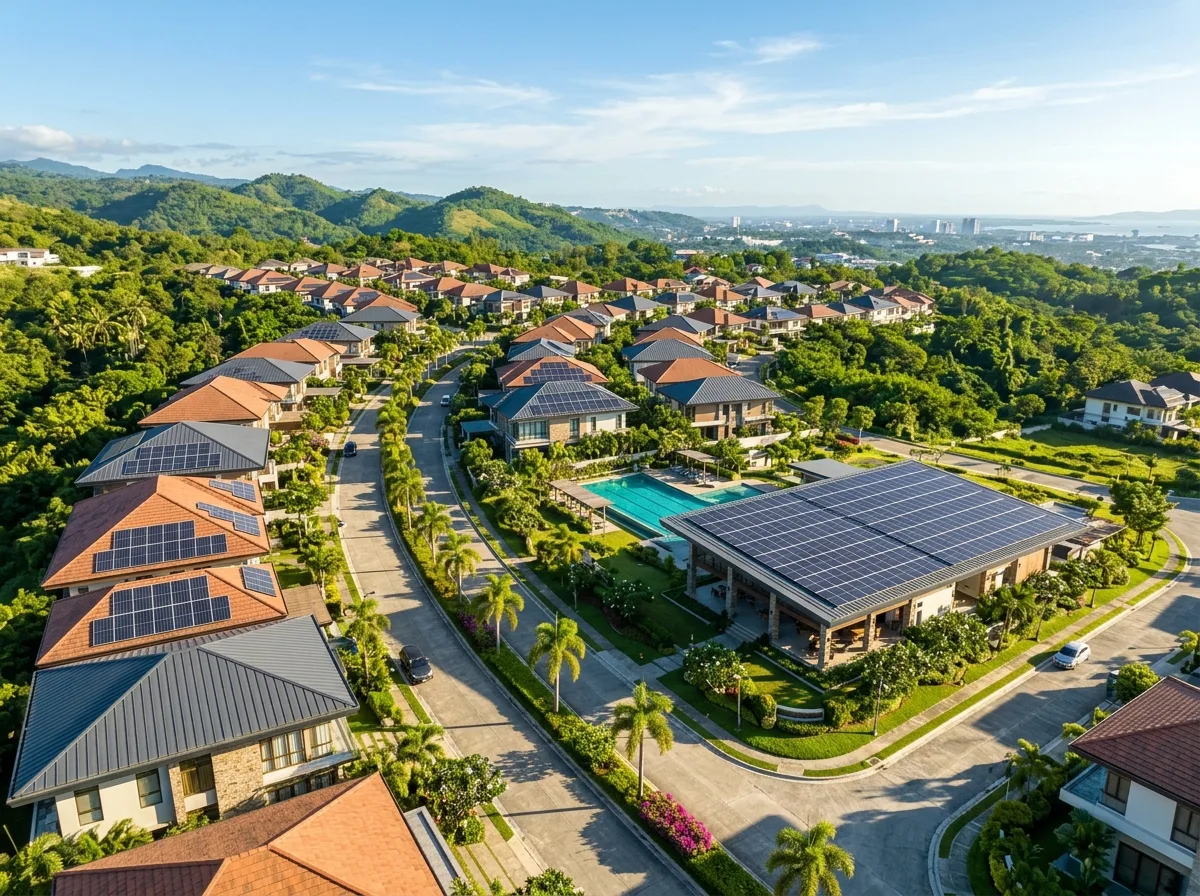
Solar for Real Estate Developments in Cebu. Lower HOA bills and deliver solar-ready homes.
Horizontal subdivision developers, townhouse estates, and homeowner associations (HOAs) across Metro Cebu, Liloan, Consolacion, Minglanilla, Talisay, Carcar, and Mactan manage recurring utility bills across clubhouses, deep-well pumping stations, security gates, and streetlights—plus strong buyer appetite for 6–18 kW hybrid homes. CebuSolar serves developers from site amenities to turnkey homes.
- 6–500 kW+ model homes & estate amenities
- 3–5 yrs typical payback period
- Tier-1 620–630 W N-type bifacial
The problem
Why do HOA amenity utility costs and homeowner expectations challenge Cebu developers?
Residential estate developers and property HOAs absorb heavy recurring electricity charges operating subdivision deep wells, cistern booster pumps, air-conditioned clubhouses, lap pools, and perimeter gatehouse grids every month. Under Cebu utility tariffs near ₱15–₱16 per kWh, common-area dues climb steadily while buyers demand outage-ready homes.
In fast-growing master-planned subdivisions spreading north through Consolacion, Liloan, and Compostela, south along Minglanilla, Talisay, Naga, and Carcar, and across Mactan Island, developers juggle dual pressures. First, developer-managed amenities—elevated water tanks, sewage treatment blowers, function pavilions, and sales offices—burn costly continuous power from pre-turnover phase onward. Second, Cebu homebuyers touring furnished model units increasingly ask for brownout backup and lower monthly VECO, MECO, or CEBECO bills built right into house turnovers.
Without unified architectural mounting standards and clear pre-packaged pricing, haphazard aftermarket retrofits mar uniform subdivision aesthetics while leaving homeowner boards struggling against rising water-pumping fees.
- Subdivision deep-well boreholes and overhead tank constant-pressure booster pumps
- Air-conditioned community clubhouses, fitness gyms, swimming pool pumps, and sales galleries
- 24-hour guardhouse checkpoints, RFID barrier arms, estate CCTV, and perimeter LEDs
- Package sewage treatment plant (STP) aeration blowers running nonstop in phase yards
- Consistent turnkey 6–18 kW hybrid packages optional on new single-attached/detached homes
How solar helps
Which solar solutions support both Cebu subdivision amenities and home buyers?
Residential developments combine commercial estate amenity infrastructure with standardized single-family hybrid home packages neatly under one shared engineering standard. CebuSolar builds with Tier-1 620–630 W N-type bifacial modules, Solis inverters, Dyness or Pylontech LiFePO4 batteries, stainless hardware, and clean uniform architectural profiles.
Turnkey hybrid clubhouses & security hubs
Keep HOA sales lounges, clubhouse halls, guardhouses, RFID gates, and security cameras running steadily through utility storms via hybrid solar with LiFePO4 batteries while slashing daytime air-conditioning and pool-pump electricity bills simultaneously.
Solar pumping for subdivision water stations & STPs
Water pumping dominates recurring HOA monthly dues in hillside estates. Adding solar water pumping or three-phase commercial arrays at central overhead reservoirs and wastewater blowers lowers association dues without noise.
Pre-priced 6–18 kW hybrid home options for buyers
Developers can offer buyers verified fixed-price 6–18 kW hybrid home packages (₱305,000–₱970,000 with expandable 5–64 kWh storage) during model-house turnover—installed uniformly to strict architectural guidelines on site.
System sizing
What solar configurations fit Cebu model houses, clubhouses, and HOA utilities?
Estate sizing splits between individual residential buyer units (fixed 6–18 kW packages matching bedroom count and aircon load) and central commercial utility meters (custom 50–500 kW+ arrays sizing pump rooms, clubhouses, and amenities). CebuSolar details itemized scopes per unit type.
| Subdivision scope | Typical equipment & circuits | Suggested solar capacity | Configuration & pricing |
|---|---|---|---|
| Townhouse, starter single-attached, or guardhouse station | 1–2 split aircons, fridge, lights, Wi-Fi, CCTV, RFID barrier | 6 kW to 8 kW Hybrid (10–14 panels, 6.2–8.68 kW solar) | Fixed packages: ₱305,000–₱470,000 (5–16 kWh battery, expandable 5–64 kWh) |
| Single-detached family home or small developer sales pavilion | 3–5 inverter aircons, kitchen appliances, work-from-home office, gates | 10 kW to 18 kW Hybrid (16–32 panels, 10–19.84 kW solar) | Fixed packages: ₱495,000–₱970,000 (5–16 kWh battery, expandable 5–64 kWh) |
| Community clubhouse, pool pump house, or central reservoir | Multi-cassette AC hall, pool filtration pumps, deep-well overhead pump | 50–120 kW three-phase | Clubhouse roof/carport solar + guardhouse LiFePO4 backup; custom quote |
| Large master-planned estate utility & commercial strip hub | Multiple pump/STP stations, amenity plaza, strip retail center | 120–300 kW+ three-phase | Phased estate commercial EPC across amenities & lots; custom quote |
Estimates only. Roof orientation, architectural truss specs, and one fixed itemized price follow a free site or plan review. Actual savings depend on system size, electricity consumption, location, and utility rates. Prices are subject to change without prior notice.
Cost and payback
What do developer and subdivision solar programs cost in Cebu?
Standardized 6–18 kW hybrid home options run ₱305,000 to ₱970,000 per residence, while commercial clubhouse, pumping, and commercial-strip systems (50–500 kW+) are custom-quoted at one fixed price. Against ₱15–₱16/kWh Cebu utility rates, typical payback lands in 3 to 5 years.
Lower HOA overhead improves long-term affordability and estate property desirability while model units showcasing live clean generation help sales teams stand apart clearly across competitive Consolacion, Liloan, and Minglanilla housing launches. Benchmarked against VECO’s October 2026 schedule of ₱15.30/kWh, MECO (~₱15.98/kWh in September 2026), and provincial CEBECO rates, solar helps keep family household and HOA budgets predictable.
CebuSolar supplies Tier-1 620–630 W N-type bifacial modules from JinkoSolar, JA Solar, Trina Solar, LONGi, and AIKO, Solis inverters, Dyness or Pylontech LiFePO4 batteries, Schneider Electric and Suntree protection breakers, and stainless coastal hardware. Review buyer sizing via our ROI calculator or view complete home prices on our cost page.
- One fixed turnkey contract price per house model or commercial block after plan inspection
- Clear milestone payments: 40% on order, 40% on delivery and mounting, 20% on switch-on
- Protected by 5-year workmanship, 12-year inverter, and 30-year panel performance warranties (at least 87% output at year 30)
- Home upgrade modularity: extra 620 W panels at ₱12,000 and 5 kWh (₱75,000), 10 kWh (₱140,000), or 16 kWh (₱160,000) batteries
- We help with your local LGU electrical permits and VECO, MECO, or CEBECO zero-export documents
How it works
How does CebuSolar coordinate solar across active subdivision builds and model homes?
Our Cebu City team reviews subdivision CAD roof plans during construction so DC/AC conduits route inside wall chases before plastering. Post-turnover HOA retrofits and clubhouse builds align around resident parking and security schedules with zero road disruption.
Blueprint or estate audit
We review structural roof trusses, pre-build electrical risers, or twelve months of existing HOA pump/clubhouse bills across VECO, MECO, or CEBECO meters.
Aesthetic layout & fixed quote
We align sleek black/dark bifacial frames flush with roof planes, prep conduit rough-in specs, assist with LGU permits, and deliver fixed itemized quotes.
Phase-timed installation
Crews finish neat roof clamping and weatherproof inverter closets in step with general contractors or turnover schedules through breaker switch-on.
Direct homeowner & HOA care
Every unit and HOA asset carries our Cebu warranty backed by local spare stock in Cebu City and a Metro Cebu 48-hour response target.
What do Cebu real-estate developers and HOA boards ask before adopting solar?
Project engineers, subdivision developers, and HOA property managers in Metro Cebu, Liloan, Minglanilla, and Mactan often inquire about HOA architectural roof aesthetics, solar-ready conduit rough-ins on pre-selling houses, clubhouse versus water-pump meter separation, post-turnover homeowner warranty care, and local LGU permit assistance.
Can houses be delivered “solar-ready” during rough-in construction for buyers to upgrade later?
Yes. CebuSolar provides simple structural roof-loading notes and concealed EMT/PVC conduit sleeve specs during home rough-in so buyers activating a 6–18 kW hybrid package later avoid any exposed exterior wall piping or chiseling through finished concrete walls.
Can panels install flush and on stone-coated metal or concrete tile subdivision roofs?
Yes. Our crews install color-matched anodized black/clear rails and engineered roof hooks across pre-painted corrugated, ribbed, stone-coated steel, and concrete tile roofs while maintaining neat geometric edges compliant with strict subdivision design rules.
Our subdivision deep-well pump sits 200 meters from the clubhouse—do they need separate arrays?
Usually yes, if they run on two separate utility billing meters. Each utility account must hold its own dedicated array wired downstream of that specific meter, though HOA boards can start with the highest-consumption deep-well pump house first and add the clubhouse array in Phase 2.
Does CebuSolar support HOAs or homeowners directly for warranty service after developer turnover?
Yes. Every installation registers directly under our 5-year workmanship, 12-year inverter, and 30-year panel performance warranties with direct support from our Cebu City team—so HOA managers and individual residents never chase distant Manila distributors.
Does CebuSolar help with municipal electrical permits across Metro Cebu and provincial towns?
Yes—we help with your permits by preparing single-line electrical diagrams, structural layout sheets, and Tier-1 datasheets required for LGU electrical offices and VECO, MECO, or CEBECO zero-export setups.
Get your personalized solar quote
Tell us about your place, pin it on the map and add a photo of your bill. Our team replies on Viber within one business day.
- 1. We size your system from your bill and map your roof by satellite.
- 2. You get your quote: panels, battery, monthly savings, payback and price.
- 3. Happy with it? We check your roof and wiring on site, then lock in one fixed price.