- Home
- Resorts & Hotels
Solar for resorts & hotels · Hospitality EPC
Solar for Resorts & Hotels in Cebu. Quiet power, cooler rooms, lower bills.
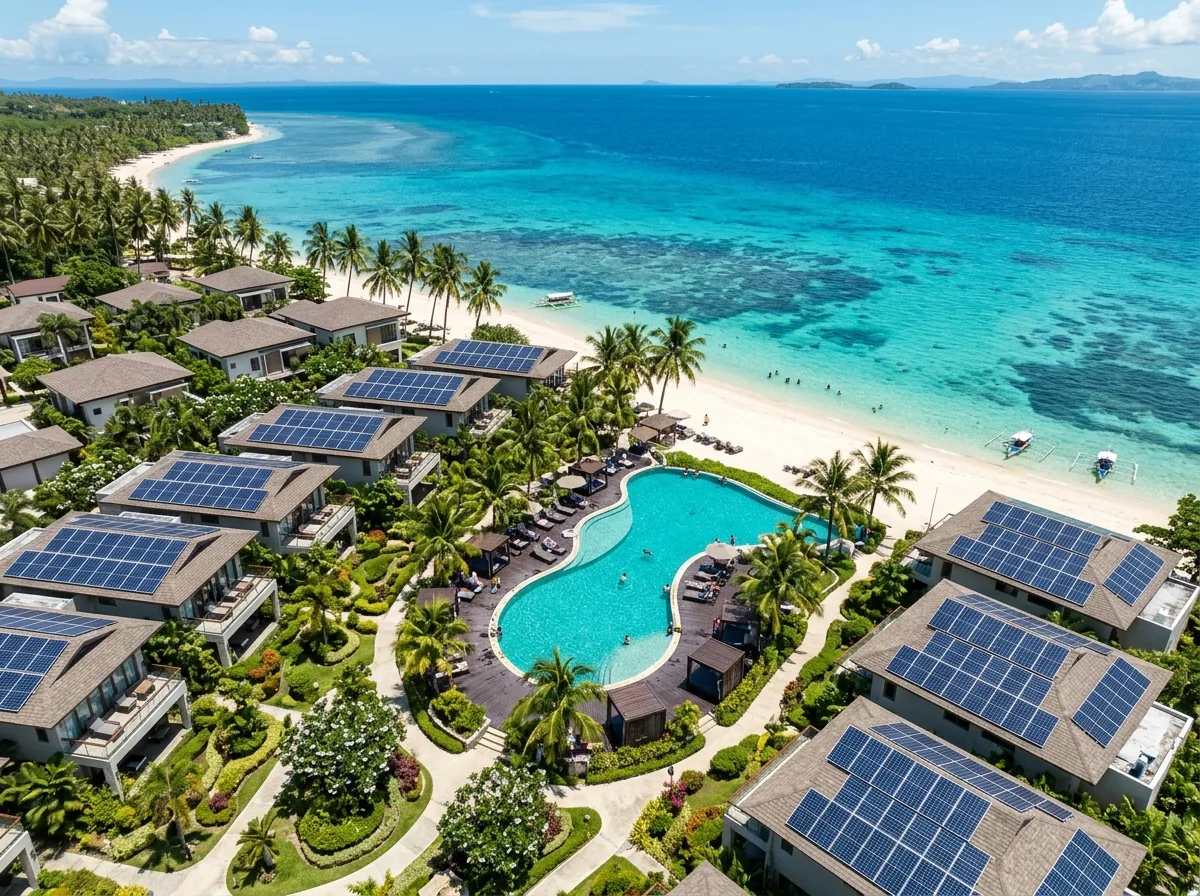
Beach resorts, dive lodges, and city hotels draw peak daytime wattage for split-type aircons, chiller plants, laundry dryers, kitchen exhausts, and pool filtration across MECO, VECO, and CEBECO feeders. CebuSolar builds three-phase commercial and hybrid solar plants tailored for Cebu hospitality properties.
- 50–500 kW+ 3-phase hotel arrays
- 3–5 yrs typical payback period
- Silent backup LiFePO4 battery options
The problem
Why are electricity costs so steep for resorts and hotels in Cebu?
Hospitality properties run centralized air-conditioning, hot-water heat pumps, swimming pool circulation, housekeeping laundries, and kitchen walk-in coolers continuously through hot daytime hours. Under Cebu retail tariffs around ₱15–₱16 per kWh, electricity becomes one of the largest monthly costs during peak tourist occupancy across Mactan and coastal towns.
Walk from a beachfront resort in Lapu-Lapu City or Cordova down to Moalboal, Badian, Oslob, Alcoy, or northern beach corridors in San Remigio, Medellin, and Bantayan, and guest comfort drives non-stop electrical demand. Lobby reception, spa treatment suites, dive-gear compressor bays, seawater desalination skids, and restaurant cold rooms all draw steady three-phase current under bright afternoon heat.
Outside Metro Cebu, provincial resorts face voltage swings and feeder interruptions that spoil frozen kitchen inventory, interrupt guest Wi-Fi, or force noisy standby diesel generators to roar right beside oceanfront villas. Meanwhile, city business hotels in Cebu City and Mandaue pay steep daytime VECO kilowatt-hour rates just to keep central HVAC and elevator banks running during conference and check-in hours.
- Guest room air-conditioning, lobby chillers, and event-hall HVAC loads
- Commercial laundry washers, heat-pump water heaters, and restaurant walk-in freezers
- Swimming pool recirculation pumps, spa jacuzzis, and dive-tank air compressors
- Elevated domestic water boosting, RO desalination, and wastewater blowers
- Guest dissatisfaction and fuel burn whenever coastal brownouts trigger diesel gensets
How solar helps
How does solar power fit Cebu hotels, villas, and coastal resorts?
Sunlight peaks during midday hours when hotel cooling, pool filtration, laundry processing, and water heating pull maximum power. CebuSolar matches 620–630 W N-type bifacial Tier-1 modules with Solis inverters, quiet LiFePO4 battery storage, and solar water pumping engineered for coastal salt air.
Grid-tied arrays for daytime chillers & laundry
City hotels and large Mactan resorts on dependable three-phase MECO or VECO service achieve rapid capital recovery through grid-tied solar. Rooftop or parking-canopy arrays feed lobby HVAC, kitchen refrigeration, and midday laundry washers directly via zero-export Solis inverters without adding battery cost.
Silent LiFePO4 hybrid backup for guest comfort
Nothing disrupts a coastal vacation like lights snapping off or loud diesel exhaust drifting past beachfront suites. Hybrid solar with Dyness or Pylontech LiFePO4 batteries shields room lights, Wi-Fi routers, POS terminals, and inverter aircons silently through outages, reserving heavy gensets only for extended storms.
Solar water pumping & remote resort power
Hillside eco-lodges, island dive camps, and large garden grounds cut fuel deliveries with solar water pumping filling elevated cisterns for guest showers and irrigation. Remote cove resorts without reliable grid poles can combine elevated storage with off-grid solar.
System sizing
What size solar installation does a Cebu resort or hotel need?
Accurate sizing depends on room count, central versus split air-conditioning, daytime laundry and pool schedules, and twelve months of utility bills. CebuSolar offers fixed-price 6–18 kW hybrid systems for boutique properties and custom-engineered 50–500 kW+ three-phase installations for full-scale resorts after a site audit.
| Property scale | Primary daytime loads | Suggested solar capacity | Configuration & pricing |
|---|---|---|---|
| Boutique inn, dive lodge, or villa cluster | Split aircons, kitchen freezers, reception Wi-Fi, small pool pump, water booster | 6 kW to 18 kW Hybrid (10–32 panels, 6.2–19.84 kW solar) | Fixed packages: ₱305,000–₱970,000 (5–16 kWh battery, expandable 5–64 kWh) |
| Mid-sized coastal resort or city hotel | Centralized water heating, laundry house, restaurant chillers, pool pumps, elevator | 50–100 kW three-phase | Rooftop or carport grid-tied or hybrid; custom quote after site visit |
| Multi-wing beach resort or convention hotel | Chiller plant, banquet halls, spa HVAC, dive center, commercial kitchen | 100–250 kW three-phase | Three-phase Solis plant with zero-export & genset coordination; custom quote |
| Integrated destination resort & estate | Multiple accommodation wings, central chillers, desalination, wastewater plant | 250–500 kW+ three-phase | Multi-inverter commercial plant + optional battery & water pumping; custom quote |
Estimates only. Exact capacity and one fixed itemized price are confirmed after a site visit. Actual savings depend on system size, electricity consumption, location, and utility rates. Prices are subject to change without prior notice.
Cost and payback
How much does resort solar cost in Cebu, and when does it pay back?
Commercial hotel arrays from 50 kW to 500 kW+ are custom-quoted at one fixed price following an on-site survey, whereas boutique 6–18 kW hybrid packages range from ₱305,000 to ₱970,000. Across Cebu’s utility tariffs near ₱15–₱16/kWh in October 2026, hospitality investments typically recover cost in 3 to 5 years.
Daytime hotel activity aligns naturally with solar output, turning pool pumps, laundry boilers, kitchen cold rooms, and lobby cooling into immediate bill reductions rather than idle peak tariffs. Evaluated against VECO’s October 2026 schedule of ₱15.30/kWh alongside MECO and CEBECO commercial rates, every solar kilowatt-hour produced on-site trims recurring overhead and shields margins during high season.
Hospitality roofs sit close to ocean humidity, so CebuSolar installs Tier-1 620–630 W N-type bifacial modules from JinkoSolar, JA Solar, Trina Solar, LONGi, and AIKO paired with Solis inverters, Dyness or Pylontech LiFePO4 batteries, Schneider Electric and Suntree protection, and stainless steel fixings built for salt air. Smaller villas can run estimates via our ROI calculator or inspect tiers on our pricing page.
- One fixed contract price after a survey, listing every module, inverter, and breaker
- Three-step payment schedule: 40% on order, 40% on delivery and mounting, 20% on switch-on
- 5-year installation workmanship warranty, 12-year inverter warranty, and 30-year panel performance warranty (at least 87% output at year 30)
- Expandable smaller hybrid setups: add 620 W panels at ₱12,000 each or stack 5 kWh (₱75,000), 10 kWh (₱140,000), or 16 kWh (₱160,000) batteries
- We assist with your local LGU electrical permits and utility zero-export documents
How it works
How does CebuSolar install solar without disturbing resort guests?
Our Cebu City installation crew works discreetly during weekday occupancy windows, keeps tools and material staging hidden inside back-of-house service yards, and schedules brief electrical switchboard tie-ins during quiet mid-morning periods so check-ins and guest stays carry on with minimal disruption.
Property survey
We visit from our Cebu City office to review twelve months of MECO, VECO, or CEBECO bills, inspect villa, kitchen, or carpark roofs, and verify main switchboard and genset ATS layouts.
Discreet design & fixed quote
We map panel rows neatly out of scenic sightlines, specify coastal stainless hardware and zero-export or hybrid backup controls, help with permit paperwork, and present one fixed price.
Quiet, low-profile installation
Crew staging stays strictly in service corridors, avoiding early-morning noise near guest suites, with switchboard tie-in completed inside a scheduled maintenance gap.
Ongoing warranty & support
Your engineering team receives complete handover documentation backed by our warranty coverage, locally stocked spares, and a 48-hour Metro Cebu response target.
What do Cebu hoteliers and resort engineers ask before going solar?
General managers, chief engineers, and resort owners across Mactan Island, Cebu City, Moalboal, Oslob, and northern coastal beaches commonly inquire about roof sightlines, coastal salt mist protection, guest-room aircon backup during brownouts, parking canopies, and local permit support before signing off.
Will solar panels spoil ocean views or clash with resort architecture?
Not when engineered thoughtfully. Most Cebu hotels and beach resorts mount arrays flat along back-of-house service roofs, laundry buildings, staff dormitories, convention halls, or shaded guest parking carports where panels sit neatly out of beachfront sightlines. Flush dark-framed Tier-1 N-type panels on low-slope villa roofs also blend from ground level while shielding roofs from midday sun.
Can a hybrid solar battery run guest air-conditioning silently during brownouts?
Yes, depending on how critical loads are grouped. Using a hybrid Solis system with Dyness or Pylontech LiFePO4 batteries, properties often separate essential circuits—lighting, Wi-Fi, water pumps, reception POS, cold rooms, or selected inverter room aircons—onto backed-up subpanels so essential services stay silent during short outages before a standby genset starts.
How do coastal salt spray and storm gusts affect beachfront solar mounts?
Salt mist along Mactan Channel, Oslob, and Moalboal quickly pits ordinary carbon-steel bolts. CebuSolar uses stainless steel fixings engineered for coastal salt air, Tier-1 620–630 W N-type bifacial modules from JinkoSolar, JA Solar, Trina Solar, LONGi, and AIKO, and locates inverters inside ventilated, weather-protected electrical rooms clear of salt spray.
What if our resort runs a standby diesel generator during scheduled feeder maintenance?
We wire three-phase grid-tied inverters upstream of the automatic transfer switch or add dynamic generator synchronization so solar output adjusts safely alongside generator load without reverse-power trips. That avoids diesel engine under-loading while lowering daytime fuel consumption whenever grid maintenance occurs.
How does CebuSolar assist with permits for hospitality properties?
CebuSolar helps with your permits by assembling technical datasheets, structural mounting plans, and single-line diagrams required for LGU electrical permitting and MECO, VECO, or CEBECO zero-export compliance. Zero-export limiting ensures all generated solar electricity powers your resort’s internal HVAC, kitchen, and water loads directly on-site.
How does low tourist occupancy during rainy months impact resort 3–5 year solar payback?
Even on quiet off-peak rainy weeks, background walk-in freezers, lobby chillers, pool filtration timers, and staff water pumps run daily—meaning CebuSolar models payback conservatively over full 12-month historical bills rather than assuming peak summer every month.
Can a beachfront property run on batteries overnight instead of a noisy diesel genset?
For smaller properties, often yes for selected circuits. With enough roof panels and stacked LiFePO4 batteries (5–64 kWh on our packages), guest-room lights, fans, kitchen fridges and Wi-Fi can run through the night on stored solar. We size the battery to the loads and hours you need during the site visit; larger resorts usually keep a genset for long storms (see off-grid solar).
Do seaside coconut palms around pools ruin rooftop array output across the resort?
During site surveys we trace palm crown shadow sweeps and target bright kitchen roofs, staff quarters, dive center decks, or sunny parking/ground frames free of afternoon palm fronds.
Get your personalized solar quote
Tell us about your place, pin it on the map and add a photo of your bill. Our team replies on Viber within one business day.
- 1. We size your system from your bill and map your roof by satellite.
- 2. You get your quote: panels, battery, monthly savings, payback and price.
- 3. Happy with it? We check your roof and wiring on site, then lock in one fixed price.