- Home
- Coconut Processing
Solar for agro-processing · VCO, copra & coir EPC
Solar for Coconut Processing in Cebu. Lower expeller, dryer, and coir mill bills.
Virgin coconut oil (VCO) centrifuges, copra expeller mills, desiccated coconut lines, and coco-coir decorticators operate heavy continuous motors across sunny rural corridors in Bogo, Medellin, Sogod, Danao, Argao, Dalaguete, and Toledo. CebuSolar builds three-phase commercial solar tailored to agro-processing roofs.
- 50–500 kW+ 3-phase coconut & coir plants
- 3–5 yrs typical payback period
- Tier-1 620–630 W N-type bifacial
The problem
Why are energy expenses eroding margins at Cebu coconut and coir mills?
Coconut value-adding runs high-torque screw expellers, hammer crushers, hot-air dehydrators, high-speed VCO centrifuges, and coco-fiber baling presses under demanding provincial grid conditions. Paying CEBECO commercial tariffs near ₱15–₱16 per kWh or burning diesel standby fuel compresses export margins on oil, meal, and peat.
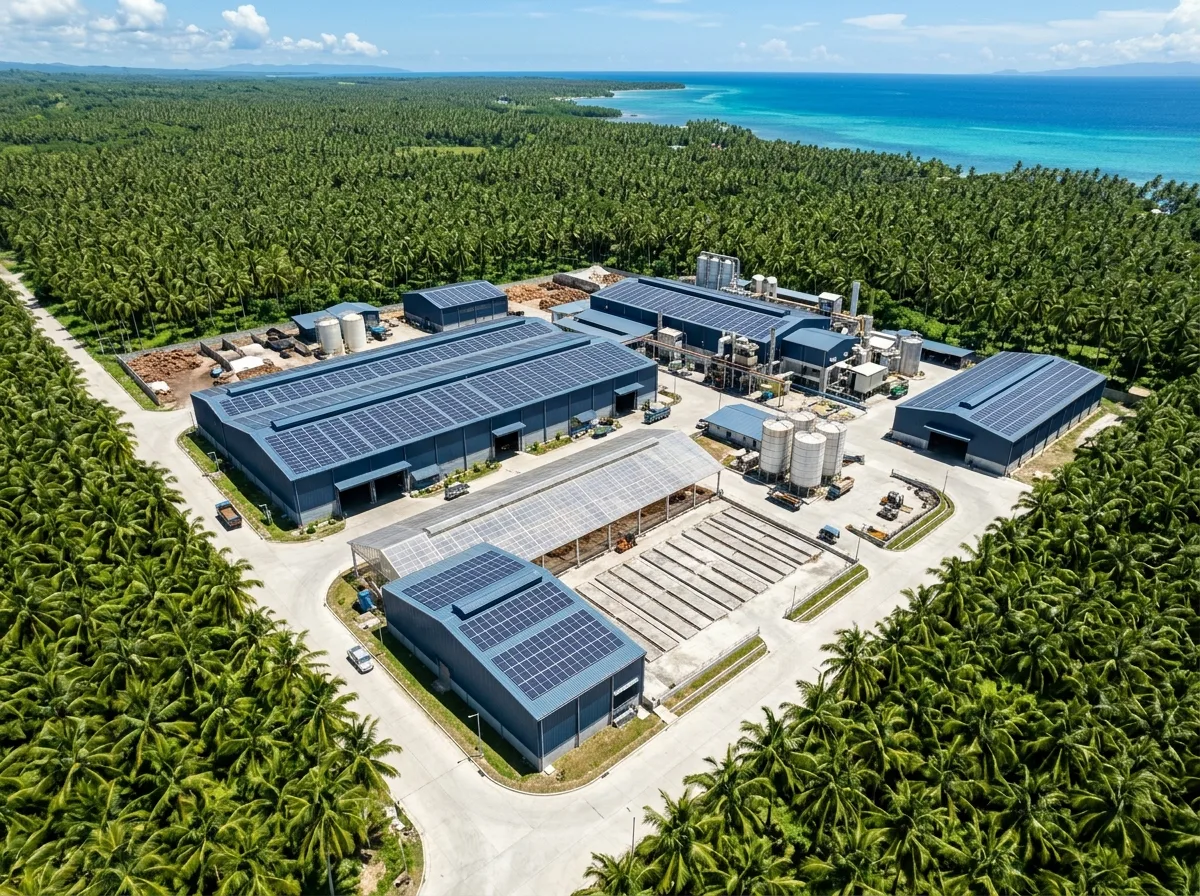
From northern copra and coco-fiber centers in Bogo, Medellin, Tabogon, and Sogod down through southern Argao, Dalaguete, and western Toledo estates, raw nut cracking, paring, drying, and pressing peak straight across daylight working hours. Vast long-span processing sheds and dried-copra warehouses expose wide sunny metal roofs right above the motor control centers running heavy screw presses and air blowers.
At the same time, provincial agricultural feeders can suffer afternoon voltage drops and unexpected outage trips that stall continuous centrifuge separation, cake-cooling conveyors, and hydraulic fiber balers mid-shift—forcing plant owners onto costly diesel generator runs just to empty loaded dryers safely.
- Copra hammer mills, rotary cooker agitators, and heavy oil screw expellers
- Stainless high-RPM VCO centrifuges, cold-press skids, and vacuum dryers
- Desiccated coconut blancher conveyors, rotary cutters, and hot-air drying fans
- Coconut-husk decorticators, rotating sieves, and high-pressure hydraulic coir balers
- Cleanroom bottling halls, product chillers, and farm deep-well washdown pumps
How solar helps
Which solar architectures fit Cebu VCO plants, copra mills, and coir yards?
Agricultural processing centers combine large daylight press loads with rural outage exposure along island coastlines. CebuSolar configures Tier-1 620–630 W N-type bifacial modules with three-phase Solis inverters, coastal stainless hardware, LiFePO4 battery protection for VCO hygiene lines, and solar washdown pumping.
Three-phase grid-tied solar for heavy expeller sheds
Copra expellers and husk-decorticator lines tied to CEBECO or VECO three-phase transformers capture immediate cost relief using grid-tied solar. Multi-inverter Solis systems deliver continuous power directly into press and blower switchboards during clear afternoon production shifts.
Hybrid LiFePO4 backup for hygienic VCO & bottling halls
Temperature-sensitive cold-pressed virgin coconut oil centrifuges and export bottling rooms cannot pause mid-batch during brief rural brownouts. Integrating hybrid solar with Dyness or Pylontech LiFePO4 storage keeps lab controls, hygienic HVAC, and bottling skids running through brief outages.
Small estate mills, off-grid yards & process water pumps
Boutique tablea-coco co-ops, small desiccating sheds, and farm drying barns run fixed 6–18 kW hybrid packages starting from ₱305,000—while washing stations cut pump power via solar water pumping or off-grid setups.
System sizing
What solar capacity suits a Cebu coconut oil, coir, or copra processing plant?
Sizing reviews daytime press and blower kilowatts, husk-fiber dust conditions, roof structural trusses over steamy blanching bays, and twelve months of utility bills. CebuSolar furnishes fixed 6–18 kW kits for co-op dryers and custom 50–500 kW+ commercial arrays for export factories after site survey.
| Coconut plant scale | Main daytime machinery | Suggested solar capacity | System type & pricing |
|---|---|---|---|
| Small artisanal VCO cold-press co-op or husk baling station | Small screw press, grater, dryer fans, sealer, farmhouse lights | 6 kW to 18 kW Hybrid (10–32 panels, 6.2–19.84 kW solar) | Fixed packages: ₱305,000–₱970,000 (5–16 kWh battery, expandable 5–64 kWh) |
| Single-line coco-coir decorticator or small copra expeller mill | Decorticator drums, screening trommel, hydraulic baler, wash pump | 50–120 kW three-phase | Shed rooftop grid-tied array; custom quote after site audit |
| Commercial virgin coconut oil (VCO) & export bottling facility | Centrifuge banks, vacuum evaporators, cleanroom chillers, bottling conveyors | 120–250 kW three-phase | Three-phase Solis plant + QA/bottling hybrid backup; custom quote |
| Large integrated RBD oil refinery, desiccated plant & warehouse | Heavy continuous expellers, hot-air belt dryers, filter presses, boilers | 250–500 kW+ three-phase | Multi-building commercial array + genset interlock; custom quote |
Estimates only. Fiber-dust clearance, substation verification, and one fixed itemized price follow a site audit. Actual savings depend on system size, electricity consumption, location, and utility rates. Prices are subject to change without prior notice.
Cost and payback
How much does coconut-mill solar cost in Cebu, and when does it pay back?
Three-phase agro-industrial arrays from 50 kW to 500 kW+ receive one fixed quote after transformer and roof audits, whereas 6–18 kW co-op packages run ₱305,000 to ₱970,000. Against provincial utility rates near ₱15–₱16/kWh and standby fuel bills, payback typically lands in 3 to 5 years.
Rural coconut estates operate across bright sunny mornings and afternoons all twelve months of the year, keeping screw presses and dryer fans absorbing rooftop solar during peak production hours. Benchmarked against CEBECO I, II, and III rates (~₱15.08–₱15.91/kWh in September 2026) and VECO’s October 2026 rate of ₱15.30/kWh, reducing metered utility power directly improves export cost competitiveness.
To endure damp coastal coconut belts and biomass yard dust, CebuSolar uses Tier-1 620–630 W N-type bifacial panels from JinkoSolar, JA Solar, Trina Solar, LONGi, and AIKO, Solis inverters, Dyness or Pylontech LiFePO4 batteries, Schneider Electric and Suntree protection, and stainless steel hardware. Estimate smaller co-op numbers on our ROI calculator or view fixed kits on our cost page.
- One fixed turnkey contract price after on-mill inspection, every component listed
- Milestone payments: 40% on order, 40% on delivery and mounting, 20% on switch-on
- Backed by 5-year workmanship, 12-year inverter, and 30-year panel warranties (at least 87% output at year 30)
- Co-op expansion options: add 620 W panels at ₱12,000 each or stack 5 kWh (₱75,000), 10 kWh (₱140,000), or 16 kWh (₱160,000) batteries
- We assist with your municipal LGU electrical permits and CEBECO or VECO zero-export documents
How it works
How does CebuSolar install safely around husk boilers, peat dust, and loading bays?
Our Cebu City system designers chart shell-fired furnace flues, coir-fiber dust blowers, and surrounding tall palm shadows across provincial sites before siting a single rail. Sealed electrical rooms house Solis inverters while main breaker tie-in happens on a quiet weekend gap.
Plant & shade survey
We visit to check twelve months of CEBECO or VECO bills, map tall surrounding coconut palm shadows, and trace boiler chimneys and fiber cyclones.
Fire-safe layout & fixed quote
We keep solar strings clear of hot boiler stacks and dusty baling outlets, specify coastal stainless fixings, assist with permits, and issue one fixed quote.
Non-disruptive roof installation
Crews complete structural mounting across warehouse or VCO processing sheds while deliveries run below, finishing breaker tie-in.
Warranty & Cebu parts backing
Finished mills hold our Cebu warranty backed by local spare hardware and a Metro Cebu 48-hour response target.
What do Cebu coconut and agro-mill owners ask before building solar?
Factory owners and plant operations engineers in Bogo, Medellin, Sogod, Argao, and Toledo commonly ask about tall surrounding coconut palm shade, fine coir-fiber dust on panels, biomass-boiler chimney clearance, standby generator synchronization, and local municipal permit assistance before going solar.
Won’t surrounding tall coconut palms shade panels around rural agro-industrial mills?
Every site survey includes solar horizon charting across adjacent palm groves. We cluster strings over clear high-bay warehouse and expeller roofs well away from perimeter tree shadows, and use split-cell Tier-1 N-type bifacial modules paired with multi-MPPT Solis inverters so distant dawn or dusk shadows barely affect midday yield.
How do solar arrays hold up near dusty coco-coir decorticators and biomass boiler flues?
We locate solar strings upwind of coir-fiber sieving exhausts and maintain clear buffer spacing around shell-fired steam boiler flues so ember sparks and dense soot plumes stay clear of the glass, while keeping inverters and breakers sealed inside clean ventilated masonry switchrooms.
Can a plant combine roof solar on warehouses with ground mounts in open drying yards?
Yes, provided any open yard solar sits outside concrete copra sun-drying pavements needed by delivery forklifts and trucks. Combining warehouse rooftop and carport structures expands generation capacity neatly alongside expanding production lines.
How does solar coordinate with standby diesel gensets on rural CEBECO lines?
We wire three-phase grid-tied arrays upstream of automatic transfer switches or use a dynamic PV-genset controller so inverters trip or ramp whenever standby diesel engines take over mill power during rural outages.
Does CebuSolar assist with municipal permits in northern and southern Cebu towns?
Yes—we help with your permits by preparing single-line electrical diagrams, structural layout sheets, and Tier-1 datasheets required for LGU electrical offices and CEBECO I, II, III, or VECO zero-export compliance.
Get your personalized solar quote
Tell us about your place, pin it on the map and add a photo of your bill. Our team replies on Viber within one business day.
- 1. We size your system from your bill and map your roof by satellite.
- 2. You get your quote: panels, battery, monthly savings, payback and price.
- 3. Happy with it? We check your roof and wiring on site, then lock in one fixed price.