- Home
- Warehouses & Cold Storage
Solar for warehouses & cold storage · High-bay C&I EPC
Solar for Warehouses & Cold Storage in Cebu. Put wide roofs to work cutting chiller bills.
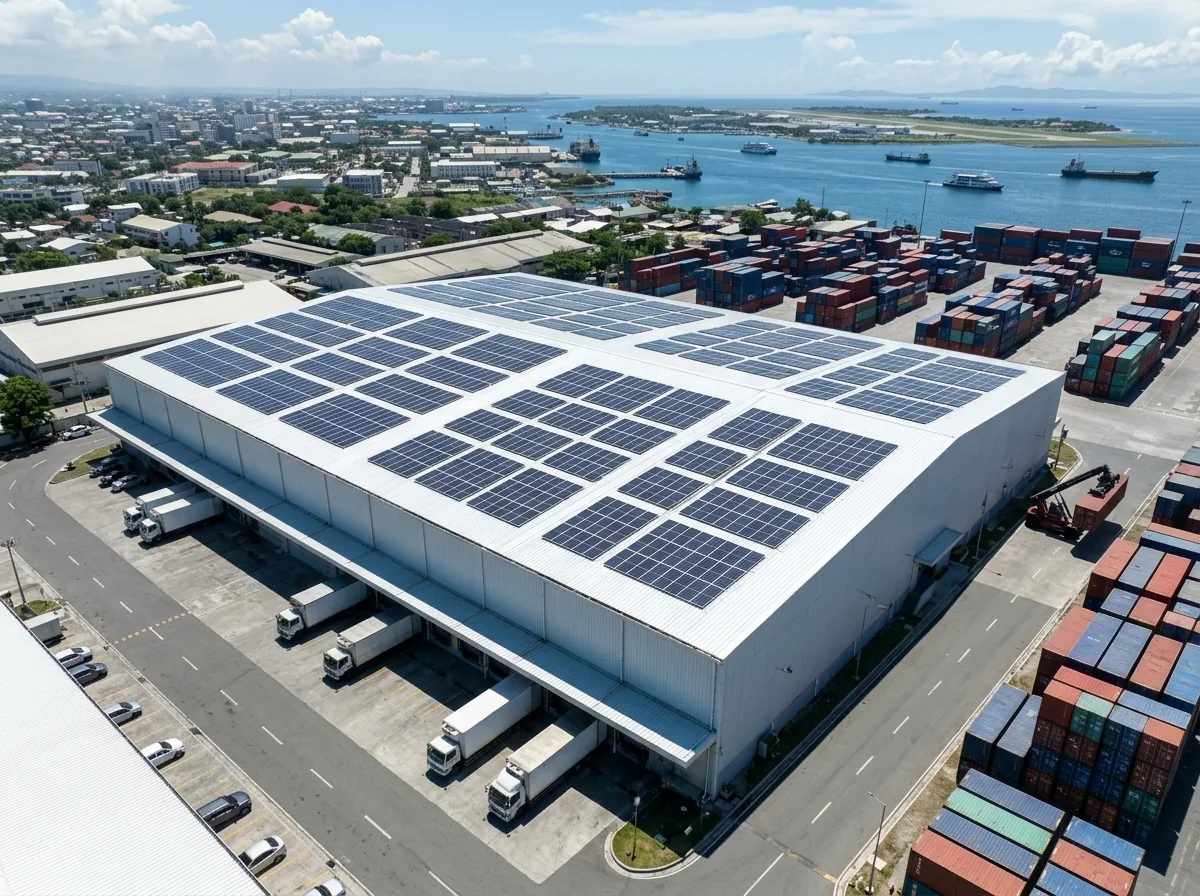
Insulated cold rooms, blast chillers, battery-forklift chargers, and high-bay logistics warehouses pair massive clear roofs with heavy daytime cooling demand under VECO, MECO, and CEBECO tariffs. CebuSolar designs three-phase commercial solar plants from 50 kW to 500 kW+ engineered for zero-penetration klip-lok and steel purlin roofs.
- 50–500 kW+ 3-phase rooftop plants
- 3–5 yrs typical payback period
- Non-penetrating klip-lok seam clamps
The problem
Why do Cebu cold storage hubs and logistics depots burn so much daytime power?
Cold-storage facilities and distribution hubs push screw compressors, evaporator fans, dock air curtains, and electric forklift chargers hardest during daytime receiving and dispatch hours. Under Cebu retail tariffs near ₱15–₱16 per kWh, thermal heat gain across wide metal roofs and dock doors drives steep monthly utility costs.
Across Mandaue’s Subangdaku and Paknaan industrial zones, Cebu City’s North Reclamation Area, Consolacion and Liloan logistics parks, Lapu-Lapu air-cargo depots, and Naga or Minglanilla staging hubs, warehouse traffic peaks under bright sunlight. Every loading bay door opening admits warm humid air into +4°C chillers and -18°C freezer vaults, forcing refrigeration compressors and evaporative condensers into sustained midday draw.
Even dry ambient distribution warehouses rely heavily on electric reach-truck battery banks, automated sorting conveyors, office HVAC, dock levelers, and high-bay LED lighting through business shifts. Meanwhile, unscheduled feeder drops require continuous backup to protect perishable meat, dairy, seafood, and pharmaceutical inventory worth millions of pesos.
- Screw and semi-hermetic compressors maintaining -18°C freezer and chilled vaults
- Evaporator blower coils, condenser fans, and insulated loading-dock air curtains
- Midday thermal heat gain from warm truck dispatch and frequent dock openings
- Electric forklift, reach-truck, and pallet-jack fleet charging stations
- High-bay warehouse lighting, WMS servers, CCTV security, and office aircon
How solar helps
How does rooftop solar lower cooling and warehouse costs in Cebu?
Expansive warehouse roofs sit directly above main three-phase distribution switchboards, capturing strong midday sunlight while physically shading steel roof sheets above temperature-controlled interiors. CebuSolar engineers 620–630 W N-type bifacial Tier-1 panels with Solis three-phase inverters, optional LiFePO4 storage, and zero-export protection.
Three-phase grid-tied plants for cold-storage compressors
Because refrigeration compressors pull maximum daytime amperage when condensing temperatures climb, grid-tied solar feeds active chiller motors without needing large battery banks. Real-time zero-export sensors match array production directly to cold-room consumption across VECO, MECO, or CEBECO transformers.
Hybrid battery protection for dock automation & WMS
Brief utility voltage sags can crash warehouse management servers, barcode scanners, temperature loggers, and automatic dock doors even before backup gensets sync. Adding hybrid solar with Dyness or Pylontech LiFePO4 batteries shields control rooms, office HVAC, and critical security gear during outages.
Cooling-tower water pumping & auxiliary yard systems
Logistics yards with deep boreholes feeding condenser makeup tanks, truck-wash bays, or fire reservoirs cut utility pumping loads with solar water pumping. Gatehouses and remote yard sheds can also run independently on fixed hybrid packages or off-grid solar.
System sizing
What size solar array fits a Cebu warehouse or cold-storage facility?
Sizing reflects cold-room compressor horsepower, roof sheet area, forklift charging schedules, and twelve months of daytime kilowatt-hour bills. CebuSolar offers fixed 6–18 kW hybrid units for small forwarder offices and custom-engineered 50–500 kW+ three-phase rooftop plants for commercial warehouses after a site survey.
| Warehouse scale | Primary daytime loads | Suggested system size | Architecture & pricing |
|---|---|---|---|
| Small depot, dispatch office, or walk-in chiller | Small cold room, WMS computers, office AC, security gates, dock lighting | 6 kW to 18 kW Hybrid (10–32 panels, 6.2–19.84 kW solar) | Fixed packages: ₱305,000–₱970,000 (5–16 kWh battery, expandable 5–64 kWh) |
| Dry logistics hub or ambient cross-dock warehouse | Electric forklift chargers, sorting conveyors, high-bay LEDs, dispatch HVAC | 50–150 kW three-phase | Standing-seam or purlin rooftop grid-tied array; custom quote after site visit |
| Commercial chiller & frozen cold-storage facility | Multi-stage compressors, blast chillers, air curtains, dock levelers | 150–300 kW three-phase | Three-phase Solis plant with zero-export & genset sync; custom quote |
| Regional portside cold-chain & logistics park | Multiple -18°C halls, industrial condensers, large MHE charging bays | 300–500 kW+ three-phase | Multi-inverter commercial plant + optional LiFePO4 backup; custom quote |
Estimates only. Final sizing and one fixed itemized contract price follow a site survey. Actual savings depend on system size, electricity consumption, location, and utility rates. Prices are subject to change without prior notice.
Cost and payback
How much does cold-storage and warehouse solar cost, and how fast does it pay back?
Commercial warehouse plants from 50 kW to 500 kW+ are custom-quoted at one fixed price following structural inspection, while smaller 6–18 kW depot packages range from ₱305,000 to ₱970,000. At October 2026 Cebu rates near ₱15–₱16/kWh, commercial facilities typically see a 3 to 5 year payback.
Broad, flat warehouse roofs deliver strong per-watt installation efficiency while high daytime refrigeration loads consume solar electricity directly at the facility transformer. Evaluated against VECO’s October 2026 rate of ₱15.30/kWh and comparable MECO or CEBECO commercial tariffs, cutting daytime kWh purchase turns idle roof deck into durable long-term savings.
Every CebuSolar warehouse build uses Tier-1 620–630 W N-type bifacial panels from JinkoSolar, JA Solar, Trina Solar, LONGi, and AIKO, Solis three-phase inverters, Dyness or Pylontech LiFePO4 batteries where specified, Schneider Electric and Suntree breakers, and stainless steel fixings built for portside salt air. Smaller depots can test payback via our ROI calculator or view package specs on our cost page.
- One fixed turnkey price after a site audit, every component itemized
- Three milestone payments: 40% on order, 40% on delivery and mounting, 20% on switch-on
- Long-term backing: 5-year installation workmanship, 12-year Solis inverter, and 30-year panel performance warranties (at least 87% output at year 30)
- Expandable smaller hybrid setups: extra 620 W panels at ₱12,000 each and add-on 5 kWh (₱75,000), 10 kWh (₱140,000), or 16 kWh (₱160,000) batteries
- We assist with your LGU electrical permits and VECO, MECO, or CEBECO documentation
How it works
How does CebuSolar install on cold-storage roofs without interrupting dispatch?
Our Cebu City installation crew performs overhead mounting and DC cable runs completely outside loading bays while trucks load and chillers stay active. Main switchboard tie-in is timed during a pre-approved Sunday or off-shift maintenance window so cold-chain temperatures remain steady.
Roof & switchboard audit
We visit from our Cebu City office to verify standing-seam or rib-type roof profiles, purlin spans, 12-month VECO, MECO, or CEBECO bills, and transformer and genset transfer ratings.
Structural design & fixed price
We engineer non-penetrating seam clamps or crest mounts, lay out safe roof maintenance walkways, help with permit paperwork, and deliver one fixed contract price.
Safe, staged installation
Full harness and safety rigging keep loading lanes clear below, with electrical breaker tie-in confined to a short, planned off-peak window.
Warranty & Metro Cebu service
Post-commission care includes our Cebu warranty, locally stocked spares, and a Metro Cebu service team targeting response within 48 hours.
What do Cebu warehouse and cold-storage operators ask before going solar?
Logistics directors, cold-chain engineers, and industrial property owners across Mandaue, North Reclamation Area, Lapu-Lapu, Consolacion, and Minglanilla often ask about klip-lok roof sheet warranties, chiller thermal load reduction, standby diesel generators, phased array expansion, and utility zero-export permitting before proceeding.
Can you mount panels on klip-lok or standing-seam insulated roofs without drilling holes?
Yes. Insulated cold-storage roofs in Cebu commonly use concealed-fastener standing-seam or klip-lok panels where piercing the top skin voids roof warranties or risks vapor leaks. CebuSolar uses engineered non-penetrating seam clamps matched to your exact rib profile—preserving watertight roof integrity with zero sheet punctures while anchoring securely into the roof structure.
Does rooftop solar also reduce heat radiating into our chilled warehouse bays?
Yes. Covering bare metal warehouse sheets with elevated rows of 620–630 W Tier-1 panels blocks direct midday solar radiation from baking the steel deck, helping ease surface roof temperatures above insulated ceiling panels while generating clean three-phase power directly for your compressors and air curtains underneath.
How does solar coordinate with standby diesel generators protecting frozen inventory?
Cold storage cannot risk reverse-power trips on standby diesel generators. We integrate three-phase solar arrays upstream of your automatic transfer switch or through a dynamic PV-genset controller so solar throttles whenever the facility shifts onto backup diesel during feeder outages.
Can warehouse owners install solar across multi-bay roofs and expand later?
Yes. Phased commercial builds let operators match initial solar capacity to current compressor load—whether a 50–150 kW first stage or a full 500 kW+ roof coverage—leaving clear walkway corridors and conduit headroom for additional inverter blocks or LiFePO4 battery cabinets as cold-room capacity grows.
How does CebuSolar assist with permits for commercial warehouse installations?
CebuSolar helps with your permits by preparing single-line electrical diagrams, structural clamp specifications, and Tier-1 datasheets required for LGU electrical permits and VECO, MECO, or CEBECO zero-export setup. Real-time current limiting ensures generated energy stays inside your facility’s active cooling and charging circuits.
Get your personalized solar quote
Tell us about your place, pin it on the map and add a photo of your bill. Our team replies on Viber within one business day.
- 1. We size your system from your bill and map your roof by satellite.
- 2. You get your quote: panels, battery, monthly savings, payback and price.
- 3. Happy with it? We check your roof and wiring on site, then lock in one fixed price.