- Home
- Schools & Universities
Solar for education · Campus & school EPC
Solar for Schools & Universities in Cebu. Cut daytime classroom and lab cooling bills.
Private elementary schools, senior high campuses, colleges, maritime training academies, and covered gymnasiums concentrate electricity consumption strictly across bright school-day hours in Cebu City, Mandaue, Lapu-Lapu, Talisay, and provincial towns. CebuSolar engineers campus solar arrays across academic rooftops.
- 6–500 kW+ schools & multi-building campuses
- 3–5 yrs typical payback period
- Tier-1 620–630 W N-type bifacial
The problem
Why are cooling and lab utility bills squeezing school operating budgets in Cebu?
Air-conditioned classrooms, computer and robotics labs, libraries, registrar offices, and campus cafeterias turn on simultaneously around 7:30 AM and stay crowded until late afternoon. Paying Cebu tariffs near ₱15–₱16 per kWh forces schools either to hike miscellaneous energy fees or defer campus facility upgrades.
Across crowded urban campuses along Talamban, Banilad, Colon, Mandaue, Mactan, Talisay, and regional provincial colleges in Carcar, Danao, and Bogo, classroom schedules align remarkably well with sunny tropical hours. Broad multi-story concrete school decks and sprawling covered basketball gymnasium roofs capture unobstructed sunshine overhead right above hundreds of split and cassette inverter air conditioners running full load through dry March–May graduation and enrollment seasons.
Furthermore, sudden afternoon brownouts on suburban or provincial town feeders halt smartboards, campus Wi-Fi, hybrid distance-learning servers, and lab workstations mid-exam unless protected by clean battery ride-through.
- Split and VRF air-conditioning systems across classrooms, lecture halls, and faculty rooms
- Computer laboratories, engineering simulation suites, and maritime training simulators
- Libraries, campus chapels, auditorium ventilation blowers, and canteen walk-in chillers
- Campus administration IT servers, registrar records, CCTV grids, and ID gates
- Deep-well water booster pumps serving multi-floor restrooms and campus drinking stations
How solar helps
Which commercial solar setups match Cebu schools, colleges, and training centers?
Educational institutions enjoy textbook daytime energy curves: empty buildings at night and peak air-conditioned classrooms under strong sun. CebuSolar pairs Tier-1 620–630 W N-type bifacial modules with three-phase Solis inverters, zero-export meters, Schneider switchgear, and hybrid LiFePO4 battery protection for IT and admin hubs.
Three-phase grid-tied arrays on covered courts & wings
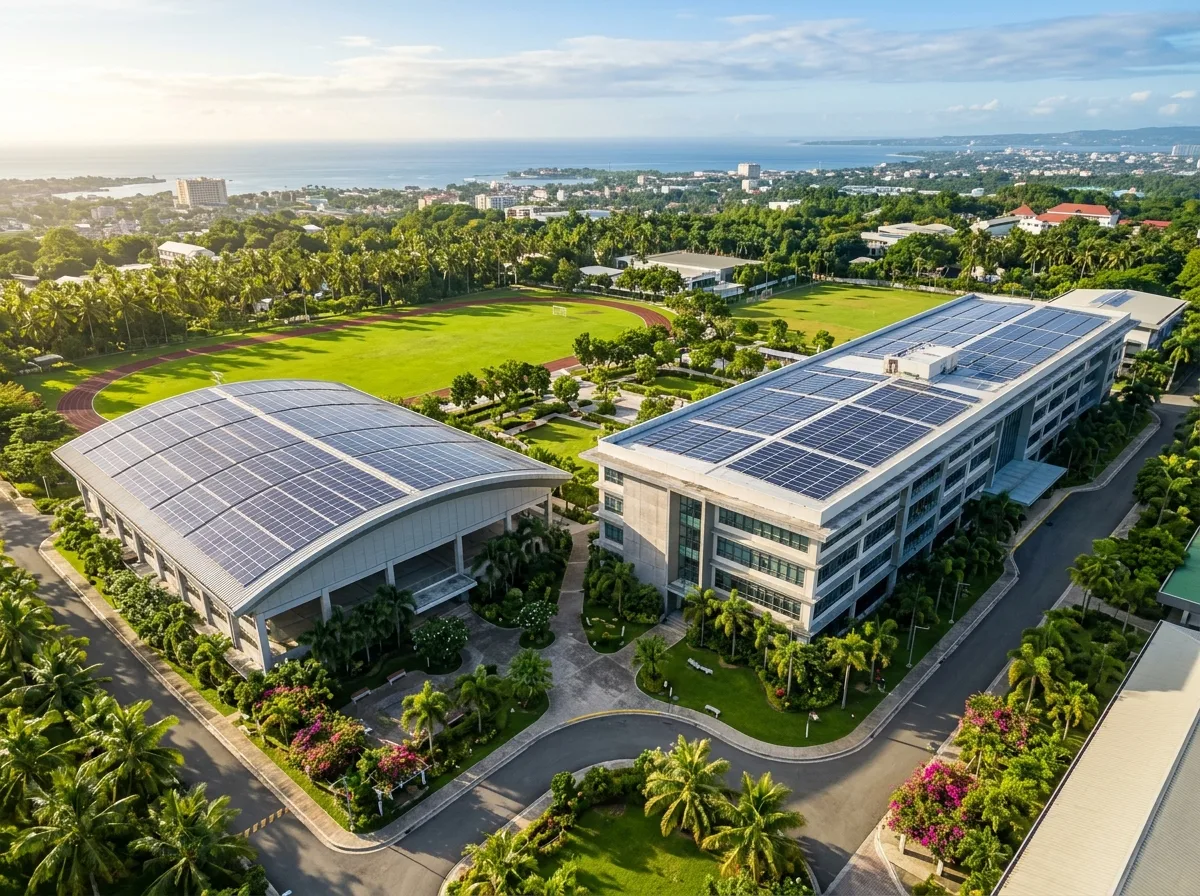
Multi-building schools and universities earn shortest payback from three-phase grid-tied solar. Clear-span covered gymnasiums and academic roof decks generate daytime kilowatts flowing straight into classroom aircon panels via zero-export sensing with little ongoing upkeep.
Hybrid LiFePO4 backup for registrar & computer labs
Exam servers, campus fiber switches, and biometric gates cannot drop offline during mid-day utility flickers. Adding hybrid solar with Dyness or Pylontech LiFePO4 storage bridges registrar offices, testing centers, and faculty hubs quietly across outage interruptions.
Review centers, preschools & campus pumping
Smaller K-8 academies, Montessori schools, tutorial centers, and review hubs deploy fixed 6–18 kW hybrid packages starting from ₱305,000—while spacious provincial campuses cut borehole pumping bills using solar water pumping.
System sizing
How much solar power does a Cebu school campus or covered gymnasium hold?
Campus sizing reviews daytime peak classroom occupancy versus semestral break schedules, covered-court roof truss capacity, separate utility meters across split blocks, and twelve months of billing statements. CebuSolar provides fixed 6–18 kW packages for small academies and custom 50–500 kW+ arrays for large campuses.
| Campus scale | Daytime campus loads | Suggested solar capacity | Configuration & pricing |
|---|---|---|---|
| Preschool, learning center, or review school suite | 4–8 split aircons, smartboards, computer stations, reception Wi-Fi | 6 kW to 18 kW Hybrid (10–32 panels, 6.2–19.84 kW solar) | Fixed packages: ₱305,000–₱970,000 (5–16 kWh battery, expandable 5–64 kWh) |
| K-12 private academy or maritime/technical institute | Classroom wings, covered gym lighting, computer labs, canteen chillers | 50–120 kW three-phase | Gymnasium or academic roof grid-tied array + IT hybrid bank; custom quote |
| Large multi-wing college or regional parochial campus | HVAC VRF plants, multiple computer labs, elevators, science rooms, admin | 120–300 kW three-phase | Multi-building three-phase Solis plant with zero-export control; custom quote |
| Major university campus with engineering & medical blocks | Central chillers, multi-story lecture blocks, stadium gym, campus cold hub | 300–500 kW+ three-phase | Phased multi-building campus EPC across roofs & carports; custom quote |
Estimates only. Purlin inspection over covered courts, meter grouping audit, and one fixed itemized price follow a site audit. Actual savings depend on system size, electricity consumption, location, and utility rates. Prices are subject to change without prior notice.
Cost and payback
What do school and university solar projects cost in Cebu?
Three-phase school arrays from 50 kW to 500 kW+ receive one fixed turnkey quote after reviewing roof framing and utility meters, while smaller 6–18 kW academy packages run ₱305,000 to ₱970,000. At Cebu utility rates near ₱15–₱16/kWh, typical school payback ranges 3 to 5 years.
Every classroom air conditioner running from morning homeroom past afternoon clubs aligns straight onto daytime solar harvest, meaning zero-export arrays displace costly afternoon power across the heart of the academic calendar plus summer bridge classes and enrollment months. Benchmarked against VECO’s October 2026 schedule of ₱15.30/kWh, MECO (~₱15.98/kWh in September 2026), and CEBECO commercial rates, freeing tuition budgets for academic improvements becomes predictable and long-lasting.
CebuSolar installs Tier-1 620–630 W N-type bifacial panels from JinkoSolar, JA Solar, Trina Solar, LONGi, and AIKO, Solis inverters, Dyness or Pylontech LiFePO4 batteries, Schneider Electric and Suntree protection, and stainless steel hardware. Test small academy numbers on our ROI calculator or view fixed tiers on our cost page.
- One fixed turnkey contract price after site survey, every component listed
- Milestone payments: 40% on order, 40% on delivery and mounting, 20% on switch-on
- Protected by 5-year workmanship, 12-year inverter, and 30-year panel performance warranties (at least 87% output at year 30)
- Academy flexibility: add 620 W panels at ₱12,000 and 5 kWh (₱75,000), 10 kWh (₱140,000), or 16 kWh (₱160,000) batteries
- We assist with your local LGU electrical permits and VECO, MECO, or CEBECO zero-export compliance
How it works
How does CebuSolar build above school grounds safely without disrupting classes?
Campus student safety shapes every step of installation. Our Cebu City crew schedules noisy rigging or crane hoists on Saturdays, holidays, or semestral breaks wherever possible—roping off safe ground drop zones, keeping lockable DC disconnect gear away from corridors, and tying in overnight.
Campus & safety audit
We inspect twelve months of VECO, MECO, or CEBECO bills, identify main distribution rooms across classroom blocks, and assess covered-court steel framing.
Student-safe design & fixed quote
We map clear concealed conduit shafts away from hallways, specify lockable Schneider enclosures, help with LGU permits, and deliver one fixed board-ready quote.
Holiday or weekend construction
Teams complete structural mounting and electrical testing strictly outside occupied school periods, timing breaker commissioning before Monday bell.
Warranty & visible monitoring
Commissioned campuses receive our Cebu warranty backed by local spare parts, a Metro Cebu 48-hour response target, and monitoring tools students can learn from.
What do Cebu school boards and campus facilities directors ask before approving solar?
School trustees, university presidents, and campus facilities directors in Cebu City, Mandaue, Lapu-Lapu, and provincial colleges frequently ask about locked safety enclosures away from students, cooling inside metal-roofed covered gymnasiums, semestral vacation scaling, separate building utility meters, and local permit assistance.
Are inverters, DC cabling, and batteries kept out of student reach on campus?
Yes. CebuSolar installs all Solis inverters, Dyness or Pylontech LiFePO4 batteries, and Schneider Electric/Suntree disconnects inside locked electrical rooms or lockable enclosures using steel conduit protection down external walls, away from student hallways, playgrounds, and basketball courts.
Does putting solar atop our open covered basketball gym actually reduce indoor heat?
Yes. Broad corrugated iron covered-court roofs radiate intense heat straight down onto assemblies and PE classes across sunny afternoons. Shading bare steel roof spans with Tier-1 panels blocks overhead radiant heating substantially while powering large gym blowers and classroom aircon adjacent to the court.
What happens during quiet Christmas breaks or school vacations when classrooms sit empty?
Zero-export Solis controllers throttle solar output to serve base campus security lighting, IT servers, registrar office aircon, canteen freezers, and water pumps without feeding power backward into utility meters, while full-occupancy semester months still maintain strong 3 to 5 year payback.
Our school buildings sit on different VECO utility meters—can one roof power all of them?
Every solar plant ties directly behind the utility billing meter serving the target building or consolidated transformer block. During site survey, we inspect all campus meters and align array allocation per meter (or pair buildings feeding off one consolidated primary campus transformer).
Does CebuSolar help prepare permit packages for municipal offices and utility zero-export?
Yes—we assist with your permits by preparing single-line electrical diagrams, structural layout drawings, and Tier-1 datasheets required for city LGU electrical offices and VECO, MECO, or CEBECO zero-export compliance.
Get your personalized solar quote
Tell us about your place, pin it on the map and add a photo of your bill. Our team replies on Viber within one business day.
- 1. We size your system from your bill and map your roof by satellite.
- 2. You get your quote: panels, battery, monthly savings, payback and price.
- 3. Happy with it? We check your roof and wiring on site, then lock in one fixed price.