- Home
- Rice Milling
Solar for rice & corn mills · Grain & warehouse EPC
Solar for Rice Milling in Cebu. Lower per-sack processing electricity bills.
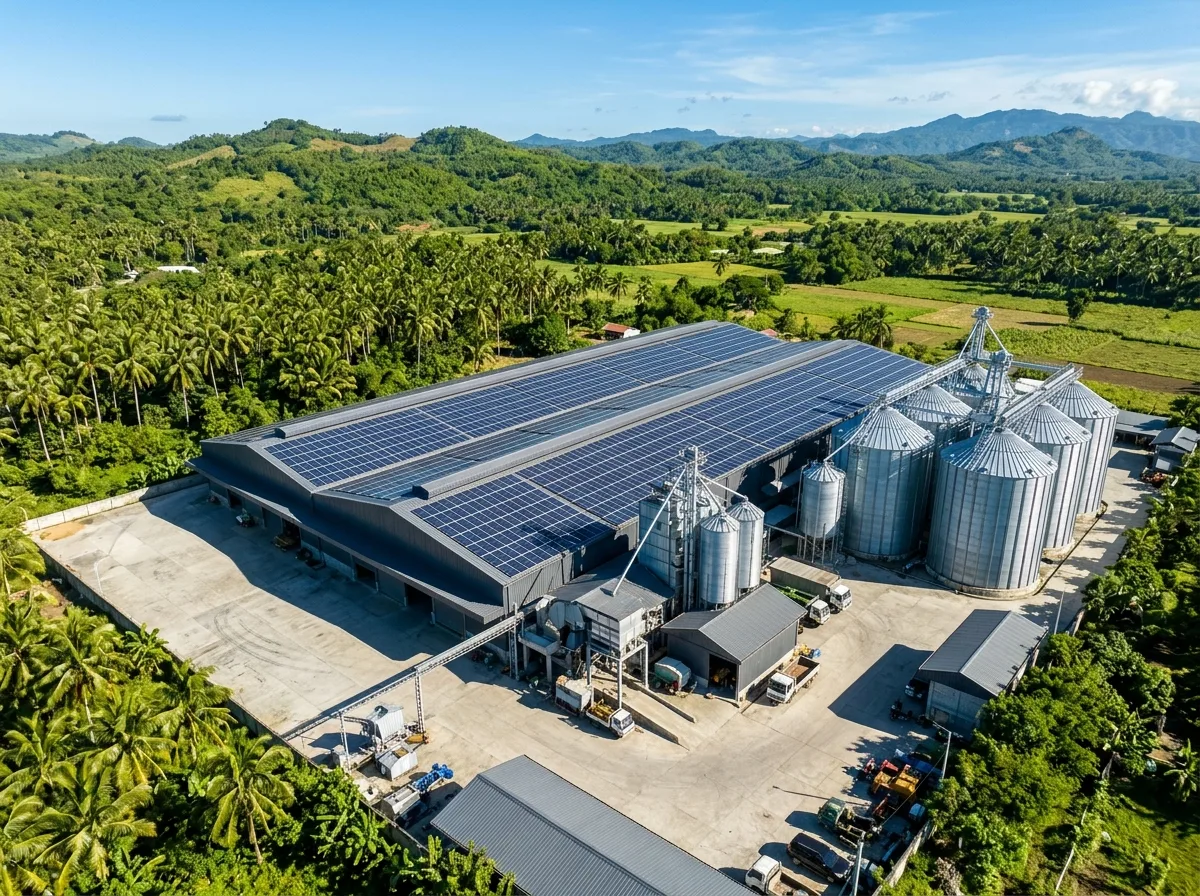
Multi-pass rice mills, corn grits mills, grain drying bays, and wholesale palay warehouses run continuous three-phase hullers, polishers, dust cyclones, optical color sorters, and auger elevators across daylight hours in Asturias, Balamban, Tuburan, Bogo, Carcar, and Metro Cebu. CebuSolar designs commercial solar arrays for broad grain-mill roofs.
- 50–500 kW+ 3-phase milling & drying plants
- 3–5 yrs typical payback period
- Tier-1 620–630 W N-type bifacial
The problem
Why do electric bills take such a heavy bite out of Cebu rice and corn milling?
Modern milling lines run large three-phase induction motors across rubber-roll huskers, paddy separators, abrasive whiteners, silky mist polishers, pneumatic lifts, and optical sorters from morning start-up until dusk. Facing Cebu electricity tariffs around ₱15–₱16 per kWh, power expenses directly narrow slim wholesale margin per sack.
In agricultural valleys around Asturias, Tuburan, Balamban, Bogo, Barili, and Carcar—alongside large grain distribution bodegas in Metro Cebu—multi-pass rice and corn mills pull high continuous kVA across 8-to-12-hour daylight milling shifts while mechanical flatbed dryers operate heavy centrifugal blowers during wet harvests. Meanwhile, long bare steel bodega roofs above bagged rice stocks sit right next to dedicated three-phase pad-mount transformers.
Beyond steep utility kWh charges under CEBECO and VECO, voltage sags along provincial feeders trip optical color sorter boards and overload motor starters, forcing millers either to scale down throughput during afternoon utility sags or fire costly standby diesel gensets.
- Pre-cleaners, destoners, rubber-roll hullers, and multi-stage paddy separators
- Vertical abrasive whiteners, water-mist silky polishers, and grading sifters
- High-pressure compressed-air headers driving electronic optical color sorters
- Mechanical grain-dryer centrifugal hot-air blowers and bucket elevator towers
- Bagging scales, sewing conveyors, forklift chargers, and warehouse offices
How solar helps
Which solar systems cut milling power costs on Cebu grain bodegas?
Daytime-dominant milling operations and vast empty steel warehouse roofs align naturally with direct commercial solar consumption. CebuSolar matches Tier-1 620–630 W N-type bifacial modules with Solis three-phase inverters, zero-export meters, dust-sealed electrical rooms, and optional LiFePO4 protection for sensitive optical sorters.
Zero-export grid-tied arrays for multi-pass mills
Commercial mills connected to VECO or CEBECO three-phase service recover investment rapidly with grid-tied commercial solar. Multi-inverter Solis arrays inject steady daytime power directly into huller, whitener, and air-compressor motor control centers under zero-export rules.
Hybrid battery protection for sorters & truck scales
Utility voltage flickers crash electronic optical color sorters, weighbridge terminals, and milling control PLCs before generators catch load. Pairing hybrid solar with Dyness or Pylontech LiFePO4 batteries shields precision electronics, bagging controls, and admin offices.
Custom 6–18 kW warehouse kits & farm grain pumps
Smaller town cono mills, retail rice repackers, and truck scales can deploy fixed 6–18 kW hybrid packages starting from ₱305,000—while surrounding irrigated rice-field estates deploy solar water pumping or off-grid power.
System sizing
What solar size matches a Cebu cono rice mill or regional grain complex?
Grain-mill sizing checks connected tons-per-hour motor draw across hulling, polishing, and sorter compressors, warehouse roof framing spans, husk-dust wind direction, and twelve months of power bills. CebuSolar offers 6–18 kW packages for small grain dealers and custom 50–500 kW+ plants for regional mills.
| Mill & warehouse scale | Active daytime equipment | Suggested solar capacity | Setup & pricing |
|---|---|---|---|
| Small town cono mill, grain shop, or truck scale office | Compact huller, polishing unit, small blower, digital scale, office aircon | 6 kW to 18 kW Hybrid (10–32 panels, 6.2–19.84 kW solar) | Fixed packages: ₱305,000–₱970,000 (5–16 kWh battery, expandable 5–64 kWh) |
| Single-line 2–3 TPH commercial rice or corn mill | Multi-pass hullers, whiteners, cyclone fans, sorter air compressor, dryer blowers | 50–120 kW three-phase | Rooftop grid-tied array over palay warehouse; custom quote after site audit |
| Integrated 5–8 TPH automated rice mill & silo yard | Dual polishing lines, multi-chute optical sorters, mechanical dryers, elevators | 120–250 kW three-phase | Three-phase Solis plant + sorter/office hybrid backup; custom quote |
| Large regional milling complex & port bagging bodega | High-capacity silos, multiple milling halls, rotary compressors, logistics bay | 250–500 kW+ three-phase | Multi-warehouse rooftop commercial installation; custom quote |
Estimates only. Purlin inspection, husk-chaff cyclone clearance, and one fixed itemized price follow a site audit. Actual savings depend on system size, electricity consumption, location, and utility rates. Prices are subject to change without prior notice.
Cost and payback
How much does rice-mill solar cost in Cebu, and how fast does it pay back?
Commercial arrays of 50 kW to 500 kW+ are custom-quoted at one fixed price after reviewing substation transformers and roof trusses, whereas 6–18 kW dealer setups run ₱305,000 to ₱970,000. Against Cebu utility rates near ₱15–₱16/kWh, payback averages 3 to 5 years.
Daylight milling shifts give grain processors direct absorption across every sunny hour without overnight storage expense, turning broad metal palay warehouse roofs into reliable cost-cutting infrastructure. Benchmarked against provincial CEBECO I, II, and III rates (~₱15.08–₱15.91/kWh in September 2026) and VECO’s October 2026 schedule of ₱15.30/kWh, lowering processing overhead protects per-kilo competitiveness all harvest season.
CebuSolar installs Tier-1 620–630 W N-type bifacial panels from JinkoSolar, JA Solar, Trina Solar, LONGi, and AIKO, Solis inverters, Dyness or Pylontech LiFePO4 batteries, Schneider Electric and Suntree protection, and stainless steel hardware. Test small depot savings on our ROI calculator or view fixed kits on our cost page.
- One fixed turnkey contract price after site inspection, every part itemized
- Milestone payments: 40% on order, 40% on delivery and mounting, 20% on switch-on
- Backed by 5-year workmanship, 12-year inverter, and 30-year panel warranties (at least 87% output at year 30)
- Modular options for smaller grain dealers: extra 620 W panels at ₱12,000 and 5 kWh (₱75,000), 10 kWh (₱140,000), or 16 kWh (₱160,000) batteries
- We help with your local LGU electrical permits and CEBECO or VECO zero-export documents
How it works
How does CebuSolar install over dusty grain warehouses and silo yards?
Our Cebu City crew coordinates around rice-delivery truck bays, keeps panels clear of rice-husk cyclone discharge stacks, encloses Solis inverters and Schneider switchgear inside dust-sealed electrical rooms, and ties into the main breaker on a planned quiet gap without halting milling runs.
Mill & roof survey
We visit to check twelve months of CEBECO or VECO bills, map paddy husk cyclone exhausts and bucket elevator towers, and test electrical room dust tightness.
Dust-safe design & fixed quote
We keep arrays upwind of bran dust vents, design safe washdown access catwalks, assist with LGU permits, and deliver one fixed quote.
Zero-downtime roof mounting
Crews mount rails and external conduits overhead while bodegas ship and mill grain below, timing breaker tie-in during a scheduled pause.
Warranty & Cebu parts backing
Finished mills hold our Cebu warranty backed by locally stocked spare parts with a Metro Cebu 48-hour response target.
What do Cebu rice millers ask before putting solar on grain bodegas?
Mill operators and grain traders across Asturias, Bogo, Tuburan, Carcar, and Metro Cebu often ask about rice-bran dust build-up on panels, tall silo shadowing, seasonal off-harvest zero-export scaling, standby diesel genset synchronization, and LGU permit assistance before installing commercial solar.
How do solar arrays handle fine rice-bran dust and husk exhausts around active mills?
During site layout, our installers keep panel blocks safely upwind or outside heavy chaff-cyclone discharge paths and mount arrays with maintenance walkways for easy periodic water rinsing during dry harvest months. Solis inverters and DC combiner protection stay enclosed inside sealed electrical rooms away from grain dust.
Won’t vertical bucket elevators and grain silos cast shade across mill roofs?
Every roof audit charts tall elevator legs, silo cones, and drying chimney shadows across seasonal Cebu sun angles. We concentrate strings on clear palay storage bodegas adjacent to the noisy milling tower so zero shaded elevator pockets pull string production down.
During slower off-harvest weeks when mills only bag grain, what happens to surplus power?
Grid-tied Solis zero-export systems automatically scale inverter output down to match live office, warehouse fan, conveyor, and blower demand automatically, with no power exported to the utility, while busy peak-harvest daytime runs keep overall 3 to 5 year payback compelling.
Can solar coordinate with big standby diesel generators during CEBECO brownouts?
Yes. Provincial mills running heavy standby gensets wire solar arrays upstream of automatic transfer switches or use a dynamic PV-genset controller so inverters disconnect or throttle safely whenever standby diesel power takes the mill bus.
Does CebuSolar help with municipal electrical permits across provincial Cebu towns?
Yes—we help with your permits by preparing single-line electrical diagrams, structural layout sheets, and Tier-1 datasheets required for LGU electrical offices and CEBECO or VECO zero-export compliance.
Get your personalized solar quote
Tell us about your place, pin it on the map and add a photo of your bill. Our team replies on Viber within one business day.
- 1. We size your system from your bill and map your roof by satellite.
- 2. You get your quote: panels, battery, monthly savings, payback and price.
- 3. Happy with it? We check your roof and wiring on site, then lock in one fixed price.