- Home
- Poultry Farms
Solar for poultry farms · Commercial & agricultural EPC
Solar for Poultry Farms in Cebu. Cut daytime fan bills and protect every flock.
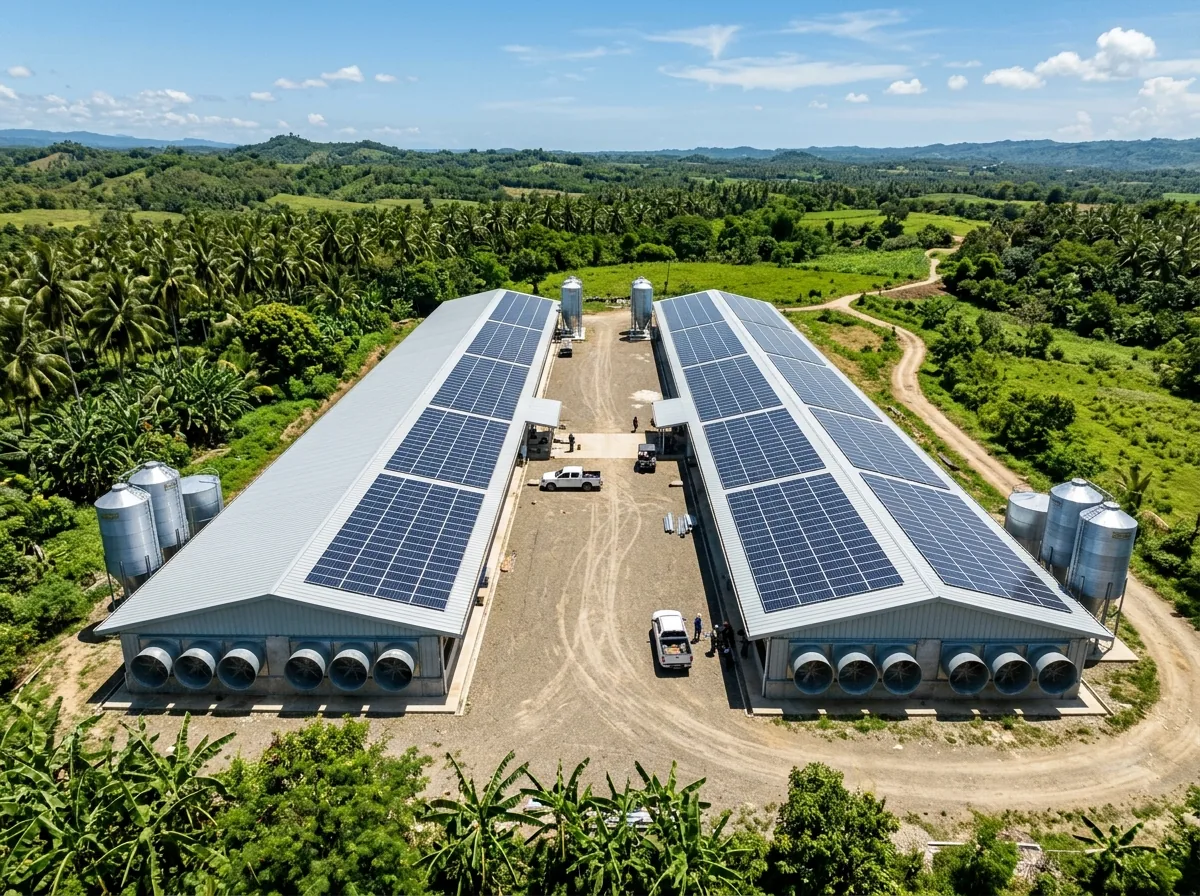
Tunnel-ventilated broiler houses, layer sheds, and hatcheries draw their heaviest power in the middle of the day when Cebu heat peaks and exhaust fans run at full speed. CebuSolar engineers three-phase commercial and hybrid solar systems for poultry growers across CEBECO I, II, and III, VECO, and MECO service areas.
- 50–500 kW+ 3-phase commercial arrays
- 3–5 yrs typical payback period
- Tier-1 620–630 W N-type bifacial
The problem
Why are electricity bills so high for poultry farms in Cebu?
Poultry farms across Cebu run heavy tunnel exhaust fans, evaporative cooling pads, water pumps, auger feed lines, and egg chillers continuously through the hottest midday hours. Because ventilation and pumping peak right alongside retail utility rates around ₱15–₱16 per kWh, electricity often ranks among a grower’s largest monthly operating expenses.
Walk into any tunnel-ventilated broiler house in Barili, Asturias, Balamban, Carcar, Dumanjug, Toledo, Sibonga, or northern poultry towns around Tuburan, Bogo, San Remigio, Medellin, and Daanbantayan at noon, and nearly every kilowatt on the farm meter is fighting ambient heat. As outside temperatures climb above 32°C, automated controllers stage on bank after bank of 50-inch exhaust fans, circulate groundwater across cooling pads, and run submersible borehole pumps to keep drinkers pressurized for tens of thousands of birds.
Layer farms, breeder houses, and hatcheries face an added round-the-clock burden from egg collection belts, grading machines, chick brooder controls, and refrigerated egg holding rooms. Even when night airflow drops slightly, daytime cooling still drives the bulk of monthly kilowatt-hour charges on CEBECO I, II, and III or VECO feeders—while sudden feeder brownouts force farms onto costly standby diesel generators within seconds to prevent heat stress and flock losses.
- 50-inch tunnel exhaust fans running hardest during peak midday heat
- Evaporative cooling-pad circulation pumps and high-pressure fogging lines
- Automated pan-feeder augers, silo conveyors, and layer egg-belt motors
- Deep-well drinking water pumping, biosecurity sprayers, and washdown pressure pumps
- Heat-stress mortality risk and instant diesel burn whenever provincial feeders drop
How solar helps
How does solar power work for a Cebu poultry farm?
Solar matches poultry energy demand naturally because sunshine peaks at the exact midday hours when tunnel fans and cooling pads draw maximum power. CebuSolar pairs Tier-1 620–630 W N-type bifacial panels with Solis three-phase inverters, optional LiFePO4 battery banks, and elevated-tank solar pumping built for Cebu farms.
Three-phase grid-tied solar for daytime ventilation
For commercial broiler houses and layer sheds connected to stable CEBECO or VECO three-phase lines with an existing standby generator, grid-tied solar delivers the lowest cost per watt. Solis three-phase string inverters feed exhaust fans, augers, and feed mixers directly from rooftop or ground arrays with automated zero-export control, cutting daytime utility draw without battery expense.
Hybrid solar with LiFePO4 backup for critical loads
Breeder houses, hatcheries, egg cold rooms, and isolated provincial feeders cannot tolerate a single missed transfer. Hybrid solar systems add Dyness or Pylontech LiFePO4 battery storage to keep lighting, controllers, water pumps, and critical ventilation stages running during brief outages, bridging the gap before a diesel genset even needs to start.
Solar water pumping for drinkers and washdowns
Water outages hit bird performance fast. Our solar water pumping systems use MPPT controllers to lift borehole or spring water by day into an elevated cistern or tank that feeds drinking lines and cooling pads by gravity day and night—or pairs with off-grid solar for remote upland grower sites.
System sizing
What size solar system does a poultry farm in Cebu need?
System sizing depends on the number of poultry houses, fan motor horsepower, daytime versus nighttime load split, and 12 months of utility billing. CebuSolar supplies fixed-price 6–18 kW hybrid packages for smaller farms and custom-engineered 50–500 kW+ three-phase plants for commercial growers after a site visit.
| Farm operation scale | Primary daytime loads | Suggested solar size | Architecture & pricing |
|---|---|---|---|
| Small layer shed, brooder, or farm office | Lighting, small drinkers, water pressure pump, egg room cooling, staff quarters | 6 kW to 18 kW Hybrid (10–32 panels, 6.2–19.84 kW solar) | Fixed packages: ₱305,000–₱970,000 (5–16 kWh battery, expandable 5–64 kWh) |
| 1–2 tunnel-ventilated broiler houses | Banked exhaust fans, cooling-pad pumps, auger feeders, deep-well pump | 50–100 kW three-phase | Rooftop or ground-mounted grid-tied or hybrid; custom quote after site visit |
| Multi-house contract grower or layer complex | Multiple tunnel sheds, egg grading, cold storage, biosecurity washdown pumps | 100–250 kW three-phase | Three-phase Solis array with zero-export & genset coordination; custom quote |
| Integrated poultry complex, hatchery & feed mill | High-load tunnel fans, incubators, hammer mills, pelletizers, cold rooms | 250–500 kW+ three-phase | Multi-inverter commercial plant + optional battery & solar water pumping; custom quote |
Estimates only. Your exact system size and one fixed price come after a site visit, with every part listed. Actual savings depend on system size, electricity consumption, location, and utility rates. Prices are subject to change without prior notice.
Cost and payback
How much does poultry farm solar cost in Cebu, and how fast does it pay back?
Commercial poultry solar plants from 50 kW to 500 kW+ are custom-quoted at one fixed price after a site audit, while smaller 6–18 kW hybrid packages range from ₱305,000 to ₱970,000. Across Cebu’s high power tariffs—around ₱15–₱16/kWh in October 2026—poultry farms typically see a 3 to 5 year payback.
Why do poultry houses reach that 3 to 5 year payback reliably? Because tunnel cooling and water pumping run hardest under bright midday sun, meaning nearly every solar kilowatt-hour produced goes directly into active farm motors rather than sitting unused. Against VECO’s published ₱15.30/kWh rate in October 2026 and comparable CEBECO provincial tariffs across Cebu, daytime self-consumption converts roof or idle yard space into immediate monthly operating savings.
Every CebuSolar installation uses bankable Tier-1 components chosen for agricultural durability: 620–630 W N-type bifacial panels from JinkoSolar, JA Solar, Trina Solar, LONGi, and AIKO; Solis inverters; Dyness or Pylontech LiFePO4 batteries; Schneider Electric and Suntree electrical protection; and stainless steel fixings built to resist coastal salt air from Bantayan to southern Cebu. You can model smaller bills on our CebuSolar ROI calculator or review package tiers on our solar cost guide.
- One fixed price after a site visit, with every panel, inverter, breaker, and cable itemized
- Clear three-stage payment: 40% on order, 40% on delivery and mounting, 20% on switch-on
- Tier-1 warranties: 5-year installation workmanship, 12-year Solis inverter, and 30-year panel performance (at least 87% output at year 30)
- Add-on flexibility for smaller hybrid sites: extra 620 W panels at ₱12,000 each and stackable 5 kWh (₱75,000), 10 kWh (₱140,000), or 16 kWh (₱160,000) batteries
- We assist with your LGU electrical permits and utility documentation
How it works
How does CebuSolar install solar around live flocks and farm biosecurity?
Our Cebu City installation crew follows strict farm biosecurity protocols and schedules roof and switchboard work around your grow-out calendar. Most mounting and conduit runs happen outside the sheds, keeping final electrical tie-in brief so tunnel ventilation stays safe.
Farm site visit
Our system designers review 12 months of CEBECO or VECO bills, measure shed purlin spacing or open ground-mount space, check transformer and genset transfer panels, and map daytime fan amp draws.
Engineering design & fixed quote
We size strings around your daytime cooling load, specify Tier-1 hardware and zero-export or hybrid controls, help with permit paperwork, and deliver one fixed itemized contract price.
Biosecurity-safe installation
Our crew complies with wheel-bath and footbath disinfection rules, times roof work between grow-out cycles where preferred, and keeps electrical tie-in brief so fans stay protected.
Warranty & Cebu service
After switch-on, your system is backed by our local Cebu warranty and a team in Cebu City that aims to reach Metro Cebu sites within 48 hours with spare parts in stock.
What do Cebu poultry farm owners ask before switching to solar?
Before committing to solar, Cebu broiler growers, layer operators, and farm engineers usually want to know how it works with standby diesel generators, poultry house roofs, corrosive coastal air, strict biosecurity schedules, and local LGU permitting across VECO, MECO, and CEBECO I, II, and III franchise areas.
Can solar work alongside our standby diesel generator during CEBECO or VECO brownouts?
Yes. On poultry farms with large standby diesel generators, we either wire grid-tied inverters upstream of your automatic transfer switch or integrate a controller that coordinates solar generation with generator load so your genset runs safely without reverse-power trips. If you need silent backup for hatcheries, controllers, or critical fan banks without waiting for a genset warm-up, a hybrid system with LiFePO4 batteries switches over automatically during grid drops.
Should we install panels on tunnel-house roofs or on ground-mounted frames?
Both work well depending on your shed structure and yard layout. Long, wide poultry house roofs often provide abundant unshaded space—and rooftop panels even shade the metal roofing slightly, helping reduce radiant heat above the ceiling. Where older timber trusses cannot take extra weight, or where sheds sit near tall coconut trees, CebuSolar designs ground-mounted three-phase arrays on open farm margins clear of feed-truck lanes.
How do Tier-1 panels and brackets hold up to poultry dust, ammonia, and coastal salt air?
Coastal Cebu farms—including exposed sites near Bantayan, Daanbantayan, Barili, and Carcar—face salt mist alongside feed dust and exhaust-fan discharge. We install Tier-1 620–630 W N-type bifacial double-glass modules from JinkoSolar, JA Solar, Trina Solar, LONGi, and AIKO with stainless steel fixings specifically chosen for salt air, and position inverters inside clean, shaded electrical rooms away from direct exhaust-fan plumes. Periodic panel rinsing keeps output strong through dry harvest months.
Can CebuSolar install during the clean-out window between broiler batches?
Yes. We can coordinate mobilization with your farm manager so roof rail mounting and cable tray runs happen during harvest-to-chick clean-out days, minimizing foot traffic while birds are housed. Even on multi-house layer complexes where sheds stay populated year-round, our crew follows your farm’s sanitation rules, works purely on exterior roofs and utility rooms, and keeps switchboard tie-in scheduled during cool morning hours.
Does CebuSolar help with permits and zero-export setup for poultry farms?
Yes—we help with your permits, preparing the technical documentation, single-line electrical diagrams, and equipment specifications required for local LGU electrical permits and VECO, MECO, or CEBECO zero-export compliance. With zero-export current transformers regulating inverter output in real time, your farm consumes its daytime solar harvest directly on-site to power tunnel fans, augers, and water pumps without exporting back to the distribution feeder.
Does one- or two-week harvest clean-out downtime between flocks ruin solar payback?
No—evaluating full 12-month CEBECO or VECO utility invoices captures realistic downtime gaps inside CebuSolar’s conservative 3–5 year ROI window, without relying on idealized zero-break math.
What if older timber or corroded poultry shed roofs cannot bear rooftop solar panels?
Idle fenced farm pasture right beside sheds or washdown lanes houses engineered ground-mount solar arrays safely with near-zero structural burden on old sheds.
Can office quarters and chick cold-storage vaccine rooms get backup batteries while fans stay grid-tied?
Yes—high-draw tunnel exhaust houses run cost-effective 3-phase grid-tied solar alongside your ATS genset, while admin offices and vaccine fridges add compact 6–10 kW hybrid LiFePO4 packages.
Get your personalized solar quote
Tell us about your place, pin it on the map and add a photo of your bill. Our team replies on Viber within one business day.
- 1. We size your system from your bill and map your roof by satellite.
- 2. You get your quote: panels, battery, monthly savings, payback and price.
- 3. Happy with it? We check your roof and wiring on site, then lock in one fixed price.