- Home
- Ground-mount solar
System type · Ground-mounted PV
Ground-Mount Solar in Cebu. Put idle land to work powering your operation.
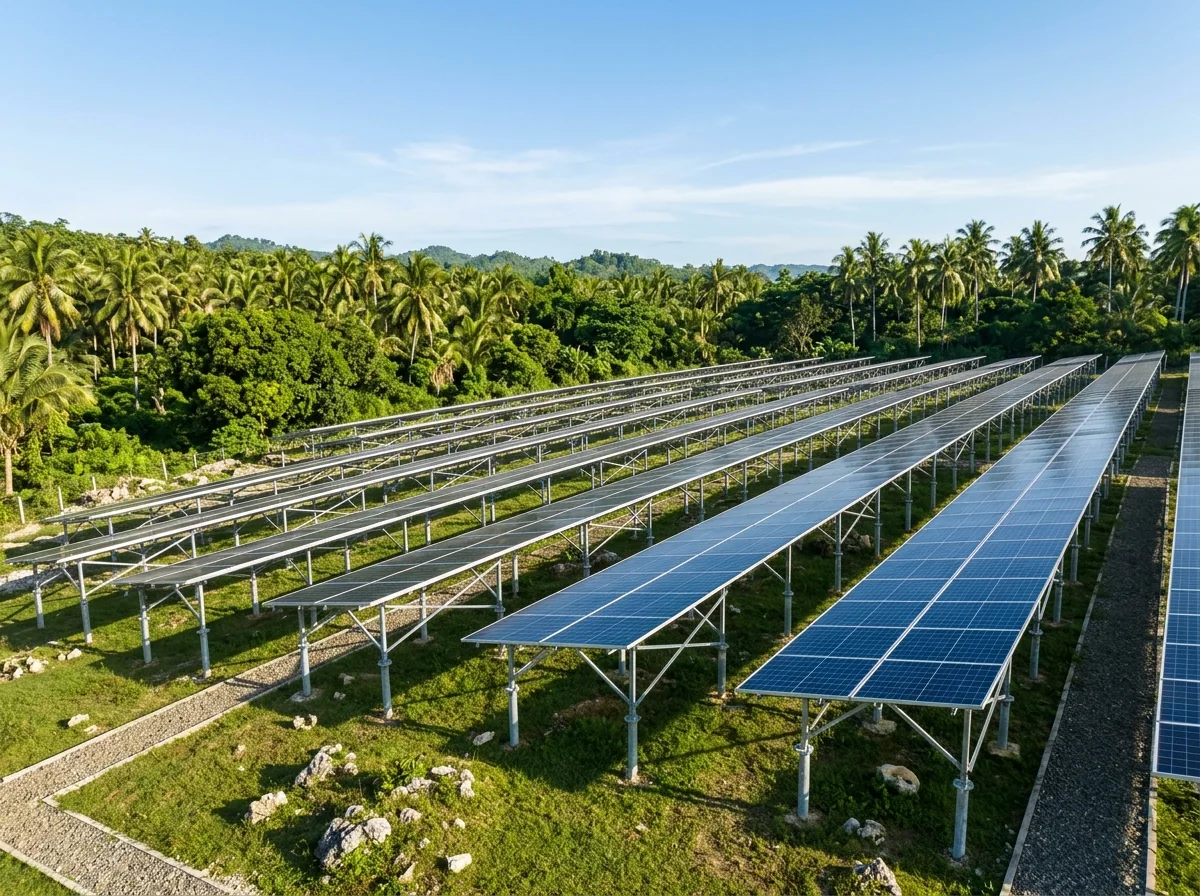
When aging factory roofs cannot carry structural loads, tree lines shade low bungalows, or electricity demand outstrips every square meter of warehouse iron, engineered ground-mounted arrays harvest pure unobstructed sunshine across open Cebu land at optimum tilt toward the sun.
- 50–500 kW+ commercial ground arrays
- Zero roof load safe for older buildings
- Easy access ground-level cleaning
Why ground-mount
When does ground-mounted solar outperform rooftop installation in Cebu?
Across Cebu’s ports, quarries, livestock estates, and legacy industrial yards paying VECO (~₱15.30/kWh, October 2026) or CEBECO (~₱15.08–₱15.91/kWh, September 2026), weak trusses, tree shade, or small roofs often block heavy commercial accounts from reaching 3–5 year payback—engineered open-land ground racking can unlock it.
Not every site owns a fresh wide-span steel warehouse roof capable of holding extra dead load and wind uplift. Heritage resort estates carry multi-gable ceramic roofs shaded by tall coconuts; light agricultural sheds use thin timber or undersized C-purlins; high-consumption feed mills, ice plants, and crushing yards burn vastly more daytime kilowatts than their office roof area can physically accommodate. Ground-mounted systems bypass roof limits entirely, anchoring straight into limestone or compacted clay at the ideal south-facing azimuth with crisp underside airflow cooling panels naturally.
CebuSolar pairs hot-dip galvanized or structural aluminum ground structures with Tier-1 620–630 W N-type bifacial modules—letting reflected sun off pale crushed gravel or limestone harvest extra rear-side generation—alongside Solis inverters and Schneider protection.
- Ideal tilt and south azimuth regardless of crooked building orientation or pitched roofs
- Bifacial panel undersides capture natural ground light reflection for stronger output
- Ground-height rows clean quickly with simple hose rinsing—zero ladder or harness risk
- Zero roof penetrations preserving waterproof membranes or fragile asbestos/tile roofs
Compare mounting options
Rooftop array vs. ground-mount rack vs. solar carport in Cebu
Three-phase factories, quarry crushers, beach resorts with guest parking, and sprawling poultry estates across Cebu have three proven structural methods to deploy Tier-1 solar hardware—picking the right mounting frame protects existing roof integrity, truck drive aisles, ground clearance, and future cleaning maintenance budgets across decades of sun.
| Feature | Ground-Mount Array | Standard Rooftop Array | Solar Carport Canopy |
|---|---|---|---|
| Best Cebu properties | Quarries, farms, reserves, idle lots | Factories, cold stores, malls, homes | Offices, hospitals, malls, resorts |
| Structural roof stress | None—independent soil piles | Uses existing roof purlins & trusses | None—independent steel columns |
| Bifacial backside yield | Strong over pale rock or grass | Limited close to metal sheeting | Good high-clearance reflected gain |
| Panel washing access | Ground-level hose & brush | Requires ladder & roof safety lines | Overhead frame clearance needed |
| Foundation requirement | Concrete piers or helical piles | L-feet / clamp brackets into purlins | Deep reinforced concrete pedestals |
Both commercial ground-mount and carport installations engineer around local Cebu soil profiles and typhoon exposure, integrating with commercial EPC plants or grid-tied daytime offset.
Engineering details
Four steps from barren backlot to a working Cebu ground-mount array
Soil composition across Metro Cebu reclamation lots, Toledo western cliffs, northern limestone pastures, and southern agricultural valleys shifts dramatically plot by plot—every ground-mount array follows a disciplined four-step site geotechnical, trenching, and electrical engineering workflow before a single cable trench opens or galvanized steel foundation post enters earth.
Step 1 · Land & shade check
Sun path & flood elevation
We inspect drainage contours, seasonal storm runoff lines, adjacent tree shade, and trench distance back to your main distribution switchgear.
Step 2 · Foundation spec
Concrete piers or driven piles
Match soil pull-out strength—using cast-in-place concrete footings over soft agricultural topsoil or galvanized driven/anchored steel over Cebu limestone.
Step 3 · Steel rack & trenching
Typhoon bracing & armored conduit
Erect hot-dip galvanized cross-braced tables elevated above grass trimming height, routing underground armored DC/AC conduits straight to weatherproof combiner walls.
Step 4 · Commission & fence
Protection, grounding & handover
Bond every rack frame to dedicated copper earth rods, test Schneider breakers and Solis telemetry, and advise simple perimeter fencing against grazing livestock.
Permits & protection
How does CebuSolar design foundations, trenching, and safety across Cebu lots?
Deploying field crews directly from our Cebu City office at Mclin Building, Corner T. Padilla St. and M.J. Cuenco Ave., our installers survey open land lots completely free, specify soil-matched concrete piers or piles, assist with municipal permits, and deliver protected hardware backed by our warranties.
Ground arrays sit at human reach, making clean mechanical wireways, lockable DC disconnect boxes, lightning earth bonding, and rugged trench protection essential. Explore pairing open land arrays with deep-well farm pumps, battery storage, or fixed package sizes.
- Elevated rail bottom clearance avoids splashed monsoon mud and keeps grass mowing clean
- Lockable weatherproof Solis inverter shelters and labeled Schneider DC/AC isolators
- 5-year workmanship, 12-year inverter, and 30-year panel warranties (at least 87% output at year 30)
- We assist with municipal LGU electrical/building permits and VECO/MECO/CEBECO compliance
Questions Cebu landowners and plant managers ask about ground-mount solar
Plant engineers, poultry integrators, quarry operators, and rural estate owners frequently ask how much cleared lot footprint a commercial array needs, whether rocky Cebu limestone slows piling down, how longer trench runs affect cable sizing and losses, and how municipal LGU structural permit assistance flows ahead of build.
How much open lot space does a ground-mount solar array need compared to a roof?
Ground rows need spacing between front and rear tables so the first row never casts morning or winter solstice shadows onto the second row—meaning ground installations use slightly more total footprint per kilowatt than flush metal roofs.
Can ground-mount solar work over uneven farmland or rocky limestone hills in Cebu?
Yes—adjustable steel piers step across gentle slopes and anchor securely into hard Cebu coralline limestone with concrete footings where deep pile driving meets rock refusal.
Is a ground-mount array more expensive than mounting on an existing factory roof?
Foundation civil works, steel posts, bracing struts, and underground AC/DC cabling add civil scope compared to flush roof clamps—yet unlock zero roof stress, optimal tilt, easier washing, and often allow building the full 50–500 kW+ capacity your meter truly requires.
Can a farm start with an agricultural water pump array and add buildings later?
Yes—many rural sites place an elevated steel array beside their well first for solar water pumping, leaving adjoining cleared space to extend parallel rows into a farmhouse off-grid or hybrid bank later.
Does CebuSolar help with LGU building and electrical permits for ground arrays?
Yes—because ground-mounted steel frames count as outdoor structures, we assist with permits by supplying electrical single-line diagrams, layout drawings, and Tier-1 datasheets alongside our Warranty commitments.
How much more does structural steel ground-mount add compared against clean existing rooftops?
Pouring concrete pier foundations, erecting structural hot-dip galvanized/primed I-beams, trenching armored underground cables, and perimeter fencing naturally raises initial capital cost moderately compared against bolting directly onto existing sound warehouse purlins—yet avoids expensive warehouse re-roofing and still pays back briskly in 3–5 years when scaling 50–500 kW+ daytime operations (commercial cost factors).
Can a property place half its kW atop an office roof and add the rest over a gravel parking canopy?
Yes—modern multi-MPPT Solis inverters track differing tilt strings side by side, letting cramped urban factories squeeze every sunny square meter out of rooftops first before spilling remaining capacity across steel parking aprons.
Do tropical weeds climbing under low rural ground mounts shade panels or pose grass-fire threats?
Yes if neglected completely on dirt pastures! CebuSolar can lay crushed limestone gravel under the rows or raise front module edges generously higher above ground level, keeping maintenance trimming trivial without shading lower panel cells (ground care checklist).
Choosing a solar system: what else should you read?
Types of Solar Systems in Cebu
Hybrid, grid-tied, off-grid, ground-mount or solar pumping? Compare costs, brownout backup and payback in Cebu to pick the system that suits you.
Hybrid vs Grid-Tied Solar in Cebu
Hybrid adds a battery for brownouts; grid-tied costs less and pays back faster. Compare price, backup and 3–5 yr payback to choose the right one in Cebu.
Off-Grid Solar for Bantayan, Camotes & North Cebu
Solar for Bantayan, Camotes, Daanbantayan, Bogo and Medellin resorts, farms and water pumps, with LiFePO4 hybrid and off-grid systems. Personalized quote.
Solar Battery Storage in Cebu
Add Dyness or Pylontech LiFePO4 batteries (5–64 kWh) in Cebu to store midday sun for evening use. Battery sizes, brands and add-on prices from ₱75,000.
Hybrid Solar in Cebu
Hybrid solar with a LiFePO4 battery keeps lights, fridge, Wi-Fi and aircon on through Cebu brownouts while cutting your bill. Packages from ₱305,000.
Grid-Tied Solar in Cebu
Grid-tied solar is the cheapest way to cut daytime bills in Cebu: no battery, Tier-1 panels, 3–5 yr payback. For offices, shops, clinics and homes.
Off-Grid Solar in Cebu
Off-grid solar with LiFePO4 storage for upland farms, remote villas, resorts and rural homes with weak or no grid power. Personalized quote.
Get your personalized solar quote
Tell us about your place, pin it on the map and add a photo of your bill. Our team replies on Viber within one business day.
- 1. We size your system from your bill and map your roof by satellite.
- 2. You get your quote: panels, battery, monthly savings, payback and price.
- 3. Happy with it? We check your roof and wiring on site, then lock in one fixed price.