- Home
- Barangay Water Systems
Solar for barangay water · Community pumping EPC
Solar for Barangay Water Systems in Cebu. Clean community water without diesel hassles.
Upland sitios, rural barangays, and community water cooperatives across Cebu struggle with expensive diesel pump hauling or steep CEBECO electric bills just to fill village reservoirs. CebuSolar designs solar submersible pumping systems paired with elevated gravity tank storage built for rural communities.
- Tank storage gravity supply day & night
- 3–5 yrs typical payback vs grid/fuel
- MPPT soft-start dry-well & float sensors
The problem
Why do rural Cebu barangay water associations struggle with diesel and power bills?
Community water committees and rural barangays face recurring cash shortfalls trying to pay CEBECO pumping bills around ₱15–₱16 per kWh or haul fuel drums up steep mountain trails for diesel engines. One mechanical breakdown or fuel price spike can leave dozens of households hauling buckets manually.
Across upland barangays in Tuburan, Balamban, Asturias, Barili, Dalaguete, Argao, Tabogon, Sogod and northern coastal sitios, spring or deep-well water often sits well below hilltop households. Extending power lines up steep ridges can be expensive, so many barangay water systems still rely on portable diesel or gasoline pumps.
Those fuel engines demand constant oil changes, belt replacements, and operator attendance every single morning—while grid-powered community pumps on long rural feeders suffer voltage sags that burn out submersible motors. Switching community boreholes onto dedicated solar pumping cuts daily fuel collections while keeping village reservoirs full automatically.
- Expensive diesel and gasoline hauling up rough barangay and sitio roads
- Recurring engine repairs, oil changes, and pump operator scheduling headaches
- Steep CEBECO monthly bills straining household water-association dues
- Grid voltage drops along remote rural lines damaging submersible pump windings
- Dry-season drawdown risks when wells lack automatic low-water protection
How solar helps
How does solar water pumping keep a barangay tank full without batteries?
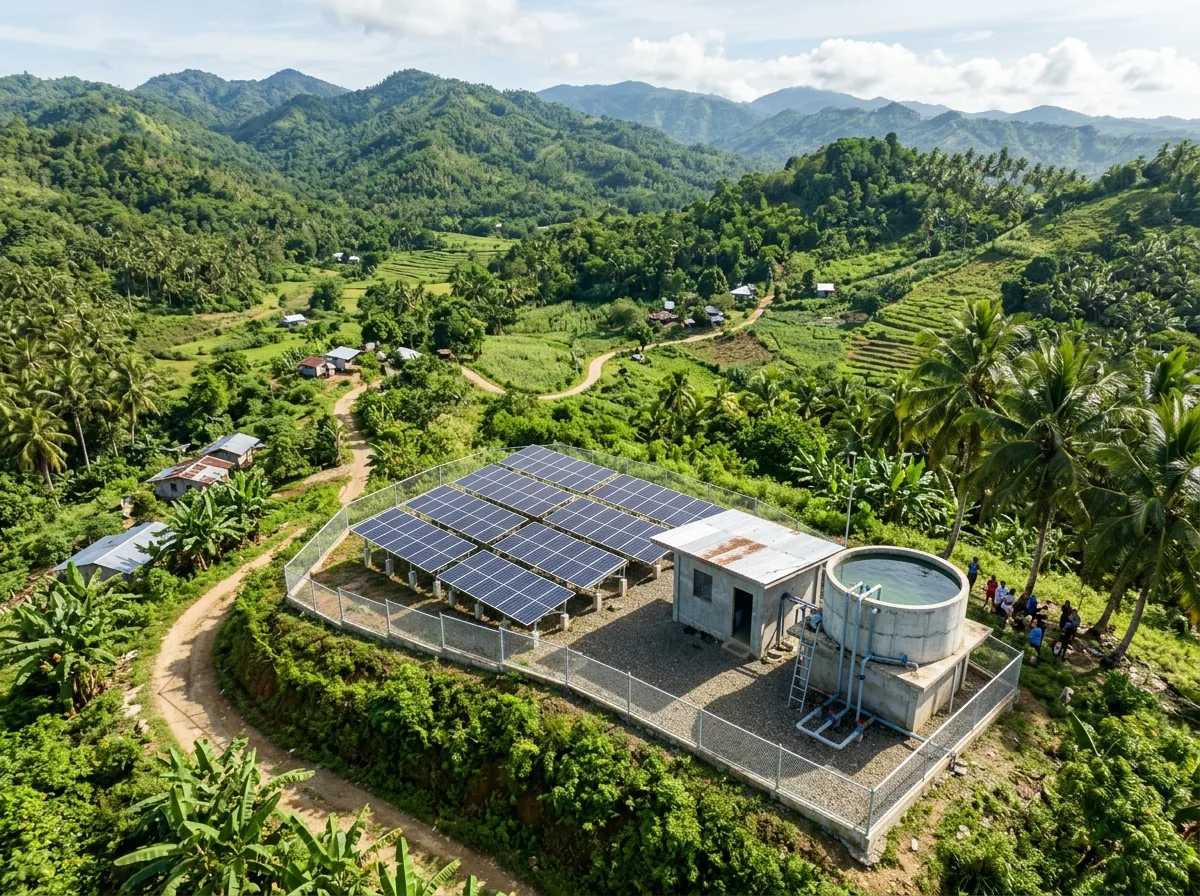
Instead of storing energy inside expensive battery banks that wear out over time, a solar barangay system stores pumped water directly in an elevated concrete or steel hilltop tank. MPPT solar pump controllers run stainless submersible impellers automatically from morning until tank float switches signal full.
Direct solar-to-tank submersible pumping
Dedicated solar water pumping systems drive brushless DC or three-phase AC borehole pumps directly from ground-mounted Tier-1 620–630 W solar panels. Water rises into elevated barangay reservoirs all day so households draw clean gravity-fed water day and night with zero battery expense.
AC/DC hybrid pumps for grid-backed barangays
Communities already connected to CEBECO or VECO lines—or keeping a small standby generator—can use an AC/DC hybrid pump controller. It runs on free daytime sunshine first and lets operators switch to grid or genset backup during extended rainy storm weeks.
Hybrid solar for community offices & chlorination hubs
Barangay halls, community clinics, evacuation centers and filtration kiosks can use hybrid solar with Dyness or Pylontech LiFePO4 batteries, or off-grid solar, to keep the lights, radios and dosing pumps you choose running during outages. We size the battery to those loads on site.
System sizing
What size solar pumping system does a Cebu sitio or barangay need?
Accurate community sizing depends on household count, daily cubic-meter target, borehole static depth and recovery yield, vertical elevation to the hilltop cistern, and HDPE pipeline friction. CebuSolar designs fixed hybrid packages for small pump kiosks and custom-sized solar pumping plants after a hydraulic survey.
| Community scale | Water source & delivery setup | Suggested solar solution | Pricing & architecture |
|---|---|---|---|
| Small sitio spring box or shallow-well tap | Surface or shallow submersible pump feeding shared barrio tank | Custom MPPT DC solar pump | Ground-mounted 620–630 W panels + dry-run & float sensors; custom quote |
| Barangay hall, water kiosk, or filtration shed | RO filtration pump, dosing unit, office lighting, emergency radio, fans | 6 kW to 18 kW Hybrid (10–32 panels, 6.2–19.84 kW solar) | Fixed packages: ₱305,000–₱970,000 (5–16 kWh battery, expandable 5–64 kWh) |
| Multi-sitio deep borehole & hilltop reservoir | Deep limestone borehole lifting water up to communal hilltop cistern | Custom MPPT AC/DC solar VFD pump | High-head stainless submersible + concrete-footed rack; custom quote |
| Large municipal or multi-barangay bulk supply | High-capacity three-phase boreholes and distribution booster pumps | 50–500 kW+ three-phase | Commercial solar array or solar pump cluster; custom quote after audit |
Estimates only. Well yield, vertical elevation lift, and one fixed itemized price are confirmed after a site visit. Actual savings depend on system size, electricity consumption, location, and utility rates. Prices are subject to change without prior notice.
Cost and payback
How much does a solar barangay water system cost in Cebu, and how fast does it pay back?
Dedicated community solar pumping builds and 50–500 kW+ municipal arrays receive one fixed custom quote after checking well depth and pipe distance, while 6–18 kW hybrid station packages cost ₱305,000 to ₱970,000. Replacing daily diesel fuel or Cebu utility bills near ₱15–₱16/kWh typically delivers 3 to 5 year payback.
For rural barangay councils, HOA boards, and LGU waterworks offices, predictable capital budgeting matters just as much as energy savings. Compared against VECO’s October 2026 rate of ₱15.30/kWh, provincial CEBECO schedules, or ongoing diesel engine repairs, shifting water pumping onto solar helps keep household water dues steady.
Rural Cebu hills test equipment hard, so CebuSolar builds with Tier-1 components: 620–630 W N-type bifacial panels from JinkoSolar, JA Solar, Trina Solar, LONGi, and AIKO, Solis inverters or dedicated solar pump controllers, Schneider Electric and Suntree protection breakers, and stainless steel fixings built for coastal air. Explore smaller package options on our pricing page or estimate electric pump savings on our ROI calculator.
- One fixed, itemized price ready for barangay council or cooperative budget review
- Clear three-stage payment schedule: 40% on order, 40% on delivery and mounting, 20% on switch-on
- Backed by 1-year workmanship, 12-year Solis inverter, and 30-year panel performance warranties (at least 87% output at year 30)
- Automatic dry-well borehole sensors and elevated tank float switches prevent pump burnouts
- We help with your municipal electrical permits and utility documentation
How it works
How does CebuSolar survey and commission a rural barangay water pump?
Our installation crew travels directly from Cebu City to rural mountain or coastal barangays to measure borehole water levels, pipe length, and hilltop tank elevation. We pour concrete ground-mount footings, secure tamper-resistant panels inside a fenced zone, and train barangay water tenders on simple operation.
Well & elevation survey
We measure static well level, borehole casing width, vertical elevation to your storage reservoir, and total HDPE or GI pipeline distance across the hillside.
Hydraulic match & fixed quote
We calculate exact total dynamic head, match the stainless submersible pump and Tier-1 panel array, help with LGU paperwork, and issue one fixed turnkey price.
Secure rural installation
Concrete-anchored steel frames go up with lockable controller enclosures and float switches, completing commissioning in full view of community leaders.
Warranty & Cebu spares
Your barangay water committee receives full maintenance training backed by our Cebu warranty, locally stocked spare parts, and a 48-hour Metro Cebu response target.
What do barangay captains and water committees ask before choosing solar pumping?
Barangay officials, LGU engineers, and community water cooperatives across Tuburan, Barili, Dalaguete, Tabogon, and Bogo often ask about lifting water up steep hills, upgrading existing diesel or AC wells, storm protection, theft prevention, and council procurement documentation before moving ahead.
How high can a solar submersible pump lift water up a Cebu hillside?
Solar pumps can lift water from deep wells and up steep hillsides. How high depends on the pump, the pipe size and the total height and distance, so we measure the well and the route to the tank during the survey and size the pump and panels to match.
Can we upgrade an existing barangay electric borehole pump to run on solar?
Often yes. If your cooperative already operates a healthy three-phase AC submersible pump inside the borehole, our installers can wire it through a solar variable-frequency pump inverter powered by ground-mounted panels—letting your community avoid pulling well pipes while adding solar savings immediately.
How do panels and controllers stay safe from theft and typhoons on isolated hillsides?
CebuSolar anchors ground racks in poured concrete footings inside your fenced compound, secures panels using tamper-resistant stainless fasteners, houses MPPT controllers inside lockable weatherproof steel cabinets, and clears brush around array perimeters.
Does a barangay water system need batteries to provide drinking water at night?
No—unless powering a purification kiosk or office at night. For pure water pumping, an elevated concrete cistern or tank acts as your battery, sized to hold a reserve pumped during the day so taps flow by gravity after sunset.
Can CebuSolar supply itemized specifications for LGU or cooperative funding approval?
Yes—we deliver one fixed, fully itemized proposal listing panel models, pump specifications, controller protections, wiring, and warranty terms, and we assist with your municipal electrical permits or CEBECO paperwork where grid hybrid controllers apply.
Get your personalized solar quote
Tell us about your place, pin it on the map and add a photo of your bill. Our team replies on Viber within one business day.
- 1. We size your system from your bill and map your roof by satellite.
- 2. You get your quote: panels, battery, monthly savings, payback and price.
- 3. Happy with it? We check your roof and wiring on site, then lock in one fixed price.