- Home
- Telecom Towers
Solar for telecom towers · Remote & hybrid power EPC
Solar for Telecom Towers & Cell Sites in Cebu. Cut genset refueling, stay on the air.
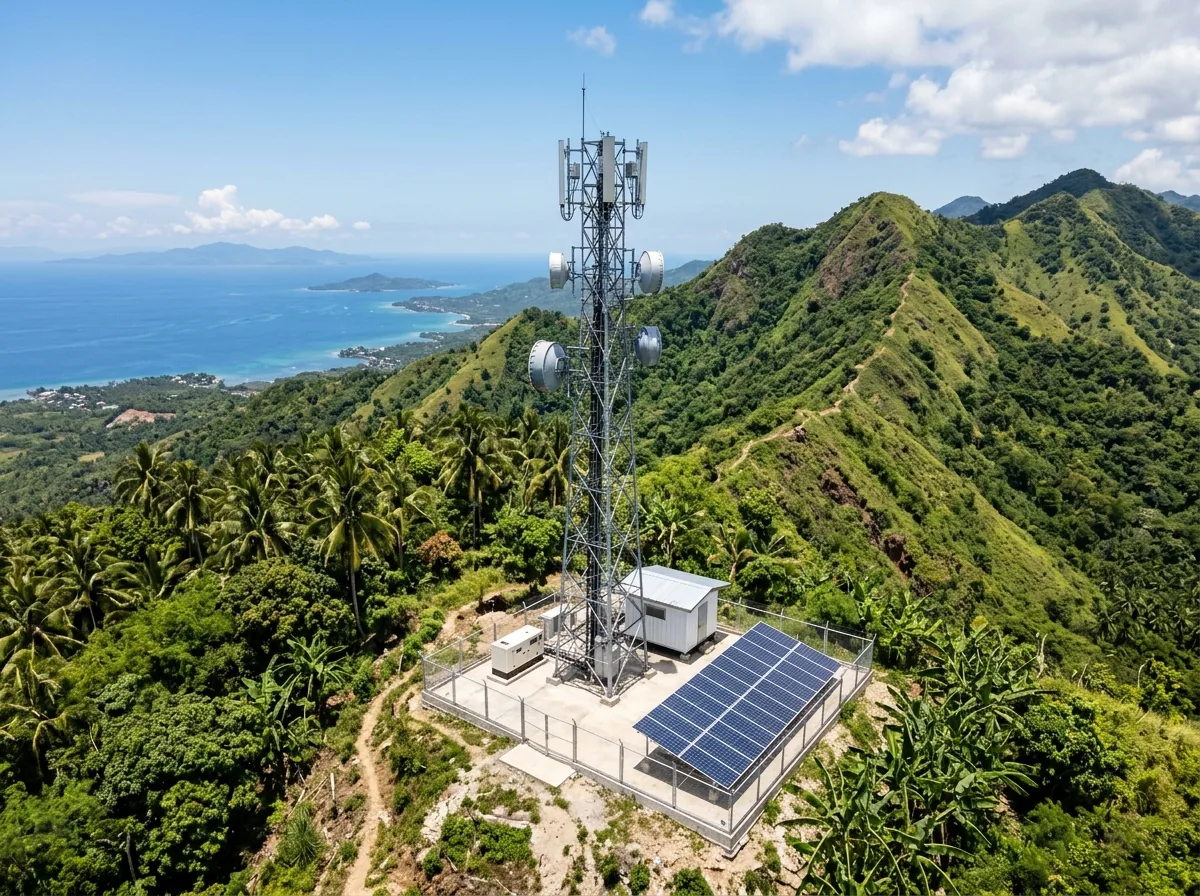
Cellular base stations, microwave repeaters, and fiber hub shelters burn heavy diesel fuel or steep CEBECO and VECO tariffs powering 24/7 radio equipment and shelter cooling. CebuSolar builds hybrid solar with LiFePO4 storage and off-grid tower power arrays across Cebu mountains and coasts.
- 6–500 kW+ shelter & hub scale
- 3–5 yrs typical payback period
- LiFePO4 5–64 kWh backup banks
The problem
Why are cell-site power bills and genset hauling costs so high in Cebu?
Telecom towers operate continuous base transceiver racks, rectifier shelves, microwave links, tower aviation beacons, and shelter air-conditioning around the clock. Grid-connected sites pay high Cebu tariffs near ₱15–₱16 per kWh, while rural ridge and coastal towers burn costly hauled diesel whenever feeders fail.
Look across Cebu’s mountain relay ridges above Transcentral Highway, Balamban, Dalaguete, and Toledo, or coastal relay compounds serving Bantayan, Daanbantayan, Moalboal, and Oslob, and power continuity dictates network uptime. Every multi-hour CEBECO or VECO brownout discharges lead-acid telecom rectifier banks rapidly, forcing diesel generators to run for hours while shelter temperatures climb under intense afternoon heat.
Hauling fuel drums up steep barangay tracks, maintaining remote generator engines, and replacing heat-degraded VRLA batteries add up to large maintenance costs. Adding compact solar arrays with long-life LiFePO4 storage cuts daytime grid use and generator hours at both grid-tied and off-grid sites.
- 24/7 radio base-band units, tower-mounted amplifiers, and microwave dishes
- Shelter air-conditioning and DC heat-exchanger cooling fans fighting midday sun
- AC-to-DC rectifier shelves recharging site backup battery banks after outages
- Costly diesel generator fuel delivery up steep Cebu mountain access roads
- Frequent replacement of heat-stressed lead-acid batteries at remote compounds
How solar helps
How does solar power integrate with Cebu telecom towers and shelters?
Compact tower compounds pair ground-mounted steel frames and shelter roofs with Solis inverters and modular Dyness or Pylontech LiFePO4 batteries, powering shelter cooling and radios straight from sunshine by day. That slashes daytime utility usage and minimizes standby diesel runtime during brownouts.
Hybrid solar with LiFePO4 banks for brownout-prone towers
Rural CEBECO towers and rooftop urban repeater nodes benefit immediately from hybrid solar with LiFePO4 battery backup. Solar carries shelter aircons and rectifiers through bright afternoon hours while charging modular 5–64 kWh lithium banks, cutting emergency genset runtime during grid drops.
Off-grid solar for mountaintop & island relay pads
Towers standing beyond distribution poles replace continuous diesel engine operation with engineered off-grid solar paired with deep-cycle LiFePO4 storage and a standby generator for long cloudy spells, cutting fuel trips up rough upland roads.
Grid-tied arrays for urban telecom switching hubs
Regional fiber POPs, data aggregation shelters, and telco engineering offices on stable Metro Cebu three-phase feeders capture rapid payback via grid-tied commercial solar wired straight into main distribution panels alongside three-phase switchgear.
System sizing
What size solar array does a Cebu cell site or switching hub need?
Telecom sizing matches shelter continuous kilowatt draw, cooling tonnage, fenced ground-mount clearance around guy wires or tower footings, and desired outage autonomy. CebuSolar offers fixed 6–18 kW hybrid packages for standalone cell pads and custom 50–500 kW+ three-phase installations for major regional switching hubs.
| Site classification | Primary continuous loads | Suggested solar capacity | Configuration & pricing |
|---|---|---|---|
| Single-carrier cell pad or rural microwave relay | BTS radio rack, microwave links, shelter cooling, beacon light | 6 kW to 12 kW Hybrid (10–22 panels, 6.2–13.64 kW solar) | Fixed packages: ₱305,000–₱640,000 (5–16 kWh battery, expandable 5–64 kWh) |
| Multi-tenant co-located tower compound | Multiple carrier shelters, higher HVAC load, rectifier battery banks | 16 kW to 18 kW Hybrid (28–32 panels, 17.36–19.84 kW solar) | Fixed packages: ₱795,000–₱970,000 (5–16 kWh battery, expandable 5–64 kWh) |
| Regional fiber POP or district switching shelter | Precision cooling racks, core routers, DC power plant, office annex | 50–150 kW three-phase | Elevated ground rack or rooftop array with zero-export; custom quote |
| Major telecom operations center & data hub | Redundant chiller plants, large UPS arrays, network NOC floor | 150–500 kW+ three-phase | Multi-inverter commercial plant + genset coordination; custom quote |
Estimates only. Site-specific wind-zone framing, load profile, and one fixed itemized price follow a site survey. Actual savings depend on system size, electricity consumption, location, and utility rates. Prices are subject to change without prior notice.
Cost and payback
How much does cell-site solar cost in Cebu, and how fast does it recover investment?
Standardized 6–18 kW hybrid systems with LiFePO4 backup cost ₱305,000 to ₱970,000 fixed, while 50–500 kW+ telco hub plants and custom remote off-grid builds are quoted at one fixed price after inspection. Compared against October 2026 Cebu power rates near ₱15–₱16/kWh and diesel hauling, payback typically runs 3 to 5 years.
High-altitude ridges and remote coastal sites amplify savings quickly because every solar kilowatt-hour produced inside the fence eliminates either retail utility power—benchmarked against VECO’s October 2026 rate of ₱15.30/kWh—or expensive fuel deliveries plus engine oil service trips. Lowering generator runtime hours also extends mechanical engine service intervals across multi-site tower portfolios.
Exposed towers demand rugged hardware, so CebuSolar specifies Tier-1 620–630 W N-type bifacial panels from JinkoSolar, JA Solar, Trina Solar, LONGi, and AIKO with Solis inverters, Dyness or Pylontech LiFePO4 batteries, Schneider Electric and Suntree protection breakers, and stainless steel fixings. Compare battery sizes via our cost breakdown or model grid savings on our ROI calculator.
- One fixed turnkey contract price after site survey—no surprise mobilization or breaker fees
- Structured payment stages: 40% on order, 40% on delivery and mounting, 20% on switch-on
- Backed by 1-year workmanship, 12-year inverter, and 30-year panel performance warranties (at least 87% output at year 30)
- Scalable 6–18 kW backup: add 620 W panels at ₱12,000 each or stack 5 kWh (₱75,000), 10 kWh (₱140,000), or 16 kWh (₱160,000) batteries
- We help with your municipal electrical permits and utility documentation
How it works
How does CebuSolar build on active telecom compounds without dropping signal?
Our Cebu City installers coordinate pad access with field security teams, pour concrete footings or bolt shelter mounts clear of RF dishes, and wire new solar switchboards alongside existing ATS panels. The changeover is planned with your team to keep downtime to a minimum.
Site survey & shade check
We inspect tower shadow paths, compound perimeter space, grounding busbars, and 12 months of CEBECO, VECO, or MECO utility bills or diesel logs.
RF-safe layout & fixed quote
We keep panels strictly below antenna azimuth beams, specify stainless coastal hardware and Schneider protection, assist with permits, and commit to one fixed price.
Secure compound build
Ground racks or shelter frames install with tamper-resistant fasteners and lockable conduit, completing electrical tie-in on a pre-cleared schedule.
Warranty & Cebu spares
Each site is protected by our Cebu warranty backed by locally stocked spare parts and a Metro Cebu response target within 48 hours.
What do Cebu tower engineers and telecom contractors ask before deploying solar?
Tower infrastructure managers, field power engineers, and co-location operators across Metro Cebu, Transcentral ridges, and coastal towns often ask about tight compound footprints, wind-exposed hilltop mounts, generator auto-start compatibility, grounding against lightning, and local municipal permitting before greenlighting site rollouts.
Can solar arrays fit inside small fenced cell-site compounds without blocking maintenance?
Yes. High-wattage 620–630 W N-type bifacial modules fit substantial capacity into tight footprints—and mounting arrays on elevated structural steel canopies over equipment shelters, concrete pad margins, or generator enclosures preserves full walk-around access for tower riggers and rectifier technicians.
How does a hybrid telecom solar array work with an existing standby diesel generator?
Solis hybrid inverters can be set up to start and stop a generator, so solar and LiFePO4 batteries carry the daily load and the generator runs only when the battery runs low. We confirm this with your generator model during the survey.
How are solar panels protected against mountain ridges, salt air, and theft at unmanned towers?
Exposed sites across Cebu ridges and coastlines require stainless steel fixings for salt air, rigid concrete pier anchors or shelter bolt-downs, tamper-resistant security bolts, and weather-sealed conduit wired straight into your existing alarm and site-security enclosure.
Can a single solar template roll out across multiple tower sites in Cebu?
Yes. Tower owners can standardize on repeatable 6–18 kW modular builds across similar radio shelter types while tuning racking height and shading clearance individually during each site’s physical survey.
Does CebuSolar help with LGU electrical permits for rural or hilltop telecom sites?
Yes. We help with your LGU electrical permit by preparing the electrical plans and Tier-1 datasheets, and assist with VECO, MECO or CEBECO zero-export paperwork.
Get your personalized solar quote
Tell us about your place, pin it on the map and add a photo of your bill. Our team replies on Viber within one business day.
- 1. We size your system from your bill and map your roof by satellite.
- 2. You get your quote: panels, battery, monthly savings, payback and price.
- 3. Happy with it? We check your roof and wiring on site, then lock in one fixed price.