- Home
- Woodworking & Sawmills
Lumber & millwork · Metro & provincial timber yards
Solar for Woodworking & Sawmills in Cebu. Power band saws, moulders, and kilns.
Industrial sawmills, kiln-dried lumber depots, pallet builders, and architectural joinery workshops across Mandaue, Liloan, Consolacion, Talisay, and Naga operate heavy daytime 3-phase planers, resaws, and vacuum cyclones under ~₱15–₱16/kWh utility rates—reaching 3–5 yr ROI via commercial and grid-tied solar.
- 12–500 kW+ joineries to full sawmills
- 3–5 yrs typical capex payback
- Inverters indoors away from sawdust
The energy squeeze
Why are resaws, planers, and dust collectors driving Cebu timber costs higher?
Timber resellers, crate fabricators, molding suppliers, and kiln-drying depots operate strictly during bright daytime 7:30 AM–5:00 PM hours when wood-cutting saws, hydraulic presses, and 30-HP cyclone vacuum fans simultaneously drive steep utility kW charges while wholesale lumber spreads remain razor-thin across Cebu yards.
Inside a working sawmill or door-and-jamb millwork shop, electrical load surges soon after the morning bell: vertical breakdown band saws slice dense hardwood flitches, four-side thickness planers and gang rip-saws run relentlessly feeding pallet assemblies, CNC dovetailers and hot veneer presses cycle nonstop, and massive baghouse dust-extraction blowers pull steady baseline amperage every single minute saws stay spinning. Meanwhile, timber kiln chambers spin high-volume reversible circulation fans continuously keeping moisture percentages even across drying charges.
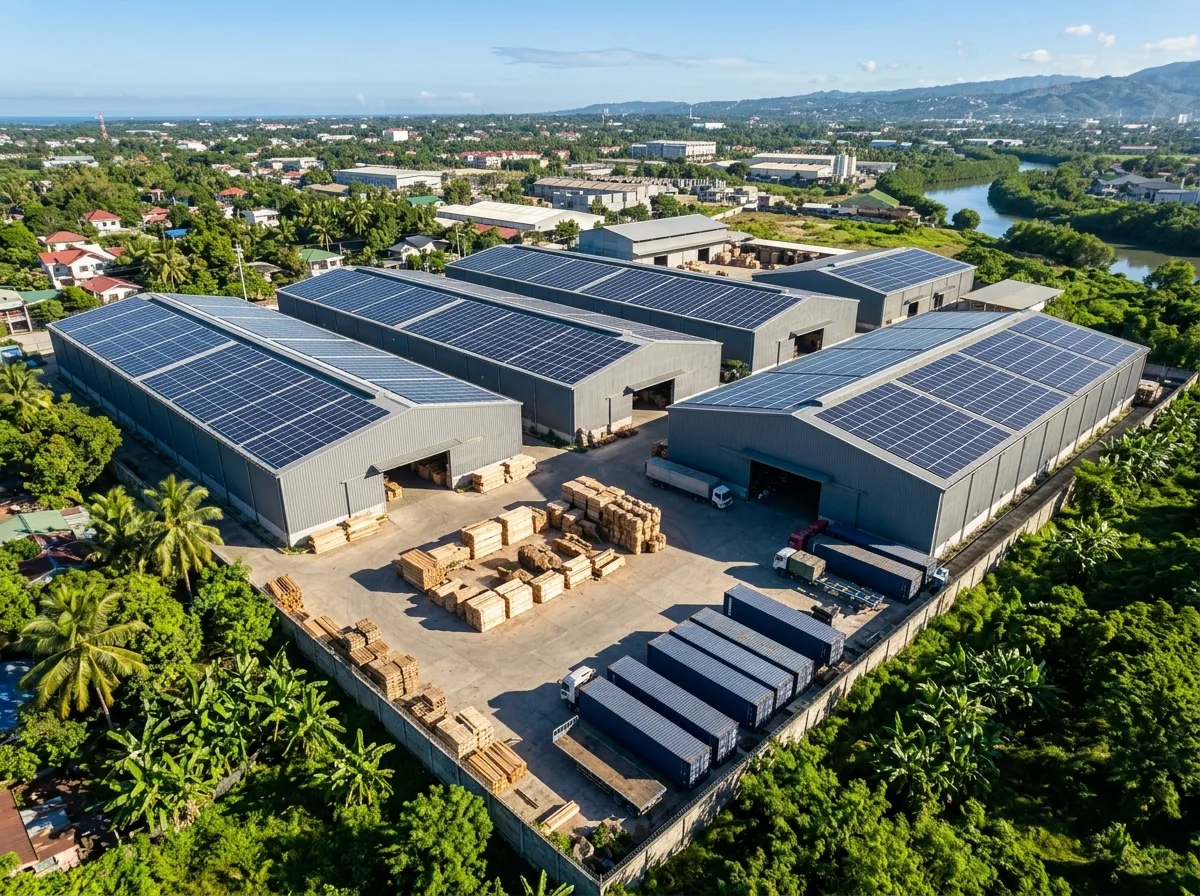
Because timber sheds boast vast low-pitch GI warehouse roofs baked all day in direct Visayan sun, leaving roofs barren literally throws away kilowatt-hours matching every running blade.
- Horizontal/vertical log breakdown band saws & automated gang rip-saws
- Four-head spindle moulders, thickness planers & heavy joinery routers
- High-static baghouse cyclone blowers & centralized shop dust extractors
- Timber drying kiln reversible air-circulation fans & hydraulic veneer presses
- Spray-booth exhaust hoods, air compressors & yard fork-truck chargers
Sawmill safety engineering
How do solar panels operate and safely over sawdust-rich timber bays?
Woodworking electricity demands careful dust hygiene: we route zero bare electrical junctions inside sawdust bays, install Solis three-phase inverters solely inside masonry office rooms separated from mill sheds, and place tilted wash-friendly arrays upwind of cyclone stacks.
Strict dust-zone inverter isolation
Solis commercial inverters and Schneider breakers sit strictly behind solid walls inside closed air-conditioned office/breaker rooms connected via sealed steel EMT conduit, keeping fine wood dust away from the inverters’ cooling fans.
Exact daytime shift self-consumption
Sawmills practically mirror Cebu sunshine curves—starting saws around 8 AM and locking gates before dusk—letting lean battery-free zero-export grid-tie arrays soak nearly every generated solar watt internally without expensive bank costs.
Targeted kiln-controller & CNC hybrid protection
While giant band saws draw steady grid power, putting CNC router servos, boiler stoker controls, and timber kiln damper relays onto compact LiFePO4 battery subpanels saves precious router bits from mid-cut grid drops.
Capacity sizing
What solar kW capacity fits a pallet workshop vs. a kiln-dried timber complex?
CebuSolar audits three-phase main switchboard load curves alongside open lumber drying sheds and steel workshop trusses carefully before drafting proposals—scaling custom joinery workshops from practical 12 kW fixed battery packages up through 500 kW+ multi-building industrial sawmills along Cebu corridors.
| Millwork Scale | Representative Timber Machinery | Suggested Solar Tier | Pricing & System Option |
|---|---|---|---|
| Bespoke joinery shop, door maker or crate assembler | Single planer, sliding panel saw, dust collector, portable nail guns, AC | 12 kW to 18 kW Hybrid (22–32 panels) | Fixed 12–18 kW packages (₱615,000–₱970,000) |
| Commercial wooden pallet mill & sash moulding factory | Gang rip-saw, multi-head moulder, central cyclone blower, compressor | 40–90 kW Three-Phase Grid-Tie | Zero-export 3-phase tie-in + CNC subpanel; custom quote |
| Industrial kiln-dried lumber depot & ply lamination plant | Multiple resaws, kiln fan chambers, cold/hot presses, rotary sander lines | 100–250 kW Three-Phase C&I | Broad lumber warehouse roof arrays; custom quote |
| Large regional timber complex & architectural export mill | Full sawmill bays, multi-chamber steam kilns, multi-axis CNC joinery halls | 250–500 kW+ Three-Phase C&I | Multi-building campus zero-export solar; custom quote |
Estimates only. Purlin structural checks, dust-baghouse setback zones, and exact itemized pricing follow a yard survey. Actual savings depend on occupancy, size, location, and rates. Prices are subject to change without prior notice.
Investment & ROI
What do woodworking and sawmill solar setups cost, and when do they repay?
Small joinery workshops choose transparent published packages starting at ₱305,000 up to ₱970,000—while automated three-phase mills lock itemized bills of materials cutting daytime ~₱15–₱16/kWh power bills down neatly inside predictable 3 to 5 year investment payback horizons across Cebu.
Benchmarked against Visayan Electric’s October 2026 tariff of ₱15.30/kWh, Mactan (~₱15.98/kWh), and provincial CEBECO I–III schedules (~₱15.08–₱15.91/kWh September 2026), cutting mill motor electricity keeps local carpentry firms sharply competitive against imported prefabricated doors (furniture & woodcraft guide).
Every array installs Tier-1 620–630 W N-type bifacial panels (JinkoSolar, JA Solar, Trina Solar, LONGi, AIKO), Solis three-phase inverters, Schneider breakers, and stainless steel hardware (commercial solar cost).
- Lower power bills for daytime saw and planer shifts
- Warranties: 1-year workmanship, 12-year inverter, and 30-year panel (at least 87% at yr 30)
- Clear 40% order, 40% equipment delivery & mounting, 20% switch-on progress structure
- Metro Cebu service: we aim to reach you within 48 hours
- Electrical plans and help with the LGU permit and utility paperwork
Install workflow
How does CebuSolar survey, layout, and install around lumber mills?
Working straight out of Mclin Building, Corner T. Padilla St. and M.J. Cuenco Ave. in Cebu City, our team inspects wooden/steel kiln trusses free, layouts easy hose-wash access clear of cyclone discharge chutes, and executes switchovers during Sunday shutdowns.
Free saw-shed & truss walk
We study 12 months of electric bills, map sawdust exhaust baghouse stacks safely downwind, and verify steel purlin thickness across wide lumber sheds.
Sealed masonry electrical plan
Our schematics mandate sealed EMT galvanized steel raceways, external roof DC isolators, and inverter siting purely inside enclosed office electrical closets (storm-mounting spec).
Cold clamping above active blades
Crews install roof mounting rails mechanically without sparks or grinder dust hovering over dry timber stacks (install process) and couple power on Sunday.
Cloud tracking & wash schedule
SolisCloud monitors real-time kilowatt offsets alongside clear quarterly garden-hose rinse routines lifting seasonal sawdust off smooth solar glass surfaces (cleaning care).
Common Cebu sawmill & woodworking shop owner solar questions
Timber yard proprietors and joinery superintendents across Mandaue, Liloan, Consolacion, and Naga often ask how cyclone sawdust coats solar glass, whether DC fire safety meets timber warehouse standards, what happens to kiln blowers overnight, and how bank financing works.
Won’t fine planer sawdust settle onto rooftop panels and kill solar output?
We strategically map panel zones upwind or far clear of cyclone exhaust ducts and leave wide inspection walkways—allowing a helper with soft garden hose pressure to wash dust away quickly every dry season (washing guide).
Is rooftop solar fire-safe atop dry stacked kiln-dried lumber warehouses?
It needs careful design. Solar adds DC wiring, so we avoid connectors near timber ceilings, run cables in steel conduit away from sawdust, put the inverters in closed masonry rooms, and fit roof DC isolators. We review the layout with your safety officer (mounting guide).
Can timber kiln circulation fans running 24 hours continuously still benefit from solar?
Yes. Zero-export solar covers the kiln fans and shop saws during the day, which lowers your total energy cost even though the kilns also run at night (commercial buyer’s guide).
Do big soft-starter band saws or star-delta motor starts trip commercial inverters?
No. A grid-tied inverter works alongside the grid, and the grid supplies the short starting surge of large motors while the panels carry the steady running load. We check your motor ratings and switchboard during the site visit.
Can lumber businesses finance a 100 kW solar installation through local Cebu banks?
Yes. Many businesses use bank financing with our itemized quote; CebuSolar doesn’t lend money. Systems carry 1-year workmanship, 12-year inverter and 30-year panel warranties (Warranty).
Get your personalized solar quote
Tell us about your place, pin it on the map and add a photo of your bill. Our team replies on Viber within one business day.
- 1. We size your system from your bill and map your roof by satellite.
- 2. You get your quote: panels, battery, monthly savings, payback and price.
- 3. Happy with it? We check your roof and wiring on site, then lock in one fixed price.