- Home
- Sugarcane & Muscovado Mills
Rural agribusiness · Medellin, Bogo & Carcar mills
Solar for Sugarcane & Muscovado in Cebu. Power cane crushers, bagging sheds, and farm pumps.
Artisan muscovado cooperatives, brown-sugar refineries, cane juice depots, and northern sugar farms across Medellin, Bogo, Tabogon, and southern Cebu run daytime electric cane crushers, centrifuge clarification drives, cooling fans, and borehole pumps along high CEBECO lines—reaching 3–5 yr ROI via commercial and pump solar.
- 6–500 kW+ co-op mills to sugar hubs
- 3–5 yrs typical payback period
- Solar pumping for irrigation & washdown
The problem
Why are daytime milling, irrigation, & packaging bills cutting into Cebu sugar profits?
Between high-torque electric cane-crusher rollers running every dry-harvest afternoon, automated crystallization stirrers, rotary muscovado pulverizers, sifting screens, storage ventilation fans, and distant estate irrigation deep-well pumps running across ~₱15.08–₱15.91/kWh rural CEBECO feeders, electrical bills squeeze rural agricultural mills relentlessly.
Cane crushing peaks during the harvest season, much of which falls in the drier months, when panels produce the most and cane fields need the most pumped water.
Rural agricultural feeders additionally experience weak afternoon voltage drops or scheduled co-op maintenance blackouts threatening half-cooked juice holding pumps unless clean hybrid storage or backup protection carries essential circuits.
- Three-phase electric cane-roller crushers & hydraulic cane feeder conveyors
- Mechanical muscovado cooling paddles, rotary hammer-mill sifters & pulverizers
- Motorized juice transfer pumps, settling tank agitators & bagging sealers
- Warehouse ceiling exhaust cooling guarding bagged hygroscopic raw sugar stocks
- Deep-well agricultural field irrigation & mill washdown water cistern pumps
How solar helps
Which solar architectures power northern & southern Cebu cane mills cleanest?
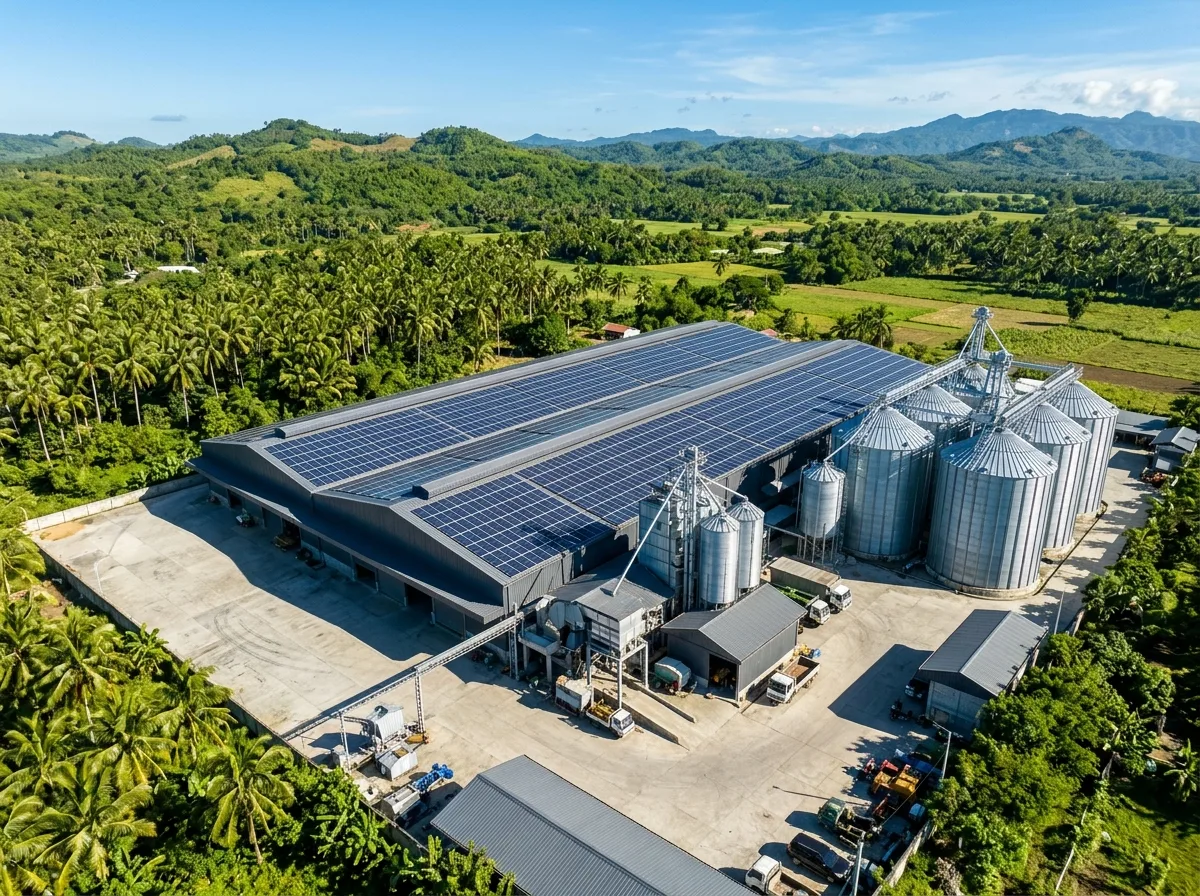
Agricultural milling complexes blend wide warehouse storage bays with dusty crushing yards and thirsty cane plots—allowing CebuSolar to deploy clean upwind rooftop 3-phase arrays alongside standalone ground-mount solar arrays and zero-diesel solar water pumps cutting fuel trips across Cebu estates.
Dry-season daytime crusher grid-tie
Regional co-op mills and commercial sugar bodegas operating heavily during bright amihan/summer days under CEBECO II (~₱15.91/kWh) trim operating utility spend using battery-free 3-phase zero-export solar (leaner capex).
Zero-diesel field irrigation & mill pumps
Replace costly uphill generator fuel hauls by wiring rural deep-wells to MPPT solar water pumping VFDs—filling high storage cisterns for dry cane irrigation and mill washdown all day.
Artisan muscovado & office hybrid backup
Community muscovado producers and off-grid farm offices protect sifters, bag weighing computers, weighing scales, lighting, and estate water boosters across rural blackouts via sealed 6–18 kW LiFePO4 hybrid packages starting from ₱305,000.
System sizing
What solar capacity suits an artisan muscovado shed vs. a regional sugar mill?
Site evaluations review twelve monthly CEBECO billing cycles alongside crusher horsepower ratings, rural transformer kVA capacity, open pasture footprint near smoky bagasse boilers, and daily water lifting height—spanning 6–18 kW community mill setups right up to 50–500 kW+ commercial agro plants.
| Mill & Farm Scale | Representative Equipment Load | Suggested Solar Tier | Deployment & Pricing Model |
|---|---|---|---|
| Community muscovado shed, weigh station & estate office | Juice agitator, hammer sifter, heat pouch sealers, lighting & computers | 6 kW to 18 kW Hybrid (10–32 panels, 6.2–19.84 kW) | Fixed packages: ₱305,000–₱970,000 (5–16 kWh battery option) |
| Commercial mid-size cane-crushing & specialty sugar mill | Three-phase electric cane rolls, transfer pumps, conveyor drives | 50–150 kW three-phase | Dry warehouse roof or open yard ground-mount EPC; custom quote |
| Large northern agro-sugar processing & dry storage complex | Heavy crushing lines, centrifugal drives, dust hoods, warehouse bays | 150–350 kW three-phase | Zero-export 3-phase Solis plant upwind from stacks; custom quote |
| Multi-hectare agricultural estate & remote irrigation campus | Milling hall demand plus multiple rural deep-well irrigation pumps | 350–500 kW+ & Pump VFDs | Combined C&I mill EPC + off-grid borehole field pumps; custom quote |
Estimates only. Bagasse soot wind evaluation, transformer rating audit, and fixed itemized quoting follow our field survey. Actual savings depend on system size, crushing season schedule, location, and rates. Prices are subject to change without prior notice.
Cost and payback
What do Cebu sugarcane mill & irrigation solar setups cost, and when is payback hit?
Community muscovado sheds buy clear fixed tiers spanning ₱305,000 to ₱970,000—whereas full 50–500 kW+ industrial mills receive custom fixed proposals after inspection. Displacing steep rural CEBECO (~₱15.24–₱15.91/kWh) bills and costly tractor diesel yields realistic capital payback in 3 to 5 years.
Benchmarked against northern CEBECO II rates around ~₱15.91/kWh in September 2026 and southern CEBECO I rates (~₱15.24/kWh), heavy afternoon milling and dry-season water pumping turn bright sun into immediate avoided diesel fuel and kilowatt charges. Skipping large batteries where the mill already has a grid line and a generator keeps the payback short.
Every installation pairs Tier-1 620–630 W N-type bifacial modules (JinkoSolar, JA Solar, Trina Solar, LONGi, AIKO), Solis inverters, Schneider Electric protection, Dyness/Pylontech LiFePO4 batteries, and galvanized steel ground structures (check C&I pricing).
- Transparent itemized fixed pricing after farm & transformer survey
- Clear milestone terms: 40% order, 40% delivery & mounting, 20% switch-on
- 1-year workmanship, 12-year inverter, and 30-year panel (at least 87% at yr 30) warranties
- Optional fenced ground-mount steel frames keep arrays clear of hot bagasse stacks
- We assist with municipal LGU electrical permits and CEBECO zero-export paperwork
How it works
How does CebuSolar design around bagasse soot and rural farm terrain across Cebu?
Deploying crews island-wide out of our Cebu City office at Mclin Building, Corner T. Padilla St. and M.J. Cuenco Ave., our system designers map upwind array footprints away from furnace bagasse ash plumes, check the ground for footings, and connect mills without slowing crush shifts.
Mill & plume wind survey
We inspect twelve months of CEBECO invoices, measure distant borehole depths, and chart prevailing furnace ash drift away from storage sheds.
Ash-clear array & fixed BOM
We site panels on dry clean-side packing bodegas or perimeter ground-mount steel bays with handy hose walkways (cleaning guide) and assist with LGU permits.
Sturdy rural erection
Technical crew completes steel foundation work or roof clamps without disturbing crush yards (install process), completing breaker tie-in over maintenance pauses.
Provincial Cebu aftercare
Remote SolisCloud monitoring runs backed by Cebu City spare inventory under our 1/12/30-year warranty commitment.
What do Cebu cane-millers & estate farmers ask before building solar?
Agricultural co-op directors, muscovado makers, and farm managers across Medellin, Bogo, Tabogon, and southern Cebu often ask how furnace ash affects output during harvest peak, whether off-grid irrigation pumps reach tall cisterns easily, how crusher inrush surges behave, and how warranties hold up rurally.
Won’t bagasse boiler soot coat solar panels too fast during dry harvest season?
Our installers intentionally site panels safely upwind over clean bagged-sugar depots, equipment sheds, or perimeter ground racks—with wide walkable catwalk clearance so workers spray ash off easily with an ordinary morning garden hose (care guide).
Can older timber-truss sugar sheds skip roof weight and mount arrays on empty farm land?
Yes—our engineered ground-mount arrays sit safely over cleared unshaded gravel or pasture beside main switchboards, avoiding aged mill trusses completely and are easy to rinse from the ground.
Does solar work far out in rural sugarcane plots without any CEBECO utility poles nearby?
Yes—both borehole solar water pumps (using tank storage without heavy batteries) and standalone off-grid power stations operate anywhere sunlight lands on rural Cebu farms.
How do high-torque electric cane crusher startup surges interact with three-phase solar?
A grid-tied inverter works alongside the CEBECO line, which supplies the short starting surge of the crusher motor while the panels carry the steady running load.
Get your personalized solar quote
Tell us about your place, pin it on the map and add a photo of your bill. Our team replies on Viber within one business day.
- 1. We size your system from your bill and map your roof by satellite.
- 2. You get your quote: panels, battery, monthly savings, payback and price.
- 3. Happy with it? We check your roof and wiring on site, then lock in one fixed price.