- Home
- Rubber & Footwear Manufacturers
Molding & shoemaking · Carcar heritage & Metro bays
Solar for Rubber & Footwear Manufacturers in Cebu. Power presses, kneaders, and stitching lines.
Industrial rubber compounders, EVA sandal molders, and heritage leather-shoe factories across Carcar, Mandaue, Lapu-Lapu, Minglanilla, and Talisay pull steep daytime 3-phase electricity for vulcanizing presses, Banbury mixers, and chilled molds on ~₱15–₱16/kWh rates—reaching 3–5 yr ROI via commercial and hybrid solar.
- 8–500 kW+ Carcar shops to export molders
- 3–5 yrs typical capex payback
- Heat relief shades stitching lofts
The energy squeeze
Why do heated presses and stitching bays squeeze Cebu shoe & rubber makers?
From multi-station EVA beach-sandal injection plants on Mactan down to historic Carcar stitched-footwear cooperatives and industrial gasket molders, continuous hydraulic platens, roll mills, air compressors, and factory air coolers inflate per-pair manufacturing energy costs each quarter without respite.
Producing vulcanized rubber outsoles, lightweight EVA midsoles, and stitched canvas or leather uppers ties thermal heating directly to heavy daytime motor load: internal Banbury dispersion kneaders and open two-roll rubber mills blend raw compounds aggressively, electrically heated hydraulic compression vulcanizers cure trays between 140°C and 180°C, injection carousels pump foam soles while chilled water loops cool mold stations rapidly, and long upper-stitching assembly benches require dense LED task lighting, fume extraction hoods, and industrial evaporative cooling across warm shifts. Operating six days a week between 7:30 AM and 5:30 PM exposes factory profits to Cebu’s steepest utility tariffs.
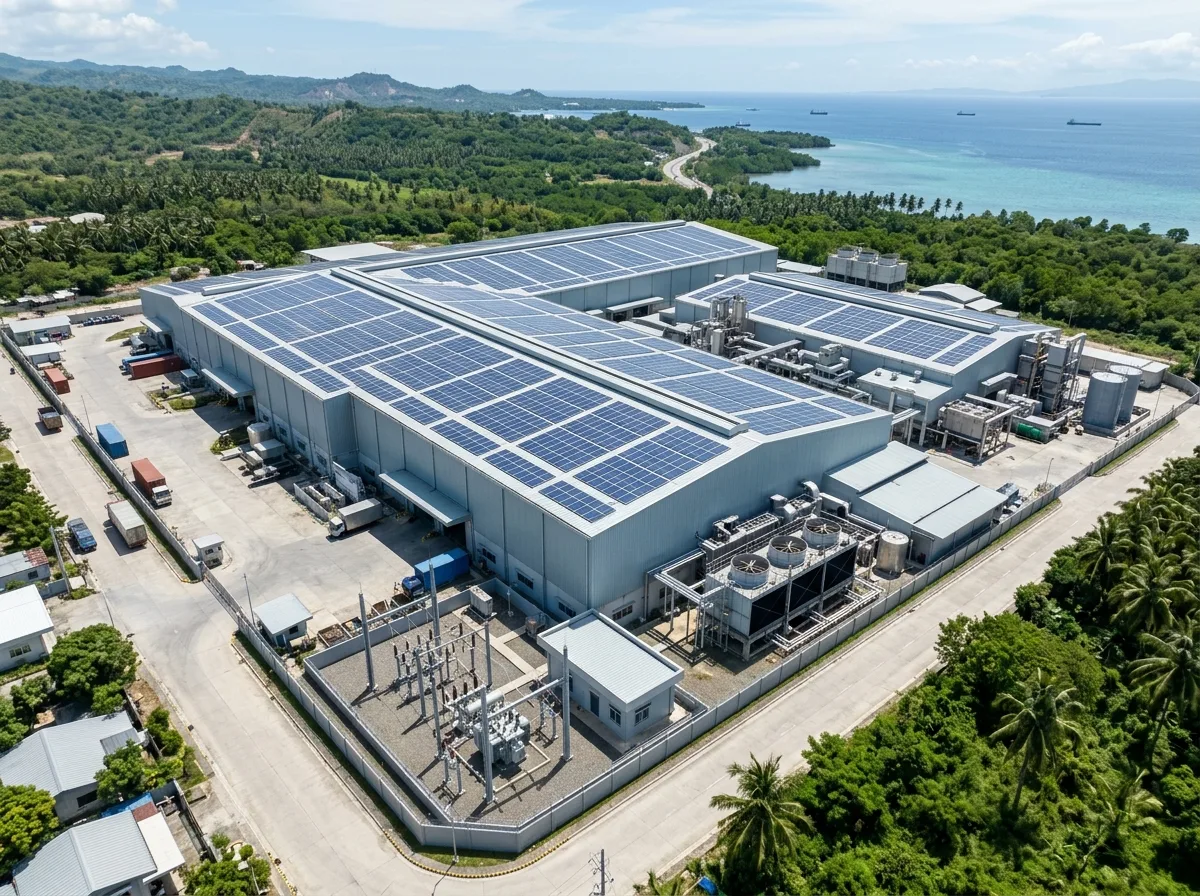
Yet sunlit long-span factory decks sitting directly overhead rarely pull their weight offsetting heated platens below.
- Hydraulic rubber vulcanizing platen presses & rotary EVA foam injection molders
- Banbury dispersion kneaders, two-roll compounding mills & bale cutters
- Die-clicking hydraulic swing-arm presses, sole cement drying tunnels & buffing fans
- Multi-table upper sewing lines, last pullers, air compressors & workshop fans
- Mold-cooling water chillers, QC testing labs & packed inventory warehouses
Solar fit
Why do daytime footwear & molding plants pair with commercial solar?
Because Carcar shoemakers and Mandaue molding lines draw maximum electrical demand squarely across bright daytime working shifts, installing clean zero-export grid-tie solar directs harvested sunlight straight onto heavy press heaters and water chillers—cooling stitching ceilings underneath while LiFePO4 batteries shield cycle PLCs.
Daytime press & kneader offset
Shifting Banbury mixing and hydraulic platen heating onto Solis 3-phase grid-tie solar drops unit kWh cost per pair directly during sunlit 8 AM–5 PM operating windows.
Cooler upper-sewing floor comfort
Covering uninsulated GI sheets with elevated 620–630 W N-type bifacial panels intercepts blazing noon roof radiation before it bakes sewing operators and adhesive curing tables inside.
Anti-scrap PLC cycle protection
Sudden grid brownouts mid-injection scrap molten EVA shots inside nozzles; wiring hydraulic valve PLCs, dosing scales and sewing terminals onto LiFePO4 battery subpanels keeps them running through brownouts.
Capacity sizing
What solar capacity suits a Carcar footwear workshop vs. an EVA molding plant?
CebuSolar inspects platen heater kW ratings, rotary compressor loads, and factory steel roof trusses thoroughly on-site prior to submitting engineering quotes—delivering transparent fixed packages for Carcar family workshops up through massive 500 kW+ industrial footwear and molded-rubber factories province-wide.
| Factory Scale | Representative Manufacturing Load | Suggested Solar Tier | Deployment & Pricing Model |
|---|---|---|---|
| Heritage Carcar shoemaking workshop or custom cobbler co-op | Hydraulic clicker press, sewing machines, buffing motors, heat gun, fans | 8 kW to 18 kW Hybrid (14–32 panels) | Fixed 8–18 kW packages (₱445,000–₱970,000) |
| Small technical-rubber gasket or molded sandal factory | 3–6 electric platen presses, open 2-roll mill, cooling tank, air compressor | 40–90 kW Three-Phase Grid-Tie | Zero-export 3-phase MDP tie-in + PLC hybrid; custom quote |
| Multi-station rotary EVA injection & vulcanized canvas shoe mill | 2+ rotary injectors, chillers, cementing ovens, long stitching conveyor bays | 100–250 kW Three-Phase C&I | Full factory roof solar trimming heavy heat load; custom quote |
| PEZA export rubber compounder & footwear complex | Heavy Banbury lines, multiple injectors, central chillers, AC assembly floors | 250–500 kW+ Three-Phase C&I | High-capacity multi-shed array matching base demand; custom quote |
Estimates only. Site transformer measurements, exhaust-hood setbacks, and itemized hardware pricing follow a free walkthrough. Actual savings depend on occupancy, size, location, and rates. Prices are subject to change without prior notice.
Cost and payback
What do footwear and rubber systems cost, and how fast do they repay?
Carcar ateliers choose clear fixed pricing between ₱305,000 and ₱970,000—while multi-press industrial factories lock exact itemized C&I quotes offsetting daytime utility rates in brisk 3 to 5 year payback periods against rising ~₱15–₱16/kWh charges across VECO and CEBECO feeders.
Benchmarked against Visayan Electric’s October 2026 schedule of ₱15.30/kWh, MECO (~₱15.98/kWh), and southern Carcar/Naga CEBECO lines (~₱15.08–₱15.91/kWh September 2026), slicing vulcanizing and molding kWh improves export cost competitiveness immediately (textile & sewn assembly reference).
Every installation pairs Tier-1 620–630 W N-type bifacial modules (JinkoSolar, JA Solar, Trina Solar, LONGi, AIKO), Solis inverters, Dyness/Pylontech batteries, Schneider gear, and stainless steel mounts (C&I cost breakdown).
- Lower electric utility bills for daytime 6-day stitching & molding runs
- 1-year workmanship, 12-year inverter, and 30-year panel (at least 87% at yr 30) warranties
- Predictable milestones: 40% order, 40% equipment delivery & mounting, 20% switch-on
- Metro Cebu service: we aim to reach you within 48 hours
- Electrical plans and help with the LGU permit and utility paperwork
How it works
How does CebuSolar survey and wire active molding lines without halted shifts?
Dispatching our team directly out of Mclin Building, Corner T. Padilla St. and M.J. Cuenco Ave. in Cebu City, our team evaluates factory steel frames free, locates inverters clear of volatile glue fumes, and completes switchboard tie-ins over scheduled Sunday shutdowns.
Free plant load & exhaust walk
We study 12-month billing records, locate gluing fume vents and Banbury carbon-black vents clear of roofs, and check MDP transformer capacity.
Sealed cool electrical routing
Our blueprints mount inverters safely inside clean breaker corridors away from volatile solvent vapors and talc dust—protecting cooling vents (structural mounting spec).
Roof rigging around production
Technical crews bolt framing rails mechanically overhead while sewing tables and presses run normally inside (install process), completing breaker tests neatly Sunday.
Live generation & bank loans
SolisCloud monitors real-time plant generation alongside simple cleaning routines and optional bank financing preserving working capital.
Common Cebu footwear & rubber manufacturer solar questions
Footwear factory owners across Carcar, Mandaue, Lapu-Lapu, and Minglanilla frequently ask how Banbury carbon-black powder cleans safely off solar panels, whether solvent-vapor safety setbacks trim roof space, how heated platen presses match solar sizing, and what warranties guarantee steady multi-shift plant reliability.
Does airborne talc powder or carbon-black mixing dust block solar panel harvest?
We orient array rows away from direct Banbury exhaust cowls and design easy perimeter catwalk gaps so maintenance workers easily flush any dry settling dust using plain garden hoses (panel maintenance).
Can rooftop solar supply electric resistance platen heaters on vulcanizing presses efficiently?
Yes—electric heating coils represent purely resistive continuous loads matching zero-export three-phase solar ideally, pulling clean kilowatts all day directly without reactive power penalties.
How do Carcar family footwear co-ops in CEBECO areas benefit during brownouts?
A fixed 8–18 kW hybrid package with LiFePO4 storage keeps sewing machines, trimmers, fans and cutting-table lights running during feeder repairs, for as long as the battery is sized to cover.
What happens every Sunday or holiday when shoe stitching floors lock completely closed?
Current transformers at the plant incoming main throttle inverter output down automatically—supplying only warehouse chillers, offices, and guard lighting with zero backfeed penalties (utility rules guide).
Get your personalized solar quote
Tell us about your place, pin it on the map and add a photo of your bill. Our team replies on Viber within one business day.
- 1. We size your system from your bill and map your roof by satellite.
- 2. You get your quote: panels, battery, monthly savings, payback and price.
- 3. Happy with it? We check your roof and wiring on site, then lock in one fixed price.