- Home
- Rope & Twine Factories
Cordage & extrusion · Metro & southern industrial hubs
Solar for Rope & Twine Factories in Cebu. Power extruders, twisters, and braiding bays.
Polypropylene cordage mills, marine hawser plants, fishing-net twisters, and abaca baling twine factories across Tipolo, Paknaan, Consolacion, Minglanilla, and Naga run heavy 3-phase induction motors continuously under ~₱15–₱16/kWh tariffs—recovering capex in 3–5 yrs with commercial and grid-tied solar.
- 50–500 kW+ ropewalk & extrusion roofs
- 3–5 yrs typical industrial ROI
- Zero export 400/440V 3-phase direct feed
The energy squeeze
Why are 3-phase extrusion and stranding bills eroding Cebu cordage plant margins?
Cebu’s maritime supply chains, Visayas aquaculture cages, and export shipping ports demand steady deliveries of twisted PP ropes, braided mooring hawsers, nylon net twine, and baled abaca fiber—yet uninterrupted barrel heating and spool twisting squeeze factory profits mercilessly each billing cycle.
Inside a busy rope factory, base baseload demand climbs right after morning shift startup: thermostatically controlled monofilament and fibrillated tape extruders hold melting zones at working temperature, multi-head godet draw rollers stretch polymer filaments through heated ovens or quench baths, and dozens of high-RPM ring twisters, planetary stranders, and 8-to-12 strand closer machines pull steady inductive kVA all day. On top of direct drive motors, closed-loop cooling-water chillers, overhead bay exhaust fans, and hydraulic baling presses keep electrical meters spinning steadily past peak sun hours.
Even with broad, flat-pitch long-span warehouse roofs bathing directly in intense Visayan sunlight overhead, uncoated GI sheets merely trap radiant heat above yarn lines while monthly VECO or co-op invoices rise unchallenged.
- PP & PE monofilament / raffia tape extrusion barrel heaters & screw drives
- Multi-stage godet stretch stands, quench tanks & annealing oven blowers
- Planetary ropewalk closers, tubular stranders & heavy hawser lay machines
- High-speed bobbin winders, abaca combing cleaners & automated hank coilers
- Process water chillers, dust-extraction blowers & warehouse bay air changes
Engineering match
Why do long cordage factory roofs deliver among the cleanest industrial paybacks?
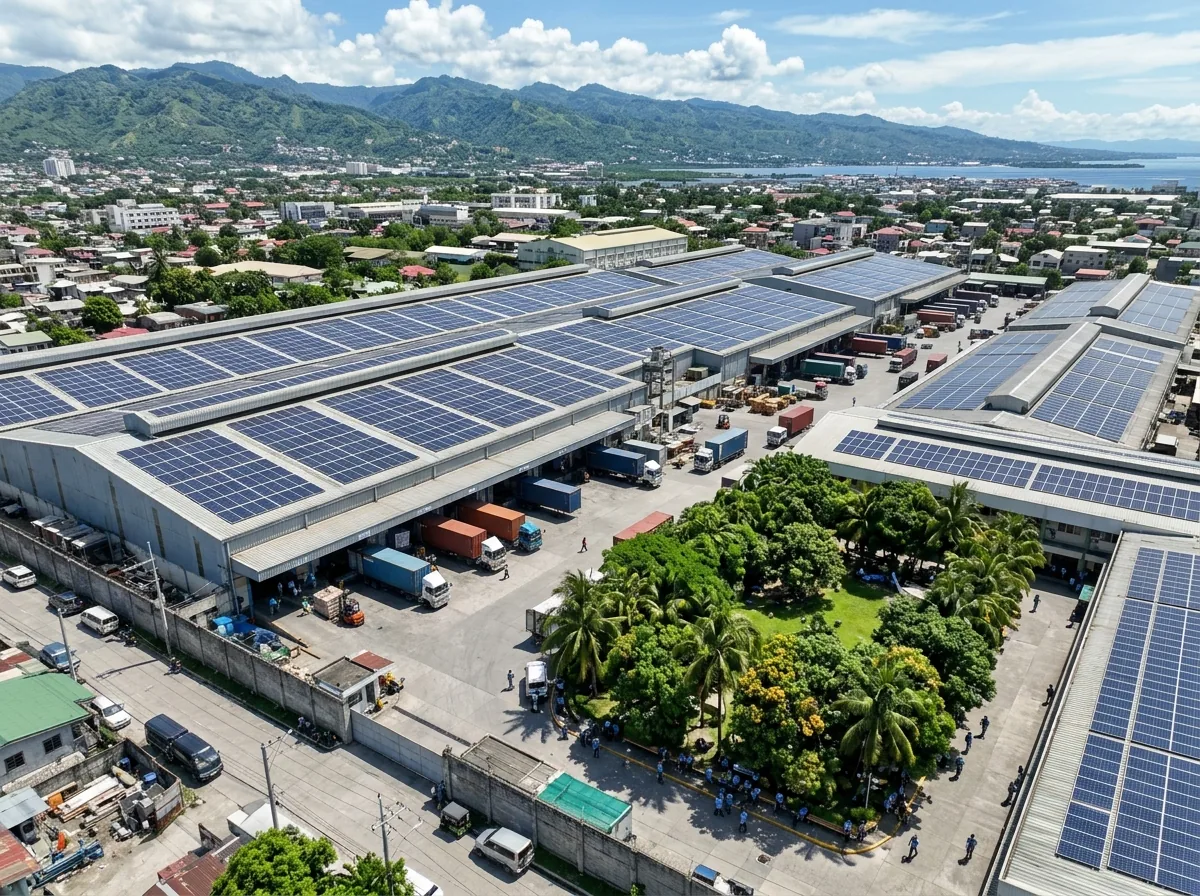
Ropewalk warehouses are naturally built for massive generation: uninterrupted long-span steel bays house constant three-phase extrusion, godet drawing, and stranding motor loads beneath wide, shade-free metal decking—letting Solis 3-phase commercial inverters feed factory busbars instantaneously during daylight shifts at minimal battery cost.
No massive battery capital needed
Whenever extrusion shifts operate predominantly across daytime 7 AM–6 PM windows, battery-free zero-export grid-tie solar consumes almost every generated watt internally—delivering lean capital spend and 3–5 yr ROI.
Lower shed roof radiant heat
Covering broad sunlit metal warehouse sheets with clean elevated 620–630 W N-type bifacial arrays physically shades steel decking beneath panels, easing indoor ambient work heat around twisting operators.
Clean hybrid reserve for restarts
Where sudden brief utility sags stall synchronized filament extruders mid-draw causing costly melted resin purges, pairing targeted control-panel LiFePO4 battery ride-through stabilizes PLC winders and heaters.
System sizing
What industrial kW capacity matches an abaca workshop vs. a full extrusion plant?
Sizing a rope cordage or baling twine manufacturing plant reliably requires clamp-on three-phase transformer logger records alongside usable clear long-span roof dimensions, rather than crude square-meter floor estimates—aligning solar AC generation just underneath continuous weekday extrusion and stranding motor loads.
| Plant Scale | Production Line Profile | Suggested Solar System | Investment Model |
|---|---|---|---|
| Artisanal abaca braiding workshop or twine coiling depot | Carding rollers, light twisters, baling press, warehouse fans, LEDs | 12–18 kW (22–32 panels) Hybrid or 3-Phase | Fixed 12–18 kW packages (₱615,000–₱970,000) |
| Single-extruder polypropylene cordage & fishing-twine shop | 1 extruder line, godet draw bench, chiller, 15+ ring twisters | 50–100 kW Three-Phase Grid-Tie | Zero-export 3-phase MDP tie-in; custom commercial quote |
| Multi-line marine rope & braided netting plant | Multiple extrusion heads, planetary closers, coilers, compressed air | 120–250 kW Three-Phase C&I | Full roof array feeding step-down busbar; custom quote |
| Export ropewalk complex & synthetic fiber compounder | 24-hr continuous industrial extrusion, heavy chillers, multiple sheds | 300–500 kW+ Three-Phase C&I | Multi-shed array matching daytime base demand; custom quote |
Estimates only. Actual transformer kVA logging, C-purlin steel thickness scans, and itemized pricing follow a plant survey. Actual savings depend on occupancy, size, location, and rates. Prices are subject to change without prior notice.
Economics & specs
What do cordage mill installations cost, and when does solar pay back?
Small twine workshops lock in published packages up to 18 kW, while larger extrusion factories receive exact itemized C&I bills of materials calibrated to lower peak daytime kWh and monthly demand spikes—commonly recovering outlay within 3 to 5 years.
Comparing project payback against VECO’s October 2026 rate of ₱15.30/kWh alongside Mactan (~₱15.98/kWh) and CEBECO provincial feeders (~₱15.08–₱15.91/kWh September 2026), daytime solar on extrusion schedules lowers the power cost per kilo (Cebu manufacturing ROI guide).
Every array installs Tier-1 620–630 W N-type bifacial solar panels (JinkoSolar, JA Solar, Trina Solar, LONGi, AIKO), Solis three-phase inverters, Schneider circuit gear, and stainless clips (commercial cost details).
- Direct offset across daytime ~₱15–₱16/kWh commercial industrial billing tiers
- 1-year workmanship, 12-year inverter, and 30-year panel (at least 87% at yr 30) warranties
- Clear 40% order, 40% delivery & mounting, 20% switch-on progress milestones
- Metro Cebu service: we aim to reach you within 48 hours
- Electrical plans and help with the LGU permit and utility paperwork
Install workflow
How does CebuSolar retrofit busy ropewalks without stopping extruders?
Operating from Mclin Building, Corner T. Padilla St. and M.J. Cuenco Ave. in Cebu City, our system designers check power factor and harmonics, verify roof truss structural load allowances free, install steel mounting clamps overhead, and synchronize busbars during planned pauses.
Transformer & shift logging
We examine 12-month VECO or co-op billing histories, log midday extruder kW draw, and check panel dust conditions around abaca fiber shredders (maintenance guide).
Zero-export CT calibration
Our schematics position three-phase current transformers directly over incoming main feeders—regulating inverter injection so zero power spills backward onto utility meters.
Exterior rigging around production
Rigging crews clamp aluminum rails straight to structural purlins overhead while twisters keep spinning inside (install process), completing electrical switchboard tie-in during Sunday shutdowns.
Telemetry & preventive checks
Continuous SolisCloud production dashboards verify clean yield against shift totals alongside our 48-hour Metro Cebu response target.
Common Cebu rope & twine factory manager solar questions
Plant superintendents and owners across Mandaue, Consolacion, Minglanilla, and Naga often ask how airborne polypropylene lint or abaca dust impacts glass cleanliness, how voltage harmonics from VFD drives interact with solar inverters, how Sunday downtime is regulated, and what financing works best.
Does airborne abaca fiber dust or polymer fluff coat rooftop panels enough for washing?
Moderate roof pitch angles let Visayan seasonal rains wash light settling dust naturally; for dry summer stretches beside abaca hackling sheds, periodic clear-water garden hose rinsing keeps 620–630 W panels at full harvest (cleaning checklist).
Can large variable-frequency drives (VFDs) on extrusion screws and stranders interfere with Solis inverters?
During the free electrical walk we check your power factor and harmonics. Grid-tied inverters are built to grid-connection standards and keep harmonic output low; we plan the connection around your capacitor banks and drives.
What happens every Sunday when twisters and extrusion lines shut completely down?
Zero-export CTs measure load fall immediately on Sundays and curtail array generation automatically—carrying only warehouse security lights, perimeter CCTV, and chillers with zero meter reversal penalties (VECO vs. CEBECO guide).
Our older ropewalk shed in Tipolo uses rusty roof sheets—must we re-sheet before solar?
Not always replaced across the entire hall—our structural survey measures steel corrosion thickness first, identifying sound roof bays ready today versus corroded zones worth re-skinning once ahead of 30-year solar framing.
Can cordage manufacturers fund a 100–250 kW solar installation through Cebu bank loans?
Yes. Many factories use bank financing with our itemized quote, with the power savings helping cover the payments; CebuSolar doesn’t lend money. Systems carry 1/12/30-year warranties (Warranty).
Get your personalized solar quote
Tell us about your place, pin it on the map and add a photo of your bill. Our team replies on Viber within one business day.
- 1. We size your system from your bill and map your roof by satellite.
- 2. You get your quote: panels, battery, monthly savings, payback and price.
- 3. Happy with it? We check your roof and wiring on site, then lock in one fixed price.