- Home
- Lechon Businesses
Solar for lechon businesses · Commissary & dining EPC
Solar for Lechon Businesses in Cebu. Keep freezers cold, cut restaurant power bills.
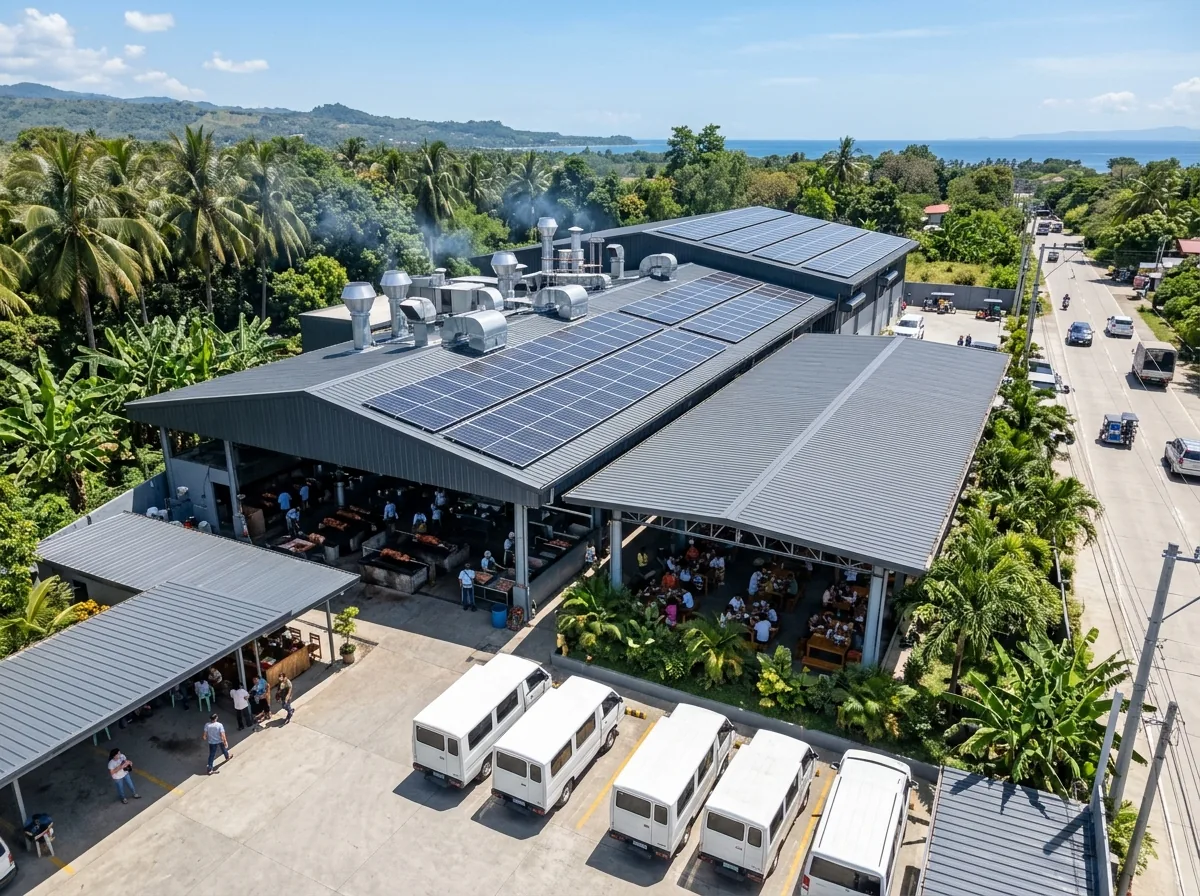
Cebu’s lechon commissaries, roasting kitchens, cold-storage prep hubs, and air-conditioned dining halls run commercial meat freezers, electric rotisserie motors, exhaust blowers, and dining HVAC through hot daylight hours. CebuSolar sizes hybrid solar packages and three-phase commercial arrays across VECO, MECO, and CEBECO areas.
- 6–500 kW+ shop & commissary scale
- 3–5 yrs typical payback period
- Cold-chain safe LiFePO4 freezer backup
The problem
Why are electricity bills climbing for Cebu lechon commissaries and restaurants?
Lechon operations combine cold-chain pork warehousing with busy daytime restaurant service—running walk-in meat freezers, electric spit-roast motors, kitchen exhaust fans, beverage chillers, and dining-room aircons concurrently under midday heat. At Cebu retail rates near ₱15–₱16 per kWh, utility bills cut into margins across every branch and central kitchen.
From heritage lechon hubs in Carcar and Talisay to flagship commissaries, airport-road takeout outlets, and dine-in restaurants across Cebu City, Mandaue, Lapu-Lapu, Consolacion, and Liloan, electrical demand peaks straight through daylight prep and lunch-to-dinner rushes. Central commissaries store high-value pork carcasses and spice marinades inside -18°C walk-in freezers while exhaust hoods pull heavy ambient air continuously beside roasting pits.
Meanwhile, flagship dining pavilions keep split or VRF air-conditioning working hard against open entrance traffic, beverage reach-ins, and vacuum-packaging sealers for export and pasabuy orders. Whenever local feeder outages drop power in Carcar, Talisay, or Mactan, thawed meat stock and stalled electric rotisserie drives create immediate spoilage and service risk.
- Walk-in meat freezers, blast chillers, and stainless prep-room refrigeration
- Electric rotisserie spit motors, commercial exhaust hoods, and makeup-air fans
- Air-conditioned dining rooms, beverage chillers, and kitchen dishwashing lines
- Vacuum-packing sealers, cold prep equipment, and POS checkout counters
- Deep-well washdown pumps at central roasting yards plus outage spoilage risks
How solar helps
How does solar fit lechon roasting yards, central commissaries, and dine-in halls?
Lunch service, afternoon meat processing, and midday walk-in freezer compressor peaks line up squarely with Cebu’s strongest sunshine, letting rooftop panels feed active refrigeration and dining aircons first. CebuSolar pairs 620–630 W N-type bifacial Tier-1 panels with Solis inverters, LiFePO4 battery protection, and solar washdown pumping.
Hybrid solar with LiFePO4 backup for shops & freezers
Single-branch roasting kitchens, takeout counters, and mid-sized commissaries gain rapid savings and brownout protection with hybrid solar and Dyness or Pylontech LiFePO4 batteries. When VECO, MECO, or CEBECO drops, walk-in freezers, POS registers, and rotisserie motors stay running smoothly without missing weekend orders.
Grid-tied arrays for high-volume commissaries & halls
Large central kitchens and multi-hall tourist restaurants connected to three-phase commercial power capture lowest-cost daytime kWh reductions via grid-tied solar. Zero-export Solis inverters offset dining-room HVAC and cold-storage compressors every single afternoon across busy holiday seasons.
Solar water pumping for yard washdown & livestock prep
Central processing yards with deep wells supplying high-volume pressure washing, cleaning, and holding pens cut pump bills using solar water pumping filling overhead tanks by day. Independent roadside stalls can start fast with modular 6–18 kW hybrid packages.
System sizing
What size solar installation does a Cebu lechon business need?
Sizing reflects walk-in freezer capacity, dining-room aircon tonnage, central versus branch kitchen layout, and twelve months of electric bills. CebuSolar offers fixed-price 6–18 kW hybrid systems for single outlets and custom-engineered 50–500 kW+ three-phase solar plants for major commissaries and multi-hall restaurants after an audit.
| Operation scale | Primary daytime loads | Suggested solar capacity | Configuration & pricing |
|---|---|---|---|
| Single roasting outlet, takeout store, or small diner | Chest freezers, beverage chiller, rotisserie drives, split aircon, POS | 6 kW to 12 kW Hybrid (10–22 panels, 6.2–13.64 kW solar) | Fixed packages: ₱305,000–₱640,000 (5–16 kWh battery, expandable 5–64 kWh) |
| Flagship dine-in restaurant or medium prep kitchen | Walk-in freezer, multiple floor aircons, exhaust hoods, vacuum sealers | 16 kW to 18 kW Hybrid (28–32 panels, 17.36–19.84 kW solar) | Fixed packages: ₱795,000–₱970,000 (5–16 kWh battery, expandable 5–64 kWh) |
| Central lechon commissary & cold-storage hub | Blast freezers, large pork cold rooms, prep-room HVAC, packaging lines | 50–150 kW three-phase | Rooftop grid-tied or hybrid with zero-export; custom quote after site visit |
| Multi-hall tourist dining & commercial processing complex | Central chillers, multiple banquet dining wings, industrial cold vaults | 150–500 kW+ three-phase | Multi-inverter commercial plant + genset sync; custom quote |
Estimates only. Final sizing and one fixed itemized price are confirmed after a site visit. Actual savings depend on system size, electricity consumption, location, and utility rates. Prices are subject to change without prior notice.
Cost and payback
How much does lechon-shop solar cost in Cebu, and how quick is payback?
Shop and restaurant 6–18 kW hybrid packages with LiFePO4 battery storage cost ₱305,000 to ₱970,000 fixed, while 50–500 kW+ central commissary arrays receive custom fixed quotes after inspection. Across Cebu tariffs near ₱15–₱16/kWh in October 2026, food businesses typically see 3 to 5 year payback.
Weekend fiestas, tourist dining peaks, and daily meat chilling keep utilization remarkably high seven days a week, letting solar kilowatts flow straight into refrigerators and dining aircons instead of utility meters. Evaluated against VECO’s October 2026 rate of ₱15.30/kWh alongside MECO and CEBECO commercial rates, daytime solar cuts fixed overhead across peak and off-peak months alike.
Kitchen roofs face smoke, heat, and coastal humidity, so CebuSolar installs Tier-1 620–630 W N-type bifacial panels from JinkoSolar, JA Solar, Trina Solar, LONGi, and AIKO with Solis inverters, Dyness or Pylontech LiFePO4 batteries, Schneider Electric and Suntree protection breakers, and stainless steel fixings. Run monthly bill scenarios via our ROI calculator or inspect package tables on our Cebu pricing page.
- One fixed turnkey contract price after a survey—every panel, breaker, and wire listed
- Clear milestone payments: 40% on order, 40% on delivery and mounting, 20% on switch-on
- Backed by 1-year installation workmanship, 12-year Solis inverter, and 30-year panel performance warranties (at least 87% output at year 30)
- Modular branch growth: add extra 620 W panels at ₱12,000 each or stack 5 kWh (₱75,000), 10 kWh (₱140,000), or 16 kWh (₱160,000) batteries
- We help with your local LGU electrical permits and VECO, MECO, or CEBECO paperwork
How it works
How does CebuSolar install solar without interrupting roasting or dining service?
Our Cebu City system designers route arrays safely clear of grease exhaust chimneys and charcoal vents while prep teams and dining rooms stay open below. Main switchboard tie-in occurs during a brief pre-arranged quiet morning window before lunch crowds arrive so freezers stay cold throughout.
Kitchen & roof audit
We check 12 months of VECO, MECO, or CEBECO bills, map grease-duct and roasting chimney plumes, and inspect dining and cold-room circuit breakers.
Clean layout & fixed price
We keep solar strings clear of hot smoke vents, specify sealed electrical rooms and zero-export or hybrid backup, assist with permits, and issue one fixed quote.
Service-safe installation
Crew work proceeds neatly overhead without disrupting kitchen prep or customer parking, confining electrical tie-in to a brief pre-lunch gap.
Cebu warranty & spares
Once live, your brand receives local warranty protection, spare parts kept in stock, and a Metro Cebu service response target within 48 hours.
What do Cebu lechon business owners ask before installing solar?
Commissary operators, multi-branch restaurateurs, and Carcar or Talisay lechon makers often ask about charcoal smoke and grease deposits on panels, keeping walk-in meat freezers cold through brownouts, single-phase versus three-phase wiring, standby generators, and local municipal permit support before committing.
Will smoke or grease from roasting pits coat rooftop solar panels?
Placement makes all the difference. During the site audit, our system designers map chimney stacks and exhaust-hood discharge paths—locating panels on the dining pavilion roof, cold-storage wing, or shaded parking canopies upwind of roasting smoke, with clear walkway gaps so routine water rinsing stays easy.
Can a hybrid battery bank keep walk-in meat freezers running during brownouts?
Yes, when sized properly around compressor running and starting amps. Using a hybrid Solis system with Dyness or Pylontech LiFePO4 batteries (from 5 kWh up to 64 kWh), we wire essential freezer, chiller, rotisserie, and POS circuits onto the dedicated backup subpanel so they keep running through outages, for as long as the battery is sized to cover.
Do small roadside outlets need three-phase power, or do single-phase packages work?
Most standalone takeout shops and mid-sized restaurants operate on single-phase 230 V utility lines, making our fixed 6–18 kW hybrid packages a good fit. Large central meat-processing commissaries on three-phase service use commercial three-phase Solis inverters tailored to their main breaker.
How does solar coordinate with a restaurant’s existing standby diesel generator?
For branches equipped with standby gensets, we wire grid-tied solar upstream of the automatic transfer switch or fit a generator-control interface so solar steps back during generator runs without reverse-power faults.
Does CebuSolar assist with permits for lechon commissaries and restaurants?
Yes. We help with your LGU electrical permit by preparing electrical plans, hardware specs and mounting plans, and assist with VECO, MECO or CEBECO zero-export paperwork.
Get your personalized solar quote
Tell us about your place, pin it on the map and add a photo of your bill. Our team replies on Viber within one business day.
- 1. We size your system from your bill and map your roof by satellite.
- 2. You get your quote: panels, battery, monthly savings, payback and price.
- 3. Happy with it? We check your roof and wiring on site, then lock in one fixed price.