- Home
- Ice Plants
Solar for ice plants · Heavy refrigeration EPC
Solar for Ice Plants in Cebu. Slash compressor bills on every ton of ice.
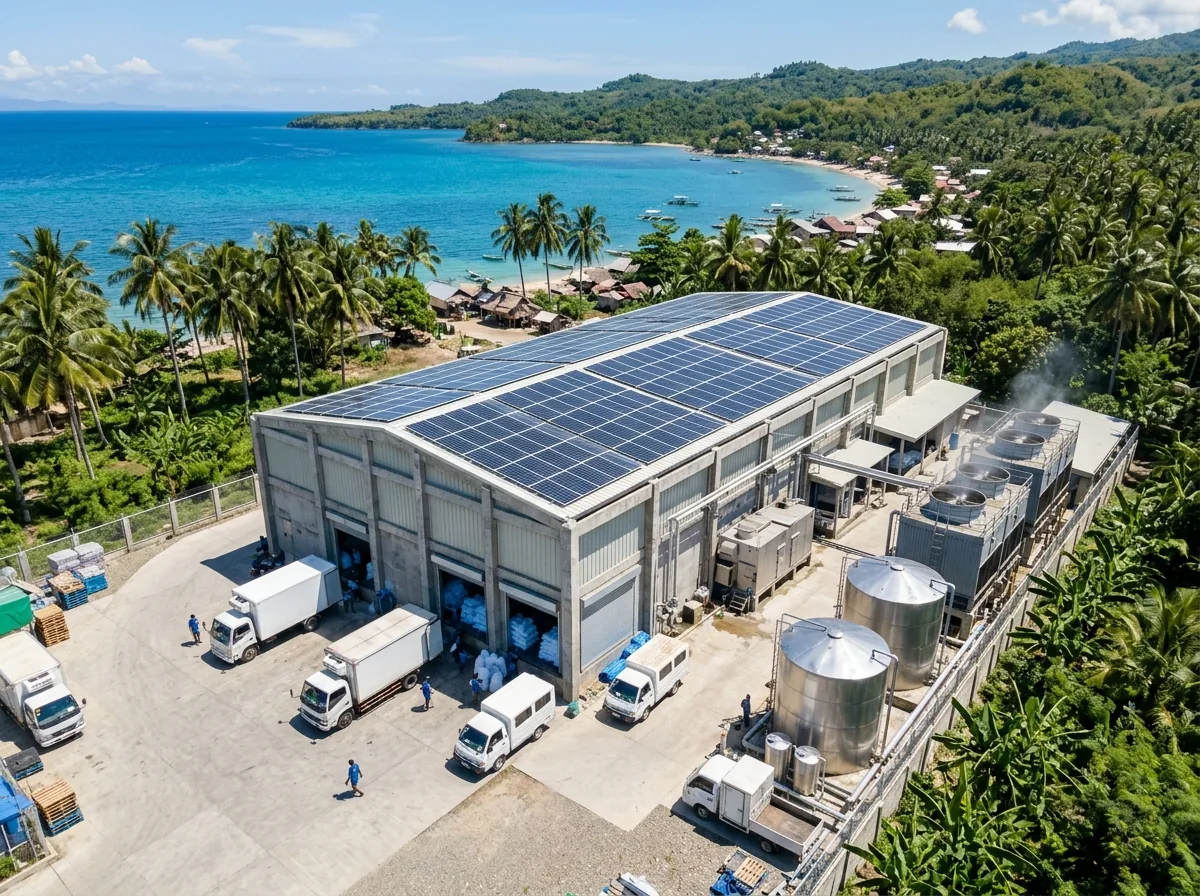
Block-ice brine tanks, tube-ice makers, and flake-ice plants consume continuous three-phase wattage for compressors, agitators, cooling towers, and water pumps across VECO, MECO, and CEBECO feeders. CebuSolar engineers high-yield commercial solar systems from 50 kW to 500 kW+ tuned for Cebu ice manufacturing.
- 50–500 kW+ 3-phase industrial plants
- 3–5 yrs typical payback period
- Salt-air ready stainless coastal fixings
The problem
Why does electricity dominate operating expenses at Cebu ice plants?
Ice manufacturing turns electricity directly into chilled thermal output via large ammonia or freon screw compressors, brine agitators, condenser fans, and continuous water pumps. With Cebu utility rates hovering near ₱15–₱16 per kWh, energy frequently represents the single biggest variable cost behind every block or bag of ice.
From coastal ports in Cebu City, Mandaue, and Lapu-Lapu to provincial fishing hubs in Danao, Carmen, Bogo, Tabogon, Bantayan, Toledo, Carcar, and Argao, demand spikes hottest under midday sun. Warm incoming municipal or borehole water, higher afternoon ambient air around evaporative condensers, and constant harvesting and crushing shifts keep three-phase main switchboards heavily loaded all day long.
Because ice margins leave little cushion when generation charges climb, rising VECO, MECO, or CEBECO bills squeeze profitability immediately. Worse, feeder fluctuations in northern and southern coastal towns force operators either to suspend ice harvests or run expensive industrial diesel generators that further inflate per-ton cost.
- Multi-horsepower ammonia or freon reciprocating and screw compressors
- Evaporative condenser blowers, circulation pumps, and brine-tank agitators
- Tube-ice harvest heaters, ice crushers, overhead cranes, and bagging augers
- Ice-storage cold rooms and high-volume makeup water pumping loads
- Afternoon condensing pressure spikes during peak Cebu heat
How solar helps
How does solar energy lower cost per ton at a Cebu ice factory?
Ice production turns kilowatt-hours into frozen thermal mass—so daytime solar is, in effect, stored as ice. CebuSolar pairs 620–630 W N-type bifacial Tier-1 panels with Solis three-phase inverters, zero-export controls, LiFePO4 backup for plant automation, and solar borehole pumping.
Three-phase grid-tied solar for heavy compressor load
Ice factories maintain steady, predictable baseload draw all afternoon, ensuring virtually every solar kilowatt-hour produced goes directly into active compressor and condenser motors. Grid-tied solar uses zero-export Solis three-phase inverters with no battery expense, delivering the quickest payback on high-tonnage plants.
Hybrid battery backup for PLC controls & storage lighting
Sudden grid flickers trip compressor safety relays, solenoid valves, bagging scales, and ice-room temperature monitors. Hybrid solar with Dyness or Pylontech LiFePO4 batteries protects sensitive plant automation, weighbridges, dispatch offices, and security systems so operations restart without corrupted batch timers.
Solar water pumping for raw ice-making supply
Every ton of tube or block ice starts with steady, clean raw water feeding filtration and pre-chilling tanks. Our solar water pumping systems lift borehole water into elevated holding cisterns by day without utility charges—or support small ice depots via off-grid solar.
System sizing
What size solar installation fits a Cebu ice plant?
Ice-plant sizing maps compressor motor kW, daily tonnage schedules, roof and yard area, and twelve months of utility interval bills. CebuSolar offers fixed 6–18 kW hybrid systems for retail ice depots and engineered 50–500 kW+ three-phase commercial solar plants for production factories after a site survey.
| Ice facility scale | Primary daytime machinery | Suggested solar size | System type & pricing |
|---|---|---|---|
| Retail ice depot, mini-flake shop, or holding freezer | Small ice maker, insulated holding box, bagging scale, water filter pump, office AC | 6 kW to 18 kW Hybrid (10–32 panels, 6.2–19.84 kW solar) | Fixed packages: ₱305,000–₱970,000 (5–16 kWh battery, expandable 5–64 kWh) |
| Town-scale tube or block ice plant | Primary refrigeration compressor, cooling tower, brine agitators, well pump | 50–150 kW three-phase | Rooftop or ground-mounted grid-tied array; custom quote after site visit |
| Regional commercial tube & block ice factory | Multiple screw compressors, harvest cranes, ice storage vaults, crushers | 150–300 kW three-phase | Three-phase Solis plant with zero-export & genset sync; custom quote |
| High-tonnage coastal & marine ice complex | Industrial ammonia compressors, large condenser banks, multiple ice lines | 300–500 kW+ three-phase | Multi-inverter commercial plant + solar borehole pumping; custom quote |
Estimates only. Final engineering capacity and one fixed price are set after a site audit. Actual savings depend on system size, electricity consumption, location, and utility rates. Prices are subject to change without prior notice.
Cost and payback
How much does solar cost for an ice plant in Cebu, and what is the payback?
Commercial ice-factory arrays from 50 kW to 500 kW+ are custom-quoted at one fixed price following structural and switchboard inspection, while smaller 6–18 kW depot packages range from ₱305,000 to ₱970,000. At October 2026 Cebu rates around ₱15–₱16/kWh, typical ice-plant payback runs 3 to 5 years.
Why do ice plants achieve steady 3 to 5 year returns? Because operators can concentrate heavy freezing cycles and water pre-chilling during peak sunlight hours, consuming nearly every solar kilowatt directly inside compressor shafts rather than paying full VECO rates (₱15.30/kWh in October 2026) or provincial CEBECO schedules. Ice storage vaults then hold frozen inventory overnight.
Coastal ice factories expose hardware to cooling-tower mist and sea air, so CebuSolar installs Tier-1 620–630 W N-type bifacial modules from JinkoSolar, JA Solar, Trina Solar, LONGi, and AIKO with Solis inverters, Dyness or Pylontech LiFePO4 batteries, Schneider Electric and Suntree switchgear, and stainless steel fixings built for salt air. Test smaller depot bills on our ROI calculator or compare package tiers on our cost page.
- One fixed turnkey price issued after a site survey, every component listed
- Milestone payments: 40% on order, 40% on delivery and mounting, 20% on switch-on
- Protected by 1-year installation workmanship, 12-year inverter, and 30-year panel performance warranties (at least 87% output at year 30)
- Modular options for smaller depots: add 620 W panels at ₱12,000 each or stack 5 kWh (₱75,000), 10 kWh (₱140,000), or 16 kWh (₱160,000) batteries
- We help with your local LGU electrical permits and utility zero-export documents
How it works
How does CebuSolar install solar on active ice plants without stopping production?
Our Cebu City system designers position solar arrays clear of evaporative condenser moisture plumes while compressors continue producing ice below. Final main-switchboard tie-in is timed during a brief scheduled harvest pause or maintenance check so brine tanks and storage vaults stay cold.
Plant & condenser audit
We visit from Cebu City to inspect 12 months of VECO, MECO, or CEBECO bills, verify truss spacing, map cooling-tower spray zones, and inspect main transformer switchgear.
Engineering & fixed-price quote
We size arrays around active compressor amperage and roof shade-free zones, assist with permit documentation, and issue one fixed turnkey contract price.
Clean overhead installation
Stainless coastal hardware mounts while ice trucks load in the yard below, timing breaker tie-in during a scheduled brief shutdown window.
Warranty & spare parts support
After commissioning, your factory receives local Cebu warranty cover, spare parts kept in stock, and a 48-hour Metro Cebu response target.
What do Cebu ice-plant owners ask before investing in commercial solar?
Ice plant operators and refrigeration engineers across Cebu City, Mandaue, Lapu-Lapu, Bantayan, and provincial fishing ports often inquire about cooling-tower mist corrosion, compressor starting surges, daytime versus overnight ice harvest scheduling, limited roof footprints, and local LGU or utility permit assistance.
Will evaporative cooling-tower mist or coastal salt air corrode our solar hardware?
Moisture plumes around evaporative condensers and salty coastal breezes require careful placement and materials. CebuSolar maps condenser discharge zones during the site audit to keep panels clear of constant mineral scaling, uses stainless steel fixings made for salt air, and installs Solis inverters and Schneider Electric switchgear inside dry, shaded electrical rooms.
Can solar inverters support heavy starting currents on older reciprocating compressors?
Yes. In a grid-tied three-phase configuration, your VECO, MECO, or CEBECO utility feeder continues supplying brief motor inrush currents while solar inverters feed steady daytime running kilowatts across the compressor shift—whether motors use star-delta starters, soft-starters, or variable-frequency drives.
Can we shift more ice harvesting into daytime hours to maximize solar savings?
Often, yes. Plants can schedule fresh water pre-chilling, tube-ice cycling, and block-ice brine tank pull-downs heavily during sunny daytime hours, letting solar power absorb maximum refrigeration energy while insulated ice vaults hold frozen product overnight with minimal nighttime draw.
What if our ice plant roof is small relative to our compressor kilowatt demand?
Even if the main tank building roof only hosts part of your total load, adding solar over adjacent ice storage rooms, loading-bay canopies, or ground-mounted racks still offsets daytime baseload power with rapid payback—because every kilowatt generated is immediately consumed inside the plant.
How does CebuSolar help with permits and zero-export setup for ice factories?
CebuSolar helps with your permits by preparing single-line electrical diagrams, hardware datasheets, and mounting plans required for LGU electrical permits and VECO, MECO, or CEBECO zero-export rules. Zero-export limiting ensures solar generation feeds your internal compressors and water pumps directly on-site.
Get your personalized solar quote
Tell us about your place, pin it on the map and add a photo of your bill. Our team replies on Viber within one business day.
- 1. We size your system from your bill and map your roof by satellite.
- 2. You get your quote: panels, battery, monthly savings, payback and price.
- 3. Happy with it? We check your roof and wiring on site, then lock in one fixed price.