- Home
- Dairy & Egg Production Farms
Livestock & layers · Bantayan, Barili & Toledo
Solar for Dairy & Egg Farms in Cebu. Power layer fans, egg graders, and milk chillers.
Commercial egg-laying complexes and fresh dairy farms across Bantayan, Barili, Toledo, Compostela, and southern hills operate continuous daytime layer-barn fans, egg grading washers, chilled milk bulk tanks, and deep-well water pumps on costly ~₱15–₱16/kWh rural feeders—reaching 3–5 yr ROI via commercial and pump solar.
- 50–500 kW+ layer barns & dairy estates
- 3–5 yrs typical payback period
- Solar pumping for drinkers & washdown
The problem
Why are 365-day layer ventilation & milk cooling bills pinching Cebu farms?
Unlike seasonal broiler operations pausing clean-out gaps every six weeks, caged egg layer complexes keep hens producing 365 uninterrupted days annually—running heavy tunnel fans, automated egg belt conveyors, cooling egg grading rooms, stainless dairy milk-bulk chillers (4°C), and continuous drinking water lines every sunny day.
Rural agricultural hubs spanning Bantayan Island egg capitals, Barili livestock pastures, Toledo dairy plots, and northern CEBECO II hills face steep kWh charges (~₱15.24–₱15.91/kWh in CEBECO I & II, September 2026) alongside remote feeder outages and diesel-pump delivery hurdles across muddy farm tracks during stormy weather.
Heat stress lowers laying rates and puts milk at risk when a brownout stops fans or chillers, which is why many farms keep diesel standby running costs on top of their power bill.
- Continuous tunnel-ventilated multi-tier battery-cage layer house exhaust fans
- Motorized egg collection belts, rotary brush washers, candling & automated graders
- Walk-in refrigerated fresh egg vaults & 4°C stainless bulk milk cooling vats
- Electric vacuum milking parlor pulsators, sanitation hot-rinse heaters & creamers
- Deep-well farm water boreholes pumping constant drinking & parlor washdown lines
How solar helps
Why do continuous 365-day layer & dairy estates achieve swift payback in Cebu?
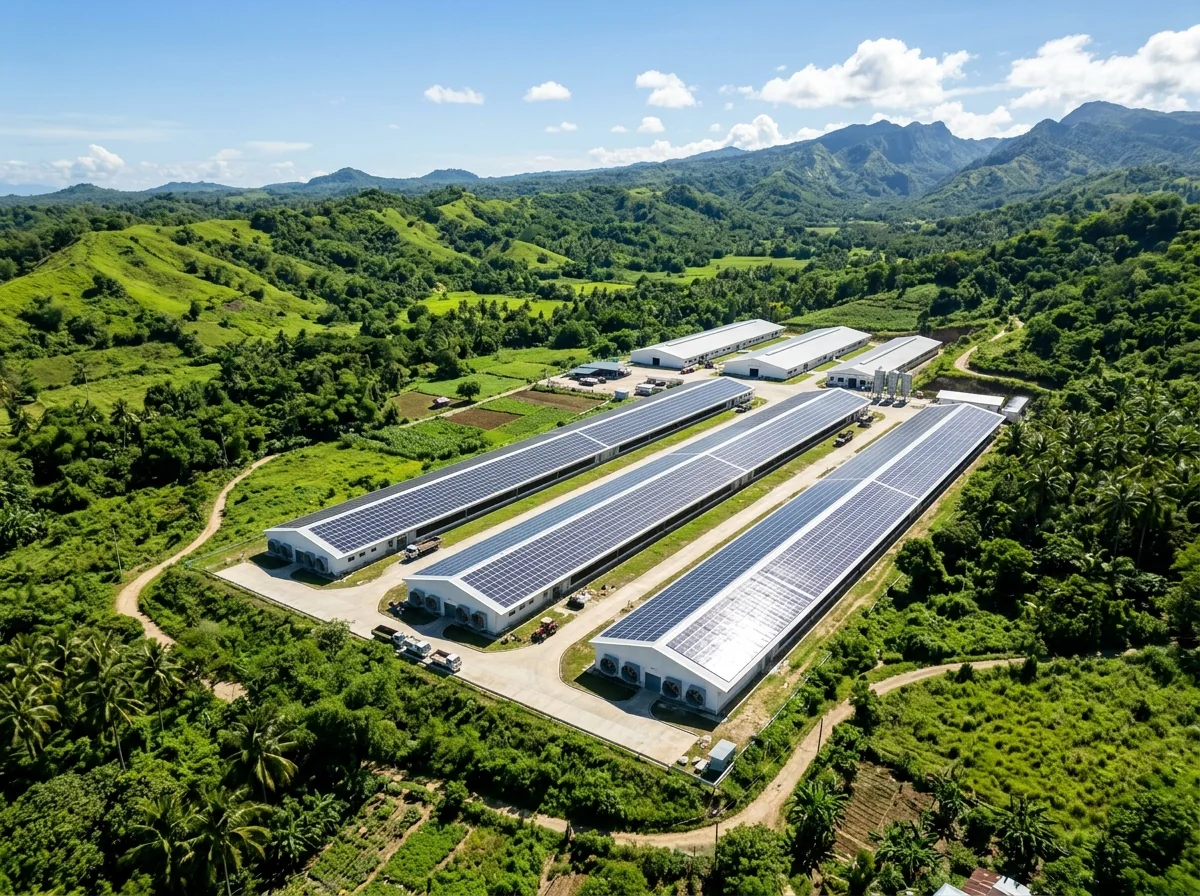
Layer farms have no clean-out breaks, so fans and graders use solar power every day of the year. Long layer-house roofs can carry three-phase zero-export solar for those loads, while separate solar water pumping fills the farm’s tanks without diesel.
365-day tunnel fan & grader grid-tied EPC
Multi-shed egg integrators owning automated farm ATS standby gensets cut monthly electricity spend using zero-export 3-phase grid-tied solar (leaner upfront capex with zero wasted Sunday downtime).
Zero-diesel parlor & nipple water pumping
Dairy washdown lanes and multi-thousand-bird layer drinker cisterns drink clean water all day—converting remote wells directly onto standalone solar water pumping drives filling elevated gravity cisterns.
Hybrid battery protection for milk vats & graders
Smaller family dairies, cheese kitchens, and central automated egg-grading rooms keep egg scales, milk chilling tanks and farm offices running through brownouts with fixed 6–18 kW LiFePO4 packages starting at ₱305,000.
System sizing
What solar capacity suits an independent dairy kitchen vs. a multi-shed egg farm?
Site surveys inspect twelve monthly CEBECO or island co-op billing histories alongside tunnel exhaust fan count, hydraulic borehole depth, manure belt/grading hall clean-roof access safely clear of corrosive discharge air, and existing genset transfer switchgear—sizing from 6–18 kW up toward 50–500 kW+ agribusiness compounds.
| Agri-Farm Scale | Representative Farm Load | Suggested Solar Tier | Deployment & Pricing Model |
|---|---|---|---|
| Small artisanal dairy parlor, cheese kitchen or starter layer shed | Bulk milk chill tank, milking vacuum pump, water pump, cool pantry | 6 kW to 18 kW Hybrid (10–32 panels, 6.2–19.84 kW) | Fixed packages: ₱305,000–₱970,000 (5–16 kWh LiFePO4 included) |
| Mid-size automated egg grading hub & 3–4 tunnel layer barns | Exhaust fan lines, automatic egg collector & washer, feed bin augers | 50–120 kW three-phase | Zero-export bay solar + separate deep-well pump VFD; custom quote |
| Large provincial egg complex & chilled fresh-egg warehouse | Multi-tier ventilated layer rows, chilled grader vault, feed mixing hall | 120–300 kW three-phase | 3-phase Solis plant upwind of tunnel discharge + ATS logic; custom quote |
| Integrated island poultry layer & automated agri-estate | Entire barn compound, egg pasteurizer/packing, borehole network | 300–500 kW+ & Pump VFDs | Combined clean-roof + hillside ground-mount EPC; custom quote |
Estimates only. Ammonia exhaust clearance mapping, borehole pump elevation testing, and locked itemized quoting follow our farm survey. Actual savings depend on house occupancy, size, location, and rates. Prices are subject to change without prior notice.
Cost and payback
What do dairy & layer farm solar builds cost, and when does payback clear?
Boutique dairy parlors and starter poultry houses buy transparent fixed packages clearly ranging ₱305,000 to ₱970,000—whereas full 50–500 kW+ layer complexes receive itemized custom proposals after audits. Offsetting steep rural CEBECO (~₱15.24–₱15.91/kWh) bills consistently returns capital squarely inside 3 to 5 years.
Benchmarked against provincial CEBECO rates around ~₱15.08–₱15.91/kWh (September 2026) alongside island diesel grid rates, continuous 365-day layer operations soak peak afternoon output without weekly shutdown dips—so more of the solar output is used than at a weekday office, and fuel hauling is reduced (poultry farm reference).
Every installation delivers verified Tier-1 620–630 W N-type bifacial modules (JinkoSolar, JA Solar, Trina Solar, LONGi, AIKO), Solis inverters, Dyness/Pylontech LiFePO4 batteries, Schneider switchgear, and stainless hardware (C&I pricing).
- Transparent fixed engineering quote delivered after agribusiness farm visit
- Clear staged payments: 40% order, 40% delivery & mounting, 20% switch-on
- 1-year workmanship, 12-year inverter, and 30-year panel (at least 87% at yr 30) warranties
- Anodized framing & stainless fixings hold tightly over coastal island barns
- We assist with municipal LGU electrical permits and co-op zero-export paperwork
How it works
How does CebuSolar mount safely over active layer barns without stressing hens?
Deploying our team island-wide out of our Cebu City office at Mclin Building, Corner T. Padilla St. and M.J. Cuenco Ave., our crews trace structural C-purlin steel uphill clear of tunnel exhaust fan cones, install without disturbing sensitive laying flocks, and finalize breaker switch-on.
Free barn truss & borehole walk
We inspect twelve monthly power & diesel totals, measure elevated storage tank hydraulic lifts, and map tunnel fan exhaust clearance safely on layer barns.
Ammonia-clear layout & BOM
We align clean stainless steel roof lines upwind or site panels on clear fenced ground-mount steel bays nearby, prepare LGU electrical permit sets, and lock fixed prices.
Quiet flock-calm installation
Crews anchor frames from exterior edge walks using low-noise fastening (install process) without startling sensitive hens inside, tying breakers over scheduled pauses.
Provincial Cebu warranty care
SolisCloud monitors generation daily backed across north, south, Bantayan & west Cebu via stocked Cebu City spares under our 1-year warranty commitment.
Common Cebu egg layer & dairy farmer questions before adopting solar
Livestock integrators, egg farm managers, and artisanal cheese producers across Barili, Bantayan, Daanbantayan, and Toledo often ask how dry feather dust and manure odors affect panels, whether older poultry steel roofs accept extra arrays, how milking parlors dodge brownouts, and how island service runs.
Will feed-mill dust or ammonia tunnel discharge corrode rooftop mounting hardware quickly?
We place panel rows away from the ammonia exhaust of the layer houses and use anodized aluminum rails with stainless hardware, with access paths for an early-morning rinse (maintenance guide).
Can weak rusting barn roofs skip roof weight and mount solar along sunny perimeter grass?
Yes. A ground-mount array on steel piers beside the layer houses puts no load on old roofs and is easy to rinse from the ground.
Can solar maintain 4°C raw dairy cooling tanks overnight during co-op rural brownouts?
It can, with a battery sized for it. A LiFePO4 battery can carry the milk chiller and vacuum pump through an outage; how long depends on the battery size and the chiller’s load, which we measure on site. Keep the generator for long outages (diesel comparison).
Can our layer house drinking wells run independently without buying pricey inverter batteries?
Yes—wiring borehole pumps via MPPT solar water pumping controllers fills raised elevated plastic/concrete drinker water tanks all sunny afternoon without heavy batteries or hauling fuel cans.
Get your personalized solar quote
Tell us about your place, pin it on the map and add a photo of your bill. Our team replies on Viber within one business day.
- 1. We size your system from your bill and map your roof by satellite.
- 2. You get your quote: panels, battery, monthly savings, payback and price.
- 3. Happy with it? We check your roof and wiring on site, then lock in one fixed price.