- Home
- Condominiums
Solar for condominiums · Common-area commercial EPC
Solar for Condominiums in Cebu. Lower association dues, power common areas reliably.
Residential towers and mid-rise condominiums across Cebu City, Mandaue, and Mactan pay steep monthly VECO or MECO utility bills just to keep elevators, lobby chillers, water booster pumps, and hallway lighting running around the clock. CebuSolar designs three-phase commercial and hybrid solar arrays built for condo corporations.
- 50–500 kW+ 3-phase tower arrays
- 3–5 yrs typical payback period
- Zero-export common-meter integration
The problem
Why are common-area electricity bills so high for Cebu condominiums?
Condominium associations pay commercial utility rates around ₱15–₱16 per kWh to run lobby air-conditioning, high-speed elevators, domestic water-booster pumps, clubhouse gyms, swimming pools, and sewage treatment blowers nonstop. Those shared daytime loads steadily push monthly association dues higher across Metro Cebu buildings.
Look closely at any residential tower or gated mid-rise compound in Cebu Business Park, Cebu IT Park, Lahug, Banilad, Mabolo, Talamban, Mandaue, or Lapu-Lapu City during midday hours, and the building’s common meter never rests. While many unit owners work off-site, building administration keeps air-conditioned lobbies, fitness studios, mailrooms, administration offices, basement exhaust fans, and pressure-booster manifolds running continuously under bright afternoon heat.
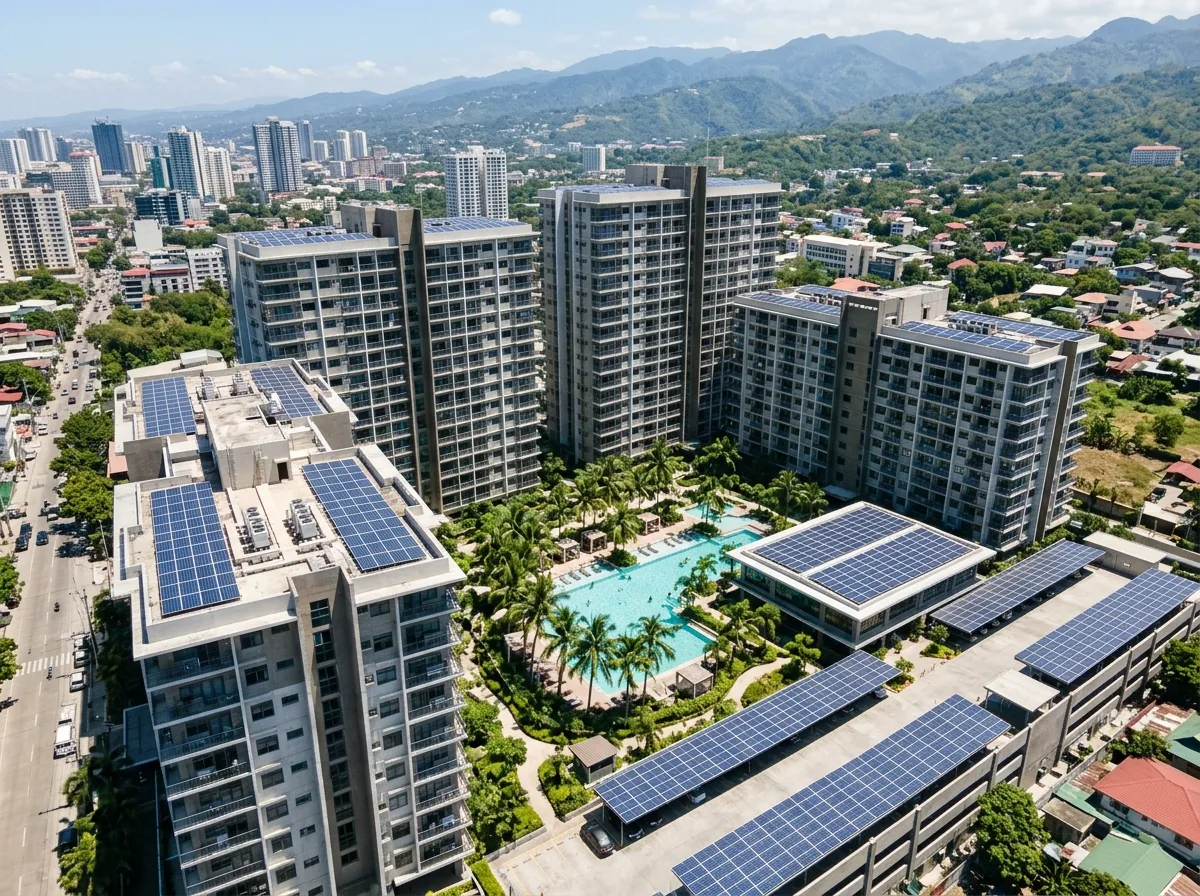
When utility tariffs climb or feeder outages force large building generators online, condo corporations either dip into reserve funds or raise monthly dues per square meter—sparking friction at homeowners association meetings. Converting flat concrete deck space, clubhouse roofs, and open podium parking canopies into active solar generation lowers shared common-area expenses directly without altering unit-owner meters.
- Passenger and service elevator banks cycling continuously across floors
- Triplex domestic water-booster stations and overhead cistern transfer pumps
- Air-conditioned reception lobbies, co-working lounges, gyms, and function halls
- Basement parking ventilation fans, corridor lighting, and sewage treatment aerators
- Swimming pool filtration motors and automatic gate or CCTV security circuits
How solar helps
How does solar energy tie into a condominium’s common-area electrical system?
Rooftop and clubhouse solar ties straight into the building’s administration switchboard, letting daytime sunshine power shared pumps, lobby cooling, elevators, and lighting before utility current is metered. CebuSolar builds zero-export three-phase plants, quiet LiFePO4 battery backup for essential controls, and solar water pumping.
Grid-tied solar on the common-area main breaker
High-rise and mid-rise towers connected to stable VECO or MECO three-phase transformers capture fastest payback through grid-tied solar wired straight into the common-area distribution board. Real-time zero-export sensors match inverter output precisely to active shared motors, trimming monthly kilowatt-hour charges transparently.
Hybrid LiFePO4 backup for security, lifts & water pumps
Sudden brownouts interrupt access-control turnstiles, CCTV racks and admin offices while residents wait for standby genset transfer. Hybrid solar with Dyness or Pylontech LiFePO4 batteries protects critical security, emergency corridor lights, and communication nodes silently across brief outages.
Solar water pumping & podium carport arrays
Low-rise garden condos and townhouse compounds with limited roof decks can mount arrays over shaded parking bays or power deep cistern refills via solar water pumping. Smaller boutique complexes can also deploy modular 6–18 kW hybrid packages for clubhouses.
System sizing
What size solar array does a Cebu condominium corporation need?
Condominium sizing balances unshaded concrete deck or clubhouse roof area, main common-area switchboard amperage, elevator regenerative loads, and twelve months of shared utility bills. CebuSolar offers fixed 6–18 kW packages for boutique amenities and custom 50–500 kW+ three-phase installations for large towers after a survey.
| Property scale | Shared daytime loads | Suggested solar capacity | Configuration & pricing |
|---|---|---|---|
| Boutique low-rise condo or subdivision clubhouse | Pool pump, admin office aircon, guardhouse CCTV, corridor LEDs, small booster | 6 kW to 18 kW Hybrid (10–32 panels, 6.2–19.84 kW solar) | Fixed packages: ₱305,000–₱970,000 (5–16 kWh battery, expandable 5–64 kWh) |
| Single mid-rise residential building | Elevators, lobby air-conditioning, water transfer pumps, basement exhaust fans | 50–100 kW three-phase | Elevated flat-deck or metal roof grid-tied array; custom quote after site visit |
| High-rise condominium tower | Multi-car elevator banks, central lobby chillers, STP blowers, amenity wing | 100–250 kW three-phase | Three-phase Solis plant with zero-export & genset sync; custom quote |
| Multi-tower residential & podium retail estate | Multiple building common meters, podium parking ventilation, amenity complex | 250–500 kW+ three-phase | Multi-inverter commercial plant + optional battery backup; custom quote |
Estimates only. Final sizing and one fixed itemized price are provided after a site audit. Actual savings depend on system size, electricity consumption, location, and utility rates. Prices are subject to change without prior notice.
Cost and payback
How much does condo common-area solar cost, and how fast does it pay back?
Three-phase condominium installations from 50 kW to 500 kW+ are custom-quoted at one fixed price following structural deck inspection, while clubhouse 6–18 kW hybrid packages range from ₱305,000 to ₱970,000. At October 2026 Cebu rates near ₱15–₱16/kWh, typical payback runs 3 to 5 years.
Because condo corporations pool common-area savings directly into building operating budgets, reducing daytime electricity bills helps boards stabilize monthly association dues without cutting resident amenities. Benchmarked against VECO’s October 2026 tariff of ₱15.30/kWh alongside MECO and CEBECO commercial schedules, daytime solar production cuts recurring overhead year after year.
High-elevation Cebu rooftops face intense sun and strong coastal winds, so CebuSolar specifies Tier-1 620–630 W N-type bifacial panels from JinkoSolar, JA Solar, Trina Solar, LONGi, and AIKO with Solis inverters, Dyness or Pylontech LiFePO4 batteries, Schneider Electric and Suntree protection gear, and stainless steel fixings. Property managers can model clubhouse packages on our ROI calculator or review figures on our cost page.
- One fixed turnkey proposal ready for condo board approval, every component itemized
- Clear three-stage payments: 40% on order, 40% on delivery and mounting, 20% on switch-on
- Backed by 1-year installation workmanship, 12-year inverter, and 30-year panel performance warranties (at least 87% output at year 30)
- Expandable clubhouse hybrid options: add 620 W panels at ₱12,000 each or stack 5 kWh (₱75,000), 10 kWh (₱140,000), or 16 kWh (₱160,000) batteries
- We assist with your city LGU electrical permits and VECO or MECO zero-export documents
How it works
How does CebuSolar install on occupied towers without disturbing residents?
Our Cebu City installation crew follows strict building-management house rules, uses service elevators and freight schedules for material delivery, and avoids drilling through waterproofing membranes on flat roof decks. Brief electrical tie-in occurs during scheduled off-peak hours so residents keep full services.
Board-ready roof & bill audit
We inspect roof decks, helipads, penthouse equipment clearances, and twelve months of common-area VECO or MECO bills to build a clear technical and financial brief for board presentation.
Watertight design & fixed quote
We specify ballasted frames or sealed anchor details, as the roof allows, around chiller pads, help with permit paperwork, and deliver one fixed turnkey price.
Quiet, rule-compliant build
Crew access follows building admin hours and freight-lift booking rules, keeping corridors spotless and timing common-meter tie-in during a planned maintenance pause.
Warranty & rapid local care
Your property engineer receives full electrical drawings backed by our Cebu warranty, stocked local spares, and a Metro Cebu response target within 48 hours.
What do Cebu condo boards and property managers ask before approving solar?
Building administrators, condominium trustees, and facilities engineers across Cebu City, Mandaue, and Lapu-Lapu often raise questions about concrete deck waterproofing, shared common-area utility metering, limited high-rise roof footprints, standby diesel generators, and local city permitting before voting on a project.
Will anchoring solar frames on a flat concrete roof deck damage waterproofing membranes?
Protecting the waterproofing is critical on towers. We inspect the slab first, then choose between ballasted frames, where the wind exposure and slab allow, and sealed frames anchored into beams or columns, to avoid punctures that cause top-floor leaks.
Can solar tie straight into a condo’s common-area meter without affecting individual resident bills?
Yes. Residential units retain their own separate VECO or MECO submeters while the solar plant connects solely into the building’s administration and common-area main switchboard. Every kilowatt generated offsets shared elevator, lobby HVAC, hallway lighting, and pump consumption transparently on the condominium corporation’s monthly utility invoice.
What if a tall residential tower has limited main roof area compared to total building load?
Even when chiller cooling towers and water tanks occupy part of the main deck, high-efficiency 620–630 W N-type bifacial panels extract maximum output from remaining sun-exposed spaces, clubhouse roofs, and open podium parking canopies—and every kilowatt produced gets consumed on-site with fast payback.
How does common-area solar behave when our building shifts onto standby diesel generators?
We wire grid-tied inverters upstream of the automatic transfer switch or fit a generator-synchronization controller so solar disconnects or throttles safely alongside building genset load, preventing reverse-power faults whenever brownouts or feeder maintenance occur.
Does CebuSolar help with city LGU permits and utility zero-export requirements?
Yes. We help with your LGU electrical permit by preparing the electrical plans and equipment specifications, and assist with VECO or MECO zero-export paperwork. Zero-export control keeps the solar power inside your common-area loads.
Get your personalized solar quote
Tell us about your place, pin it on the map and add a photo of your bill. Our team replies on Viber within one business day.
- 1. We size your system from your bill and map your roof by satellite.
- 2. You get your quote: panels, battery, monthly savings, payback and price.
- 3. Happy with it? We check your roof and wiring on site, then lock in one fixed price.