- Home
- Beverage & Bottling Plants
Beverage manufacturing · Metro & provincial plants
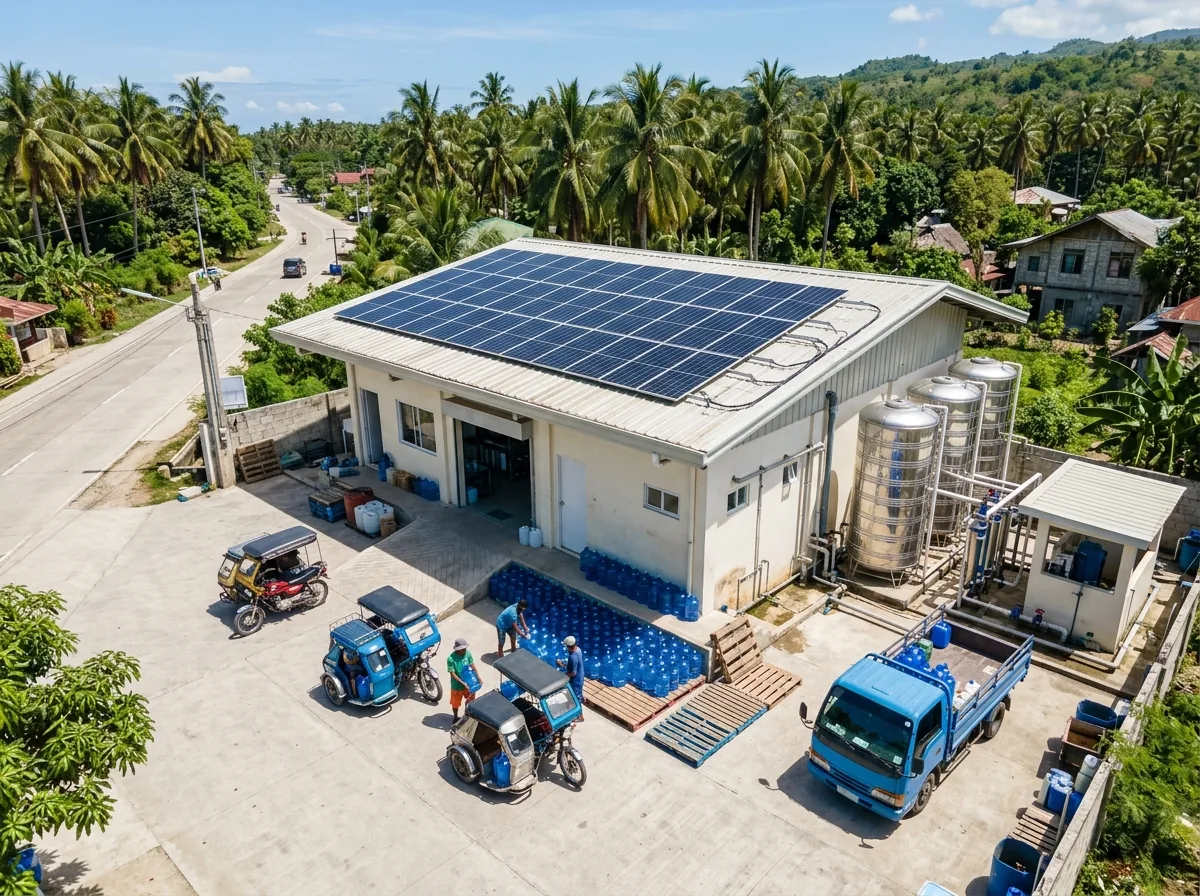
Solar for Beverage & Bottling Plants in Cebu. Power RO filtration, PET molders, and chillers at scale.
Purified bottled-water plants, juice mixers, soft-drink bottlers, and craft brewery facilities across Mandaue, Consolacion, Minglanilla, and provincial towns draw heavy continuous 3-phase power across reverse-osmosis skids, high-pressure PET compressors, glycol chillers, and filling monoblocks—cutting power bills via 50–500 kW+ commercial solar.
- 50–500 kW+ bottling line EPC scale
- 3–5 yrs typical payback period
- Pump + PV deep well & RO integration
The problem
Why are pumping, RO membrane, & bottling compression bills squeezing Cebu bottlers?
From pulling raw spring water deep underground right through high-pressure reverse-osmosis membranes, ozone tanks, 40-bar PET stretch-blow molding air compressors, pasteurizers, carbonator glycol chillers, and rotary shrink tunnels, beverage production stacks non-stop electric horsepower directly into ~₱15–₱16/kWh Cebu utility rates.
Bottled drinking water lines in Minglanilla, Consolacion, Compostela, and San Fernando alongside regional beverage bottling depots in Mandaue run peak production schedules strongly concentrated during daytime eight-to-twelve-hour bottling shifts—matching bright sunshine availability while simultaneously pumping finished pallets through dock wrappers and chilled warehouse storage zones.
Even more punishing, rural bottling complexes tapping distant spring boreholes on CEBECO lines contend with weak daytime voltage sags heating PET molders and deep-well motors unless power arrives steady straight from local distribution buses.
- Deep-well raw water source pumps & stainless transfer stations
- Multi-stage Reverse Osmosis (RO) booster pumps, UV & ozone generators
- High-pressure PET bottle blow-molding air compressors & desiccant dryers
- Glycol carbonation cooling loops, flash pasteurizers & CIP sanitizing heaters
- High-speed rotary rinse-fill-cap monoblocks, shrink wrappers & dock HVAC
How solar helps
How does commercial solar cut both deep-well pumping & bottling hall overhead?
Beverage bottling buildings enjoy two built-in storage buffers rarely available in generic retail businesses: massive elevated stainless raw-water holding tanks allowing battery-free borehole pumping all bright day, paired beside high-capacity 3-phase grid-tied plant rooftops feeding RO pumps and fillers instantaneously.
Zero-export 3-phase plant roof EPC
Connect wide bottle-packing and pallet warehouse roofs to main distribution switchgear using battery-free 3-phase grid-tied solar—cutting capex while shaving daytime RO membrane, glycol chiller, and blow-molder kVA.
Raw borehole solar water pumping
Where deep source wells sit up hillside lots away from plant roofs, pair dedicated MPPT solar water pumping driving stainless wells uphill into holding cistern tanks at zero ongoing pump electricity or fuel expense.
QA lab, PLC & micro-bottler hybrid storage
Small specialty juice bottlers or quality microbiology laboratories protect PLC bottling counters, incubator rooms, and server logs against voltage trips via 6–18 kW LiFePO4 packages starting from ₱305,000.
System sizing
What solar capacity suits a Cebu water-bottling line vs. a full beverage plant?
Site surveys evaluate raw-well hydraulic pumping head alongside PET air-compressor horsepower, cooling chiller tonnage, shrink tunnel kW, daytime bottling shift overlap, and clear steel warehouse roof spans—configuring compact 6–18 kW micro-bottling kitchens up toward 50–500 kW+ industrial bottling facilities across Cebu.
| Bottling Plant Scale | Representative Equipment Load | Suggested Capacity | Configuration & Price Structure |
|---|---|---|---|
| Large multi-lane RO station, ice-tube & 5-gallon washing depot | RO high-pressure boosters, automated jug washers, chillers, pumps | 10 kW to 18 kW Hybrid (16–32 panels, 10.0–19.84 kW) | Fixed packages: ₱495,000–₱970,000 (or commercial 3-phase) |
| Single-line PET mineral water or cold-pressed juice bottler | PET blow-molder compressor, RO train, monoblock filler, shrink tunnel | 60–150 kW three-phase | Warehouse grid-tie + PLC lab battery + optional well pump; custom quote |
| Multi-line carbonated soft-drink or craft beverage factory | Glycol carbonation skids, pasteurizers, dual blow molders, palletizers | 150–350 kW three-phase | High-capacity 3-phase Solis EPC with CT zero-export; custom quote |
| Major regional beverage & spring bottling enterprise campus | Central deep wells, bulk water tanks, multiple high-speed canning lines | 350–500 kW+ three-phase | Integrated rooftop + hillside ground/well arrays at MDP; custom quote |
Estimates only. Compressor startup current profiling, source-well elevation surveys, and locked itemized contract pricing follow our site audit. Actual savings depend on system size, usage schedule, location, and rates. Prices are subject to change without prior notice.
Cost and payback
What do bottling plant solar installations cost, and when do plants hit ROI?
Smaller bottling kitchens use clearly listed fixed tiers from ₱305,000 up to ₱970,000—while full 50–500 kW+ plants receive itemized custom contracts after audits. Offsetting VECO (₱15.30/kWh) and provincial CEBECO (~₱15–₱16/kWh) daytime charges typically recovers the cost in 3 to 5 years.
Benchmarked against Visayan Electric’s October 2026 rate of ₱15.30/kWh alongside provincial co-ops like CEBECO I and II powering spring extraction regions, continuous daytime RO pump and air compressor utilization consumes virtually all solar wattage right on generation—unlocking rapid recovery per case bottled. Eliminating battery vaults via 3-phase zero-export inverters keeps initial spend lean.
Every installation deploys Tier-1 620–630 W N-type bifacial modules (JinkoSolar, JA Solar, Trina Solar, LONGi, AIKO), Solis inverters, Schneider Electric and Suntree switchgear, and stainless hardware. Test rough targets on our ROI calculator or inspect commercial guides (C&I pricing guide).
- Transparent fixed engineering contract pricing delivered after plant audit
- Commercial milestone schedule: 40% order, 40% delivery & mount, 20% switch-on
- 1-year workmanship, 12-year inverter, and 30-year panel (at least 87% at yr 30) warranties
- Hygienic wash-ready array spacing maintains clean roof drainage over sanitary food zones
- We assist with municipal LGU electrical permits and VECO/CEBECO compliance docs
How it works
How does CebuSolar install over sanitary Cebu bottling halls safely?
Dispatching from our Cebu City office at Mclin Building, Corner T. Padilla St. and M.J. Cuenco Ave., our installation crews use sealed roof fixings over cleanroom ceilings, trace armored DC lines outside sterile filling lines, and commission over weekend clean-in-place gaps.
Well & bottling power audit
We audit twelve monthly electric bills, evaluate raw-water elevation pump heads, check PET compressor surges, and verify clear roof span structural strength.
Sanitary seal design & BOM
We map leakproof standing-seam clamps or EPDM sealed raised-crest bolts safeguarding clean-room ceilings (sealing standards), compile LGU permit packets, and lock quotes.
Hygiene-safe external build
Crews assemble frames outdoors clear of sterile bottle filling rooms—executing brief MDP switchboard synchronization during Sunday CIP maintenance windows (install process).
Stocked Cebu warranty support
Live SolisCloud telemetry combines with a 48-hour Metro Cebu response target and provincial warranty support from Cebu City (warranty coverage).
What do Cebu beverage & water bottling engineers ask before installing solar?
Plant directors, quality microbiology officers, and maintenance supervisors across Minglanilla, Consolacion, San Fernando, and Mandaue ask whether heavy compressor starts disrupt string inverters, whether overhead sanitary rooms face drip risks, how remote well pumping couples with solar, and what documents we provide.
Will high-pressure PET air-compressor cycles overload or trip commercial Solis inverters?
No. A grid-tied inverter works alongside the grid, and the grid supplies the short starting surge of large motors while the panels carry the steady running load. We check your motor ratings and switchboard during the site visit.
Can a remote hillside deep well feed our bottling tank strictly off standalone solar?
Yes—dedicated MPPT solar borehole drives lift water uphill straight into clean stainless cisterns all sunny morning without expensive power-pole stringing or fuel hauling (solar pumping specs).
Will drilling warehouse roofs create any FDA hygiene risks over bottling conveyor lines?
Using non-penetrating standing-seam clamps wherever deck ribs qualify—and otherwise driving top-crest stainless hardware over snug EPDM seals from above—protects the ceiling below from leaks (buyer checks).
Should beverage warehouses with automated backup diesels still buy huge LiFePO4 batteries?
Usually no—large bottling lines rely on battery-free commercial grid-tied arrays (leaner capex) backed by plant ATS gensets during extreme long grid blackouts, while reserving compact LiFePO4 UPS banks specifically for QC lab instruments and line controllers.
Get your personalized solar quote
Tell us about your place, pin it on the map and add a photo of your bill. Our team replies on Viber within one business day.
- 1. We size your system from your bill and map your roof by satellite.
- 2. You get your quote: panels, battery, monthly savings, payback and price.
- 3. Happy with it? We check your roof and wiring on site, then lock in one fixed price.