- Home
- Animal Feed Mills
Solar for agri-milling · Commercial feed EPC
Solar for Animal Feed Mills in Cebu. Lower grinding, pelletizing, and blending bills.
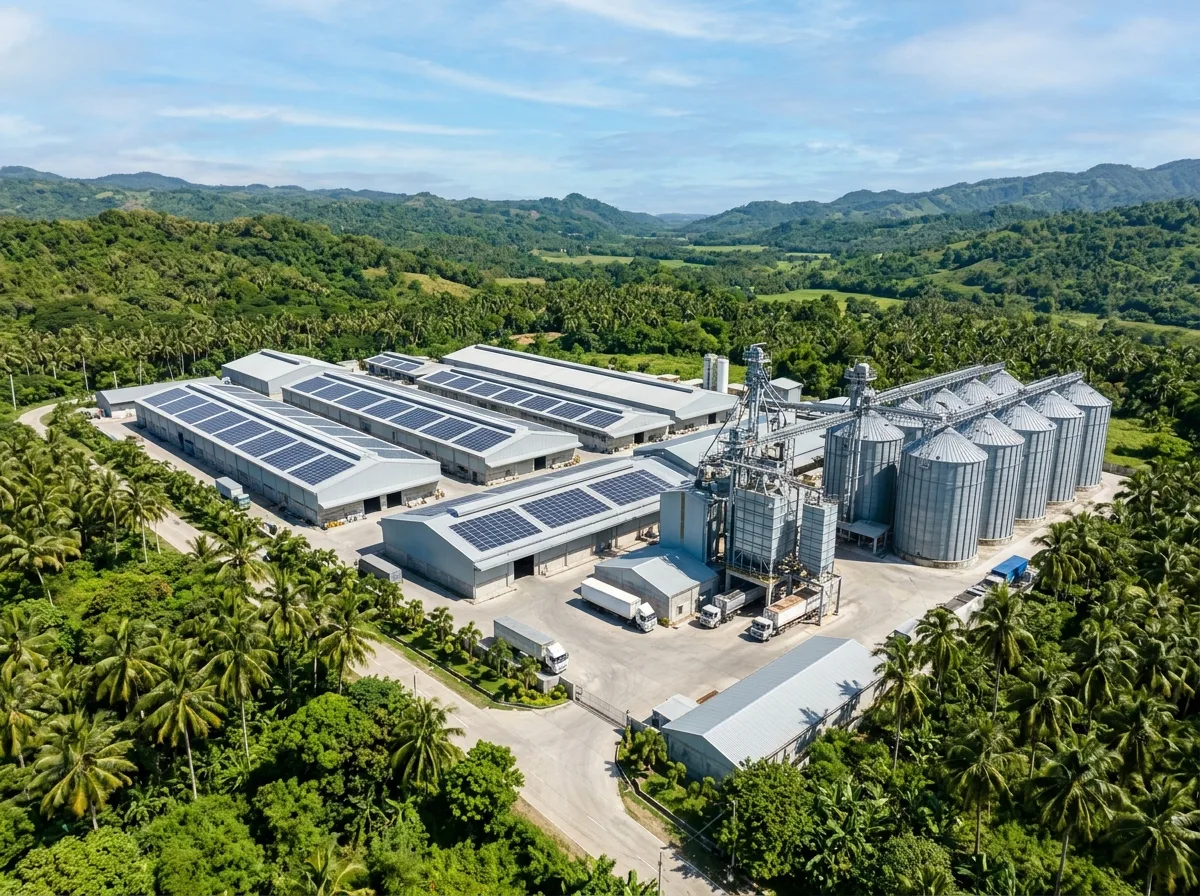
Commercial poultry, hog, and aquaculture feed mills pull heavy three-phase motor demand running hammer mills, twin-shaft batch mixers, ring-die pellet mills, counterflow coolers, and bagging lines across Mandaue, Consolacion, Naga, Carcar, Bogo, and Bantayan. CebuSolar builds commercial solar arrays over grain and pellet warehouses.
- 50–500 kW+ 3-phase commercial feed mills
- 3–5 yrs typical payback period
- Tier-1 620–630 W N-type bifacial
The problem
Why are processing energy costs surging at Cebu livestock and poultry feed mills?
Feed manufacturing transforms raw yellow corn, soybean meal, copra cake, and premixes using large high-draw induction motors running continuously across daylight batching schedules. Under Cebu utility tariffs around ₱15–₱16 per kWh, electricity ranks right beside raw grain commodities in per-bag conversion cost.
Supplying Cebu’s thriving broiler, layer, piggery, and fishpond sectors from Metro feed hubs in Mandaue and Consolacion down to Carcar, Naga, Toledo, Bogo, and Bantayan, toll millers and integrated livestock complexes push heavy batch schedules throughout sunny mornings and afternoons. Hammer mills grinding dry grain, paddle mixers, steam-conditioned pellet dies, heavy suction fans on counterflow coolers, and screw unloading augers draw massive three-phase currents directly below wide raw-material and finished-bag warehouse roofs.
Meanwhile, rural mills sitting far along provincial feeders face costly downtime and voltage sags when utility grid brownouts force batch lines to stop mid-conditioning inside hot pelletizing barrels.
- High-horsepower hammer mills, roller crushers, and pneumatic grain intake fans
- Horizontal ribbon/paddle batch mixers and micro-dosing premix screw augers
- Heavy ring-die pelletizing mills, crumble rolls, and high-CFM counterflow cooler blowers
- Compressed-air rotary pulse-jet baghouse collectors and automated sewing conveyors
- Grain elevator towers, truck weighbridges, moisture testing labs, and warehouse AC
How solar helps
Which solar architectures cut electricity bills on Cebu commercial feed mills?
Feed-mill batch shifts align closely with peak sunlight hours while sprawling sacked-ingredient and finished-feed bodegas hold ideal uninterrupted roof space beside plant transformers. CebuSolar pairs Tier-1 620–630 W N-type bifacial modules with Solis three-phase inverters, zero-export meters, dust-sealed electrical rooms, and optional lab LiFePO4 backup.
Three-phase grid-tied arrays on ingredient bodegas
Commercial toll mills and integrated livestock mills tied to VECO or CEBECO three-phase service recover capital quickly via grid-tied solar. Multi-inverter Solis plants supply continuous kilowatts into grinder, mixer, and cooling-fan buses under strict zero-export rules.
Hybrid LiFePO4 protection for batching controls & labs
Utility micro-blips abort automated SCADA weigh-hopper batching formulas, NIR grain-protein analyzers, and truck weighbridges mid-cycle. Adding hybrid solar with Dyness or Pylontech LiFePO4 storage bridges batch control desks, quality labs, and weighing gates across short drops.
On-farm mixing kits (6–18 kW) & linked livestock power
Small integrated poultry farms and piggery operations running private compact hammer-mixer sheds deploy fixed 6–18 kW hybrid packages starting from ₱305,000 without waiting on large industrial quotations.
System sizing
How much solar power does a Cebu toll feed mill or farm mixing shed need?
Mill sizing reviews tons-per-hour pellet and mash throughput, concurrent hammer-mill and pelletizer motor loads, clean corn-bodega roof span away from tall bucket elevators, dust cleanup walkways, and twelve months of power bills. CebuSolar provides fixed 6–18 kW kits and custom 50–500 kW+ plants.
| Feed mill operation scale | Primary daytime machinery | Suggested solar capacity | Setup & pricing |
|---|---|---|---|
| On-farm private hammer-mixer shed, grain bodega, or weighbridge | Small grain hammer mill, vertical batch mixer, bagger, office AC, scale | 6 kW to 18 kW Hybrid (10–32 panels, 6.2–19.84 kW solar) | Fixed packages: ₱305,000–₱970,000 (5–16 kWh battery, expandable 5–64 kWh) |
| Regional 3–5 TPH mash & crumble feed plant | Commercial hammer mill, ribbon mixer, bucket elevators, bagging conveyor | 50–120 kW three-phase | Sacked-feed bodega rooftop grid-tied array; custom quote after site audit |
| Automated 8–12 TPH commercial pelletizing mill | Heavy ring-die pellet mill, steam boiler blowers, counterflow cooler, compressor | 120–300 kW three-phase | Three-phase Solis plant + SCADA/lab LiFePO4 backup; custom quote |
| Large integrated livestock & aqua extruded-feed complex | Multiple hammer lines, extruded floating aqua-feed dryers, silo banks | 300–500 kW+ three-phase | Multi-warehouse commercial EPC tied to main LV bus; custom quote |
Estimates only. Elevator shadow mapping, dust-collector setback checks, and one fixed itemized price follow a site audit. Actual savings depend on system size, electricity consumption, location, and utility rates. Prices are subject to change without prior notice.
Cost and payback
What do feed-mill solar systems cost in Cebu, and when do they pay back?
Commercial three-phase feed-mill plants from 50 kW to 500 kW+ receive one fixed turnkey quote after electrical and truss inspection, while on-farm 6–18 kW mixing kits run ₱305,000 to ₱970,000. At Cebu utility rates near ₱15–₱16/kWh, typical payback averages 3 to 5 years.
Feed grinding and pellet cooling demand substantial steady horsepower throughout normal daytime operating shifts, absorbing solar energy immediately off warehouse roofs without battery loss while lowering electrical spend per 50-kilogram feed sack across competitive local livestock supply. Benchmarked against VECO’s October 2026 schedule of ₱15.30/kWh plus provincial CEBECO rates across Bogo, Carcar, and Bantayan, daytime solar lowers the plant’s power bill.
Fine corn flour and soybean dust demand enclosed electrical protection, so CebuSolar deploys Tier-1 620–630 W N-type bifacial modules from JinkoSolar, JA Solar, Trina Solar, LONGi, and AIKO, Solis inverters inside sealed motor-control rooms, Dyness or Pylontech LiFePO4 batteries, Schneider Electric and Suntree protection, and stainless steel hardware. Test small on-farm savings via our ROI calculator or view fixed kits on our cost page.
- One fixed turnkey contract price after site survey, every component listed
- Milestone payments: 40% on order, 40% on delivery and mounting, 20% on switch-on
- Backed by 1-year workmanship, 12-year inverter, and 30-year panel performance warranties (at least 87% output at year 30)
- Farm-mill expansion: add 620 W panels at ₱12,000 each or stack 5 kWh (₱75,000), 10 kWh (₱140,000), or 16 kWh (₱160,000) batteries
- We help with your local LGU electrical permits and VECO or CEBECO zero-export documents
How it works
How does CebuSolar install over active feed bodegas, grain cyclones, and truck bays?
Our Cebu City system designers chart vertical bucket-elevator towers and hot pellet-cooler steam stacks before setting array coordinates on clean adjoining grain bodegas. Sealed inverter cubicles stay dust-isolated inside masonry electrical rooms while main breaker switch-on finishes during a quiet Sunday pause.
Mill & shadow audit
We visit to review twelve months of CEBECO or VECO bills, trace grain silo and elevator tower shadows across seasonal paths, and inspect control room sealing.
Dust-safe layout & fixed quote
We keep modules clear of pellet-cooler moisture exhausts and hammer-mill cyclone blowers, preserve safe roof wash aisles, help with permits, and issue one fixed quote.
Roof installation around deliveries
Rigging crews stay outside active sack-loading truck bays overhead while feed deliveries continue below, scheduling breaker commissioning neatly.
Warranty & Cebu parts backing
Finished mills hold our Cebu warranty backed by locally stocked spare hardware and a Metro Cebu response target within 48 hours.
What do Cebu feed-mill owners ask before installing commercial solar?
Plant managers, integrators, and mill engineers across Mandaue, Consolacion, Carcar, Bogo, and Bantayan often ask about airborne grain dust and pellet steam plumes, silo tower shading, heavy hammer-mill inrush, standby generator coordination, and municipal LGU permit help before approving installation.
Won’t fine grain flour, molasses steam, and pellet-cooler exhaust quickly foul solar panels?
During site layout, CebuSolar keeps panel arrays off the tight exhaust hood above vertical pelletizing towers and places primary rows across expansive clean raw-corn and bagged-feed warehouse roofs upwind, complete with washdown perimeter paths for occasional water rinsing during dry harvest seasons.
How do tall galvanized grain silos and bucket elevator legs affect rooftop solar yields?
Every audit charts morning and afternoon silo shadows across adjacent low-rise roofs. We avoid shaded areas and use multi-MPPT Solis strings with split-cell Tier-1 N-type bifacial modules over open warehouse ridges for optimal full-day harvest.
Can grid-tied three-phase solar run alongside large hammer mills and soft-started pellet dies?
Yes. Connected in parallel via three-phase zero-export solar, your utility transformer handles large motor starting currents naturally while Solis three-phase inverters carry sustained daytime grinding, mixing, cooling-fan, and bagging kilowatt draw.
How does solar coordinate with standby diesel generators during provincial feeder outages?
Feed mills running big standby diesel gensets in Bogo, Carcar, or Bantayan connect solar upstream of automatic transfer switches or use a dynamic PV-genset controller so the solar inverters disconnect or ramp down when the generators take the mill load; we set this up during design.
Does CebuSolar assist with municipal building and electrical permits for agricultural mills?
Yes. We help with your LGU electrical permit by preparing the electrical plans and Tier-1 datasheets, and assist with VECO or CEBECO zero-export paperwork.
Get your personalized solar quote
Tell us about your place, pin it on the map and add a photo of your bill. Our team replies on Viber within one business day.
- 1. We size your system from your bill and map your roof by satellite.
- 2. You get your quote: panels, battery, monthly savings, payback and price.
- 3. Happy with it? We check your roof and wiring on site, then lock in one fixed price.